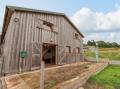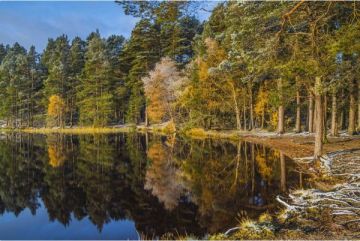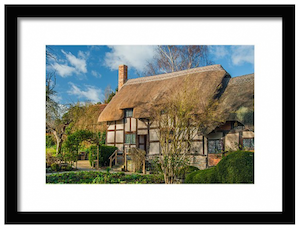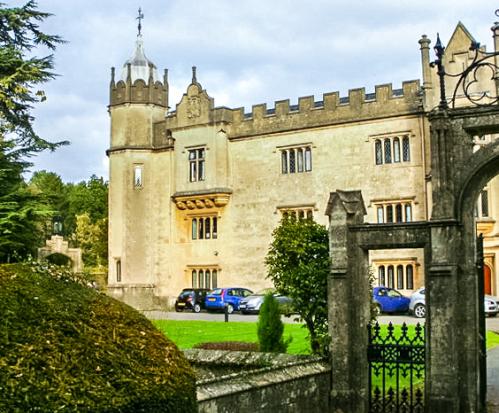
Llantarnam Abbey is a Cistercian house founded in 1179 as a daughter house of Strata Florida. The remains of that abbey are incorporated into the present buildings housing the Sisters of Saint Joseph. The fine barn, boasting 11 bays, is one of the finest medieval remnants.
History
In 1179 a Cistercian monastery was founded here as a daughter house of Strata Florida. The Cistercian order was never as popular in Wales as it was in England, and Llantarnam was one of only a handful of Cistercian monasteries in the country.
When the abbey was dissolved at the Reformation the property was sold to William Morgan, an ardent Catholic. Morgan converted the monastic buildings for use as a family home. He also had to pay regular fines for not going to Anglican church services. The amounts of fines piled up, so Morgan finally paid a large lump sum to become exempt from future fines.
In the 17th century a Morgan descendent added a new house in the abbey grounds. The Morgans also helped Jesuit priests return to Britain, and hid them from the authorities. In 1679 one of the priests, David Lewis, was captured just outside the Abbey and executed in Usk. Lewis is remembered as one of the 40 Martyrs of England and Wales, men and women executed for their religious beliefs between 1535-1679.
The Abbey passed through several hands - including the government's - until 1946 when it was purchased by the Sisters of St Joseph. It is now home to a community of sisters, which seems somehow appropriate, as if the abbey has come full circle from its origins as a religious community and has now returned to its roots.
Parts of the original 12th century abbey and the 16th century house built by William Morgan are incorporated into the current house. Surrounding the abbey house is parkland laid out in the 19th century on the site of a medieval park.
In the grounds are a medieval tithe barn, and just to the west is the church, formerly a chapel associated with the abbey. There is a walled garden, complete with a labyrinth.
Visitors are welcome to visit the chapel at any time for quiet contemplation. The abbey itself is not usually open to visitors.
UPDATE: The future of Llantarnam Abbey is up in the air after the Sisters of Saint Joseph announced their intention to move to a new location. Plans were announced to convert the site into a hospital, but at present the abbey's future is unclear. We will update this page when the situation is resolved, but in the meantime it is best not to plan a visit.
About Llantarnam Abbey
Address: Llantarnam, Cwmbran, Monmouthshire, Wales, NP44 3YJ
Attraction Type: Abbey
Location: In Llantarnam, on minor road linking A4042 and A4051, near Cwmbran. A working abbey welcomes visitors by prior arrangement. Chapel always open for prayer.
Location map
OS: ST312 929
Photo Credit: Jaggery, licensed for reuse under the Creative Commons Licence
HERITAGE
 We've 'tagged' this attraction information to help you find related historic attractions
and learn more about major time periods mentioned.
We've 'tagged' this attraction information to help you find related historic attractions
and learn more about major time periods mentioned.
Historic Time Periods:
Find other attractions tagged with:
12th century (Time Period) - 16th century (Time Period) - 17th century (Time Period) - 19th century (Time Period) - 6th century (Time Period) - 7th century (Time Period) - 9th century (Time Period) - Cistercian (Historical Reference) - Medieval (Time Period) - Nest (Person) - Reformation (Historical Reference)
NEARBY HISTORIC ATTRACTIONS
Heritage Rated from 1- 5 (low to exceptional) on historic interest
Caerleon Roman Fortress, Baths, and Amphitheatre - 2.2 miles (Roman Site) 
National Roman Legion Museum, Caerleon - 2.2 miles (Museum)
Caerleon Castle - 2.4 miles (Castle)
Newport Castle - 2.8 miles (Castle) 
Newport, St Woolos Cathedral - 3.4 miles (Cathedral)
Bellevue Park, Newport - 3.6 miles (Garden) 
Tredegar House - 5 miles (Historic House)
Torfaen Museum - 5.3 miles (Museum)
Nearest Holiday Cottages to Llantarnam Abbey: