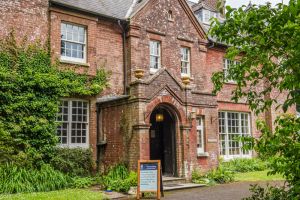
- Born: AD 955
- Died: 1010?
- Buried: Eynsham Abbey, Oxfordshire
Ælfric of Eynsham was one of the most important writers of Anglo-Saxon England: a monk, priest, abbot, and teacher whose career combined scholarship, pastoral care, and reform. Born around 955 and probably dying around 1010, he became the most prolific vernacular prose writer of his age, and his work helped shape how Christianity was taught in Old English.
Ælfric was also known as Grammaticus, Ælfric the Grammarian, Ælfric of Cerne, and Ælfric the Homilist.
Early life and education
Ælfric was educated at Winchester, where he studied under St Æthelwold, the reforming bishop who played a central role in the English Benedictine Reform. Winchester was not just a school for clerical learning; it was a centre of disciplined monastic renewal, and Ælfric absorbed both its intellectual methods and its insistence on correct liturgical and moral practice.
Sources describe him as a monk and priest before he was named as an abbot, which suggests a career built steadily through religious and educational service rather than political promotion.
His training under Æthelwold mattered greatly because it shaped the whole character of his writing. Ælfric’s prose is carefully structured, doctrinally orthodox, and aimed at making complex religious teaching accessible to ordinary English speakers. He was not simply a compiler of texts; he was a teacher who believed clear language was necessary for correct belief.
Cerne Abbey years
In 987, Ælfric was sent from Winchester to Cerne Abbey in Dorset, at the request of his patron Æthelmær the Stout, a powerful nobleman who supported monastic reform. Cerne became the setting for much of his most important work, including the two large cycles of English homilies that made his name.
These sermons drew heavily on Church Fathers, but Ælfric adapted them for an English audience rather than merely translating them mechanically.
At Cerne, he also produced works designed for students learning Latin, including the Grammar, Glossary, and Colloquy around 995. His Latin grammar is especially significant because it is often described as the first vernacular Latin grammar in medieval Europe. That achievement shows how practical his scholarship was: he wanted monks and clerics to understand Latin well enough to read, pray, and teach correctly.
Writing and influence
Ælfric’s literary output was exceptionally broad. He wrote homilies, saints’ lives, biblical commentaries, grammatical texts, and other religious works, earning later labels such as “the Grammarian” and “the Homilist”.
His writings were designed for instruction, especially for clergy, and they show constant concern with clarity, moral discipline, and doctrinal accuracy. He also translated and paraphrased scripture and patristic material in ways that made them usable for English monastic communities.
His relationship with noble patrons was essential to this work. The family of Æthelmær and his father, Æthelweard, not only supported the monasteries where he served, but also commissioned much of his English writing. That patronage enabled him write prolifically and gave his work a wider practical purpose in reforming religious life.
Eynsham and final years
In 1005, Ælfric became the first abbot of Eynsham, a monastery founded by Æthelmær a few miles west of Oxford. It seems possible that there had been an earlier monastic community at Eynsham, but Æthelmær's new foundation operated under the Benedictine rule, with Ælfric at its head.
Eynsham was closely tied to his reforming mission: it was a Benedictine house shaped by the same ideals of learning, discipline, and correct worship that had governed his earlier career.
Even in old age, Ælfric continued revising and writing. His Letter to the Monks of Eynsham reflects his concern for monastic conduct and practical religious education. He died after a life spent turning scholarship into pastoral service, leaving behind a body of work that became foundational for the study of Old English prose and the religious culture of late Anglo-Saxon England.
Identity Confusion
Ælfric's identity has been the subject of scholarly debate for centuries. A large part of this confusion arose when 18th-century historians confused him with Ælfric of Abingdon, who went on to become Archbishop of Canterbury.
The 17th-century antiquarian Sir Henry Spelman confused him with Ælfric Putto, Archbishop of York, while the 12th-century writer William of Malmesbury said that Ælfric served as Abbot of Malmesbury and Bishop of Crediton. Modern research suggests that none of these early writers were correct.
Historical importance
Ælfric matters because he bridged the worlds of monastic scholarship and vernacular instruction. He helped preserve Latin learning while insisting that English-speaking clergy and laypeople needed accurate teaching in their own language. In that sense, he was both a reformer and a communicator: a writer who made theology intelligible without diluting its seriousness. His life is a window into the intellectual vitality of pre-Conquest England.
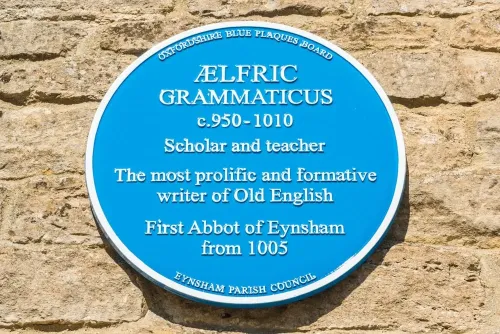
A blue plaque commemorating Ælfric's life is affixed to the wall of the ancient market hall in the square of Eynsham, opposite the parish church. Sadly, nothing remains of Eynsham Abbey. It is thought to have stood on the site now occupied by the graveyards of St Leonard's parish church (Anglican) and St Peter's Church (Catholic).
An information panel on the graveyard wall marks the location of the abbey church's high altar. Ælfric, as the first abbot, would have been buried close to this spot. Stonework found during excavations of the abbey site are reused inside St Leonard's Church.