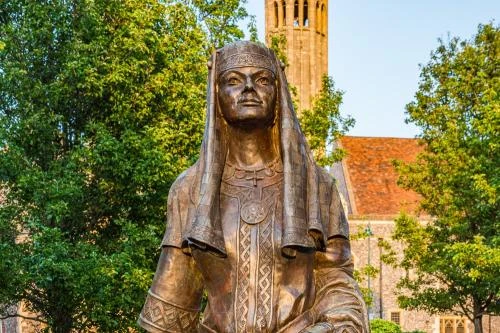
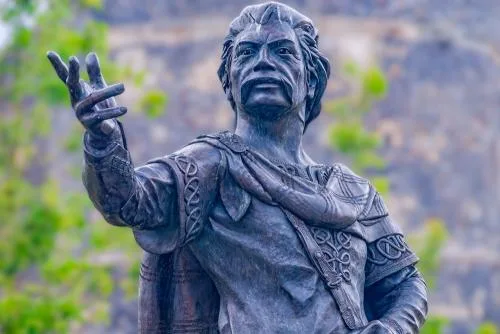
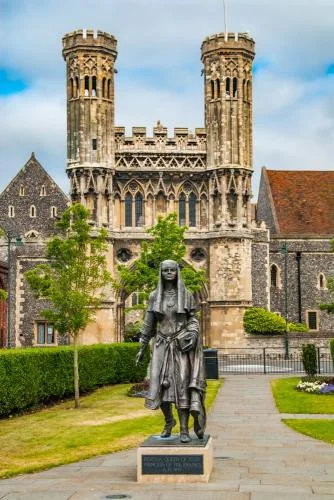
Set on a small pedestrian green before the medieval gates of St Augustine's Abbey, Canterbury, stand two modern statues depicting Queen Bertha and King Ethelbert (Æthelberht) of Kent, key figures in the establishment of Christianity in the late 6th century.
The statues were erected on Lady Wootton's Green in front of the Fyndon Gate in 2007, on the route between King Ethelbert's royal hall, which stood roughly where the cathedral now stands, and the chapel (now St Martin's Church), where Queen Bertha worshipped.
The statues capture the supposed moment when Bertha, a Christian, is met by her husband, the pagan Ethelbert, to tell her that a Christian missionary named Augustine has landed in Kent. Augustine, of course, is now known to history as St Augustine, and he had been sent by Pope Gregory the Great to convert the pagan English kingdoms to Christianity.
Queen Bertha's Walk
The statues of Bertha and Ethelbert mark one stop on a route known as Queen Bertha's Walk, which traces the traditional route taken by Bertha for her daily worship at what is now St Martin's Church. There are 14 bronze plaques set into the pavement at important points along the route, which takes in St Augustine's Abbey.
History
Sometime around AD 580 King Ethelbert of Kent married Bertha, a Frankish princess and daughter of Charibert I, King of Paris. One of the conditions of the marriage was that Bertha, a Christian, be allowed to continue to worship as she saw fit. To this end, Bertha brought with her a Christian bishop known as Leodheard, or Liudhard, when she left France to marry Ethelbert.
An old Roman building outside the city walls was made available to Bertha. This building was restored for use as a Christian chapel and was dedicated to St Martin of Tours, the city where Bertha was raised.
After St Augustine's arrival, he and his followers used St Martins as their base of operations until Augustine built the nearby monastery that now bears his name.
Ethelbert, perhaps swayed by his queen, gave Augustine the land to build his monastery and granted him the right to preach to his subjects. Ethelbert was eventually convinced to convert to Christianity and it was this conversion that paved the way for the eventual success of Augustine's mission.
Modern histories suggest that Bertha played a major role in this missionary work, but no contemporary accounts support this theory. We do know that Pope Gregory sent her a letter in AD 601, simultaneously chastising her for not having converted Ethelbert before Augustine's arrival in Kent and praising her for the help she gave him.
One of the new monastery's functions was to provide a burial place for the kings of Kent and for future archbishops of Canterbury.
We do not know when Bertha died, but it was likely sometime between AD 604 and 616, when Ethelbert died. By that time the conversion of Kent to Christianity was far from complete; even Bertha's own son, Eadbald, was a pagan when he took the throne.
Queen Bertha is thought to be buried under the step of St Martin's Church.
What is now Lady Wootton's Green formed part of a ceremonial way linking the city and the monastery, later rededicated as St Augustine's Abbey. In the 12th century, the abbey's almonry was established here, at what is now No 1, Lady Wootton's Green.
Lady Wootton
The Fyndon Gate was erected in 1308 to create a ceremonial entrance to the abbey precinct. It was rebuilt to create royal lodgings under Henry VIII, and in 1612 it was leased to Sir Edward Wootton, 1st Baron Wootton (1548–1628). Sir Edward's widow, Lady Margaret Wootton, or Wotton, lived on here after his death and the garden laid out before her gates took on her name. It became a public garden in 1896.
The Sculptures
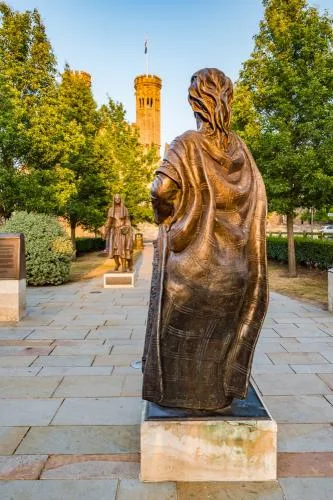
The sculptures of Bertha and Ethelbert were a gift to the city by the Canterbury Commemoration Society and are intended to show a turning point in British history, when the transformation of pagan Kent to a Christian kingdom can be said to begin. They stand facing each other, about a dozen paces apart, with Ethelbert facing east and Bertha facing west as she would have done when walking back from prayer at St Martin's Church.
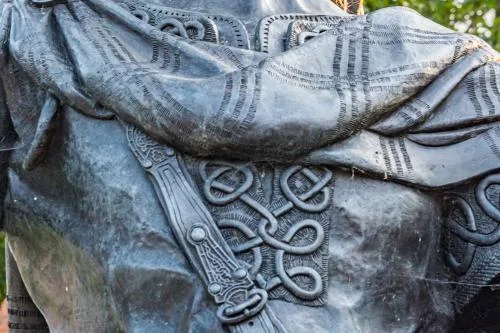
Obviously, we do not know exactly what Bertha and Ethelbert looked like, but the sculptures are based on what nobler men and women of the period would have worn.
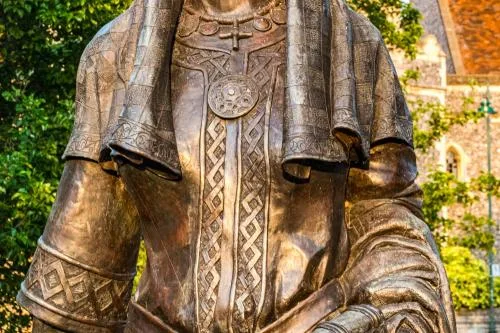
Bertha's clothing and accessories are modelled after grave goods found in the tomb of Queen Arnegunde (565-570) at St Denis in Paris.
Ethelbert's hair style is based on the earliest Anglo-Saxon image of a king, found on coins from the reign of his son, Eadbald, who reigned roughly 616-640. Details of his sword, belt, purse, and shoulder clasp are based on finds from the famous Sutton Hoo ship burial in Suffolk, the burial place of Redwald (d. 624) who followed Ethelbert as 'bretwalda' (overlord) of the English.
A bronze information plaque provides details of the sculptures in these words:
Ethelbert, a pagan, was Kent's greatest king
& overlord of the southern English kingdoms.
His queen, Bertha, a Christian, was daughter
of Charibert King of Paris.
On 26th May AD 597 Augustine's mission landed
on Thanet off the Kent coast.
Here we imagine the King Ethelbert greeting
Queen Bertha with this news as she returns
from worship at Saint Martin's Church.
Their marriage had opened Kent to this
Christian mission. Thus began the conversion
which drew the English into the mainstream
of European civilisation.
Kent's laws were recorded in written English
and Canterbury was established as the
enduring headquarters of the English church.
Visiting
The scene depicted by the two statues is apocryphal; we have no way of knowing where or how Bertha learned of St Augustine's arrival in England, but the statues are striking and they capture an important moment in the story of Britain, and they almost certainly stand on the actual route taken by Queen Bertha between the city and her chapel.
It is a striking memorial to an important moment in British history. It is also extremely easy to visit, located as it is on the direct route between the city centre, the abbey, and St Martin's Church.
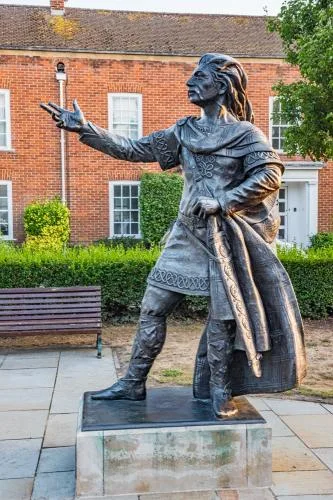
It could not be easier to find the statues; they stand on Lady Wootton's Green, immediately east of the A28 (Lower Bridge Street) and west of Monastery Street, directly in front of the Fyndon Gate. They are an easy 12-minute stroll from the cathedral and an equal walk from the abbey's main gates.
Note: As far as I can determine, the spelling of Wootton is incorrect or, at least, disputable, as the name derives from Lady Margaret Wotton, widow of Sir Edward Wotton. I've chosen to go with the Wootton spelling as that seems to be more common in modern usage.
About Queen Bertha and King Ethelbert Statues
Address: Lady Wootton's Green, Canterbury, Kent, England, CT1 1NG
Attraction Type: Historic Building - Statue
Location: In the public garden of Lady Wootton's Green , between Lower Bridge street (A28) and Monastery Street. Easy access on foot from the city centre and from St Augustine's Abbey.
Website: Queen Bertha and King Ethelbert Statues
Location map
OS: TR155578
Photo Credit: David Ross and Britain Express
NEARBY HISTORIC ATTRACTIONS
Heritage Rated from 1- 5 (low to exceptional) on historic interest
Canterbury, St Martin's Church - 0.1 miles (Historic Church) 
St Paul's Cemetery - 0.1 miles (Garden) 
St Augustine's Abbey - 0.1 miles (Abbey)
Canterbury, St Paul's Church Without the Walls - 0.2 miles (Historic Church) 
Smith's Hospital - 0.2 miles (Historic Building)
Cemetery Gate - 0.2 miles (Historic Building)
Fyndon Gate - 0.2 miles (Historic Building)
Zoar Chapel - 0.2 miles (Historic Building)
Nearest Holiday Cottages to Queen Bertha and King Ethelbert Statues:
More self catering near Queen Bertha and King Ethelbert Statues