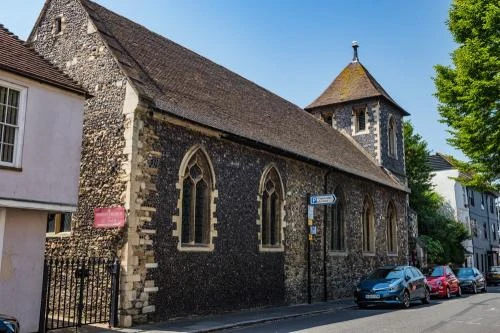
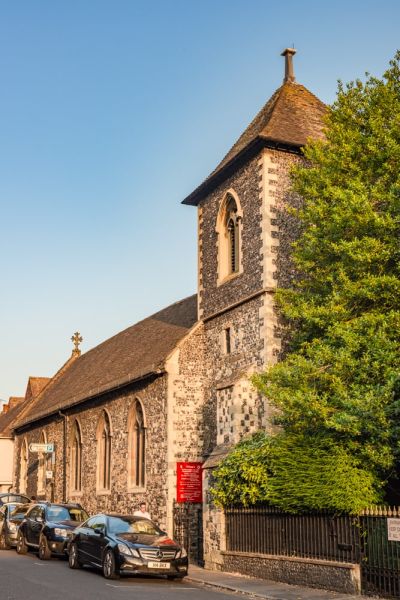
A small medieval church with a peculiar name, St Paul's Without the Walls stands just east of Burgate and immediately east of the old city walls. That fact accounts for its name, for, in this case 'without' means simply that the church was built 'outside' the city walls of Canterbury.
History
The 13th-century stands on the site of an earlier medieval church, itself built on the site of a Roman chapel and burial ground. The oldest part of the church we see today is the north aisle. The west tower was added later in the 13th century, when the current nave was inserted by breaking through the south wall of the north aisle.
The first recorded rector of St Paul's was Hamo Doge, who was responsible for building the chancel (where the organ is now). At some point in the 14th century, the south aisle was extended to create the chancel, with that aisle then serving as the new nave.
Then in 1847, Sir George Gilbert Scott completely transformed the medieval building, restoring the south aisle, installing Decorated Gothic windows, adding a vestry, and raising the height of the tower.
The 13th-century church had no burial ground, so burials were held at St Augustine's Abbey, a few minutes away. After the abbey was suppressed by Henry VIII in 1539 a new cemetery was needed. In 1591 a plot of land at the junction of Longport and Lower Chantry Lane, just over the present Longport roundabout, was purchased.
St Paul's Cemetery closed in 1953 and was transformed into a public park, though roughly 100 gravestones are preserved around the exterior walls of the new park.
Heritage Highlights
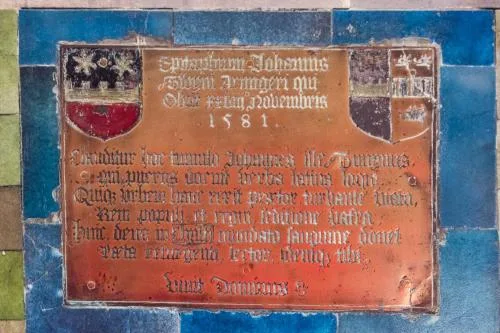
Look for a small brass plaque in memory of John Twynne (d. 1581). Twynne served as the first headmaster of King's School after the school was re-established under Henry VIII, and later became Mayor of Canterbury and an MP for the city.
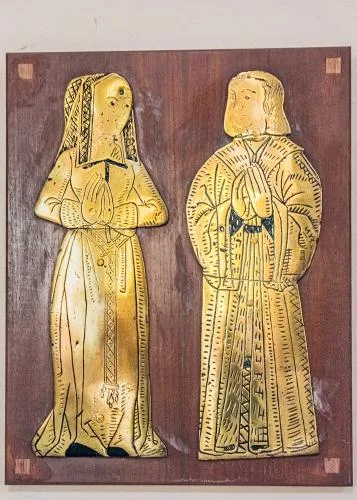
Set into the floor is a ledger slab to Edmund Hovynden (circa 1498) and on the nave aisle wall is a brass in memory of George Wyndbourne (d. 1532) and his wife, Katherine.
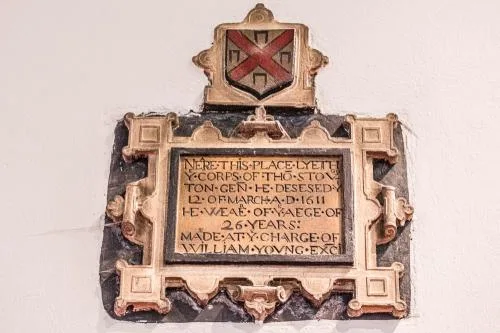
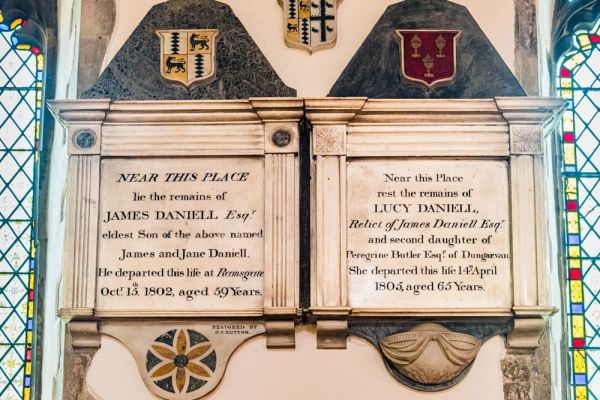
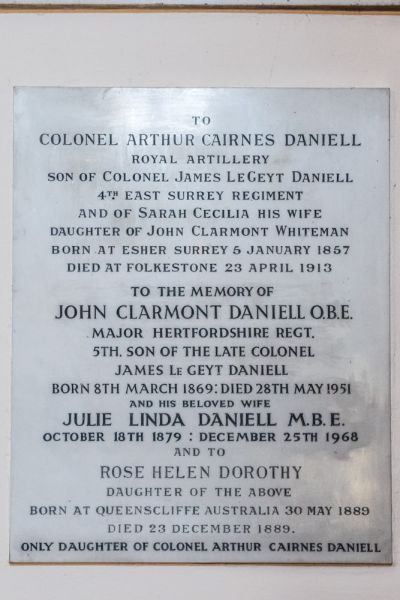
On the wall is a lovely little stone tablet to Thomas Stoughton, who died in 1611 at the age of 26.Also on the wall are a pair of Georgian memorials to members of the Daniell family; James (d. 1802) and Lucy (d. 1805). A later memorial to the same family commemorates Colonel Arthur Daniell, Royal Artillery, who died in 1913.
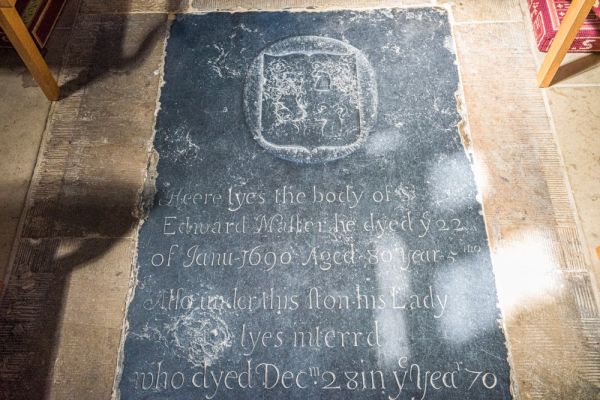
One of the oldest grave slabs in the church is in memory of Edward Masters (d. 1690). In an interesting bit of phrasing, the epitaph records, 'Also under this stone his lady lyes interred.'
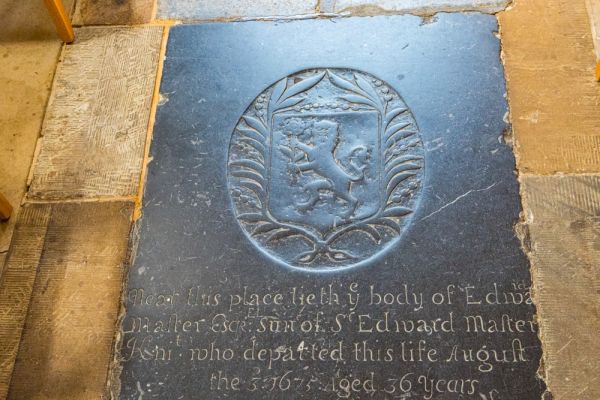
Another grave slab records the death of another Edwards Masters (d. 1675), described as the son of Sir Edward Masters, Knight. In a vault at the east end of the north aisle (where the organ now stands) lies Admiral Sir George Rooke (d. 1709), best known for his capture of Gibraltar in 1704, a success that resulted in Gibraltar being ceded to Britain.
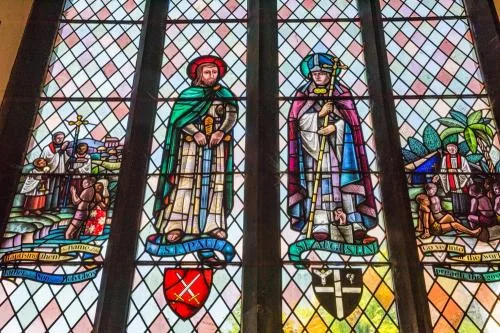
Stained-glass windows depict both St Paul and St Augustine, reflecting the church's long-standing ties to St Augustine's Abbey across the road.
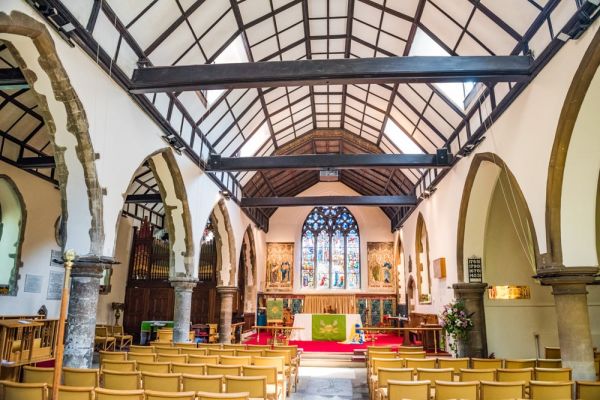
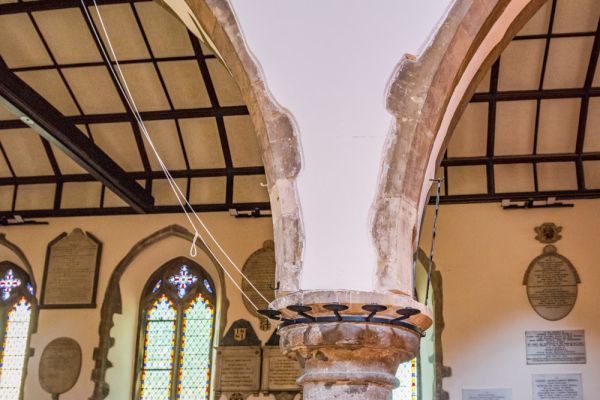
Despite the fact that the church has 13th-century origins, the interior has a very Victorian feel, thanks to Gilbert Scott's restoration. Thankfully, Scott preserved the medieval nave arcading and tried to retain as much of the original medieval fabric as he could. The excellent stained glass is modern, much of it installed after the 19th-century glass was blown out by bombs during WWII.
Visiting
The church is normally open daily for prayer and contemplation, and was open when we visited. If you visit the church, it is well worth your while walking a few minutes east on Longport, over the roundabout, to explore the former churchyard. There are almost one hundred 18th and 19th-century gravestones to discover in a peaceful park setting.
St Paul's without the Walls is a very short stroll from St Augustine's Abbey and also from the Fyndon Gate. There is parking just off the Longport roundabout, but the church is easy to access from the city centre.
More Photos
About Canterbury, St Paul's Church Without the Walls
Address: Church Street, Canterbury, Kent, England, CT1 1NH
Attraction Type: Historic Church
Location: On Church Street, immediately east of Burgate and the ring road. Easy walk from the city centre or from the Longport car park.
Website: Canterbury, St Paul's Church Without the Walls
Location map
OS: TR152577
Photo Credit: David Ross and Britain Express
NEARBY HISTORIC ATTRACTIONS
Heritage Rated from 1- 5 (low to exceptional) on historic interest
St Augustine's Abbey - 0 miles (Abbey) 
Cemetery Gate - 0.1 miles (Historic Building) 
Fyndon Gate - 0.1 miles (Historic Building)
Zoar Chapel - 0.1 miles (Historic Building)
St Thomas of Canterbury RC Church - 0.1 miles (Historic Church) 
St Paul's Cemetery - 0.1 miles (Garden)
Queen Bertha and King Ethelbert Statues - 0.2 miles (Historic Building)
Canterbury Cathedral - 0.2 miles (Cathedral)
Nearest Holiday Cottages to Canterbury, St Paul's Church Without the Walls:
More self catering near Canterbury, St Paul's Church Without the Walls