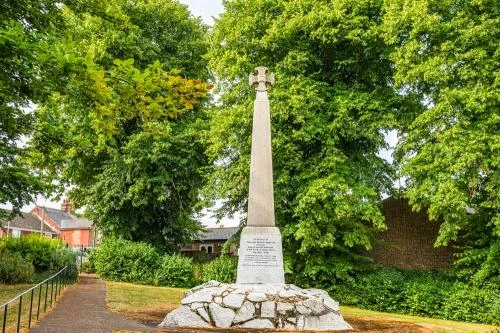
The Martyrs' Memorial is a late-Victorian obelisk erected in 1899 in memory of 41 Protestant martyrs who were burnt at the stake during the reign of Queen Mary I. The memorial was erected on the site where the 'Kentish Martyrs' were executed and stands in a small park on Martyrs Field Road.
History
The Kentish Martyrs is the name collectively given to 41 Protestants who were burnt at the stake between 1555 and 1558. They are also sometimes known as the Canterbury Martyrs. The martyrs came from all across Kent, and were brought to Canterbury for their executions. The final burning in 1558 was the last to be performed during Queen Mary's reign.
Why were the executions sited so far outside the city core? Probably so the stake could stand outside the city walls. At that time, the area that is now Martyrs Field Road would have been well away from habitation and was likely scrub land or other unused field.
The execution of the Protestant martyrs was not the end of the story, for a further 4 people were hanged for their religious convictions in the same spot during the reign of Mary's sister, Elizabeth I.
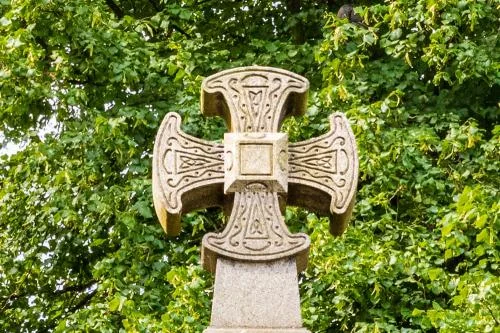
The memorial takes the form of a slender obelisk pf grey granite, 25 feet high, topped by a cross and set upon a tapered base, itself standing on a broad, rounded base of broken granite in a bed of concrete. The cross is in the style of the Canterbury Cross, a bronze brooch found locally and thought to be Roman. The memorial was paid for by public subscription and cost £600.
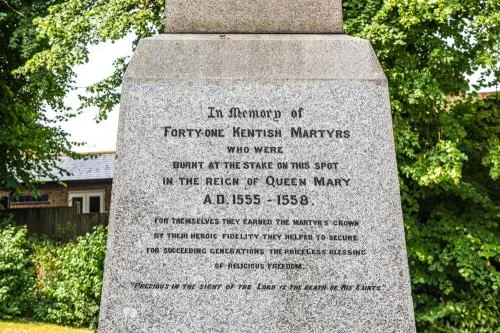
The main inscription reads:
In memory of Forty-One Kentish Martyrs who were burnt at the stake on this spot in the reign of Queen Mary A.D. 1555-1558.
For themselves they earned the martyr's crown by their heroic fidelity they helped to secure for succeeding generations the priceless blessing of religious freedom.
"Precious in the sight of the Lord is the death of his saints"
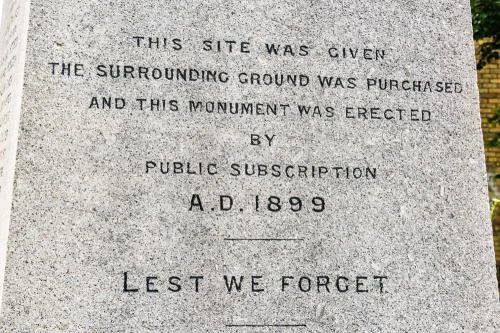
On the reverse is this dedication:
This site was given
The surrounding land was purchased
and this monument was erected
by
public subscription
A.D. 1899.
Lest we forget.
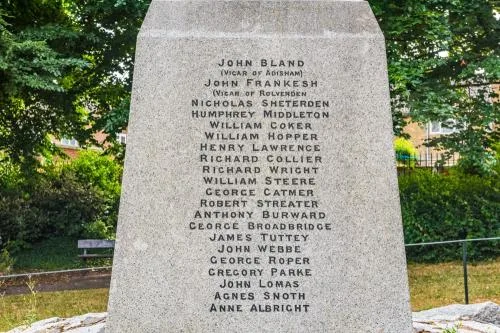
The remaining two sides of the monument base carry the names of the martyrs, listed as:
John Bland (vicar of Adisham)
John Frankesh (vicar of Rolvenden)
Nicholas Sheterden
Humphrey Middleton
William Coker
William Hopper
Henry Lawrence
Richard Collier
Richard Wright
William Steere
George Catmer
Robert Streater
Anthony Burward
George Broadbridge
James Tuttey
John Webbe
George Roper
Gregory Parke
John Lomas
Agnes Snoth
Anne Albright
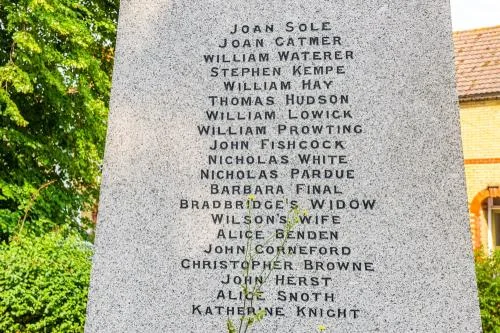
Joan Sole
Joan Catmer
William Waterer
Stephen Kempe
William Hay
Thomas Hudson
William Lowick
William Prowting
John Fishcock
Nicholas White
Nicholas Pardue
Barbara Final
Bradbridge's Widow
Wilson's Wife
Alice Benden
John Corneford
Christopher Browne
John Herst
Alice Snoth
Katherine Knight
You will notice several things amongst the list of names. First, there are several people who appear to be family members, probably husband and wife. Also, two women are not listed by their Christian names, but only as 'wife' and 'widow'.
The names are listed in the order of their execution. The first burnings took place on 12 July 1555, when John Bland, John Frankesh, Nicholas Sheterden, and Humphrey Middleton were burnt together, and the final burnings took place on 15 November 1558, when John Corneford, Christopher Browne, John Herst, Alice Snoth, and Katherine Knight were executed.
A fifth man was due to be burnt with the initial four martyrs, but he recanted his Protestant beliefs and was spared.
The story of the Kentish Martyrs is recorded in John Foxe's famous volume, 'Actes and Monuments of these Latter and Perillous Days, Touching Matters of the Church', better known as 'Foxe's Book of Martyrs', published in 1563, just 5 years after the last burning.
The Martyrs' Memorial is sadly overlooked by most visitors to Canterbury since it stands outside the city's ring road and well away from the historic city core. It is slightly disconcerting to see this poignant monument in a setting of closely-packed terraced houses, but it is still a sobering sight.
Visiting
The memorial stands in a small park on the south side of Martyrs Field Road, between Gordon Road and York Road. There is parking available along the road. The memorial can be visited at any time.
About Canterbury Martyrs' Memorial
Address: Martyrs Field Road, Canterbury, Kent, England, CT1 3PU
Attraction Type: Historic Building - Monument
Location: On the south side of Martyrs Field Road, between Gordon Road and York Road. Parking along the road.
Website: Canterbury Martyrs' Memorial
Location map
OS: TR146571
Photo Credit: David Ross and Britain Express
NEARBY HISTORIC ATTRACTIONS
Heritage Rated from 1- 5 (low to exceptional) on historic interest
Canterbury City Walls - 0.2 miles (Historic Building) 
Dane John Gardens - 0.3 miles (Garden) 
Dane John Mound - 0.3 miles (Castle) 
Canterbury Castle - 0.3 miles (Castle)
Maynard and Cotton Hospital - 0.3 miles (Historic Building)
Canterbury, St Mildred's Church - 0.3 miles (Historic Church)
Beaney House of Art and Knowledge - 0.5 miles (Museum) 
Canterbury Roman Museum - 0.5 miles (Museum)
Nearest Holiday Cottages to Canterbury Martyrs' Memorial: