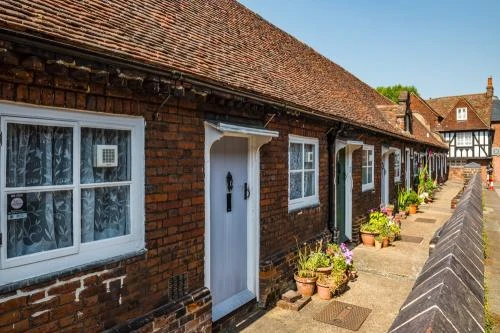
Tucked away down a quiet lane off Castle Street, south of Canterbury's city centre, is a terrace of red-brick that hides a long history going back perhaps 750 years.
Though the cottages we see today are mostly a product of the 19th-century, the history of this unobtrusive terrace dates back to 1317 when John Maynard (also known as Maynard the Rich and Maynier le Rich) established an almshouse to care for three poor men and four poor women (some sources give the numbers as 3 men and 1 woman). The original hospital buildings probably included accommodation for a priest.
History
According to the custom of the day, the almshouses were called a 'hospital' (sometimes abbreviated to 'spital' or ‘spittal’). The term hospital did not then mean a place to provide medical care, as it does today, but more often referred to what we might today call social housing; providing accommodation to the needy or those too aged or infirm to care for themselves.
The date 1317 comes from a plaque on the hospital exterior, but some historical sources suggest that Maynard lived much earlier, perhaps in the middle of the 13th century. He may have been a reeve, or local administrator.
In 1604 Leonard Cotton, Mayor of Canterbury in 1579, gave money in his will for an additional three cottages, one for a poor widower and two for poor widows. Cotton's will stipulated that the new residents come from either St Mildred's or St Margaret's parish.
As a result of Cotton's bequest, the almshouses became known as the Maynard and Cotton Hospital.
It seems likely that the hospital owned the entire block bounded by Hospital Lane, Stour Street, Rosemary Lane, and Castle Street. Rosemary Street marked the southern boundary of the hospital grounds and may take its name from rosemary herbs grown in the hospital garden.
Unfortunately, the hospital's records were lost in 1666. They had been taken to London as part of a legal dispute and were destroyed in the Great Fire of London. As a result, we know very little about the hospital's medieval history.
The houses were badly damaged in a storm in 1703 and what we see today is largely the result of rebuilding in 1708. Though you cannot tell from the exterior, one section of the hospital is given over to a wood-panelled chapel.
Finally, another two single-storey cottages were added to the rear of the property in 1970 after a contribution from May Hooker. A stone plaque on Stour Street marks 'Hookers Almshouses'.
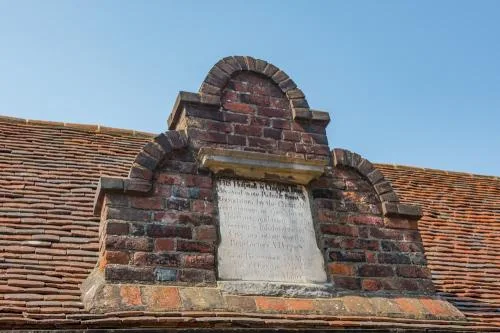
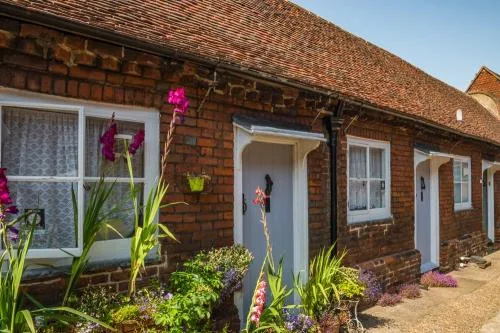
The main hospital building faces on Hospital Lane. There are ten doorways, but only six of them are actively in use, with one large casement window to each door. A very large Dutch gable dominates the Stour Street facade, and another small gable is located centrally on the Hospital Lane frontage. This ornate gable provides a setting for a stone plaque inscribed as follows:
This Hospital and Chapel being
decayed were Rebuilt from y[e]
Foundation by the Charitable
contribution of the Mayor,
Aldermen & Inhabitants of the
City and other worthy
benefactors A.D. 1708
John Beaumont Esq. Mayor
Alderman Oughton Chamberlain
Alderman William Malter [?]
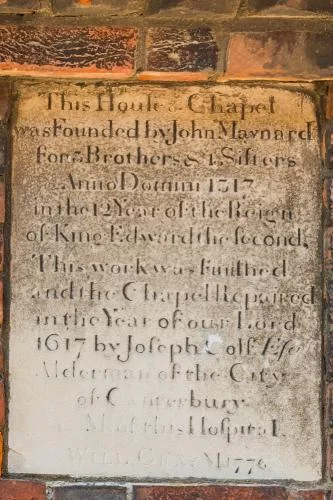
To the left of the doorway below (Number 4, Hospital Lane) is another plaque reading:
This House and Chapel
was founded by John Maynard
for 3 Brothers and 4 Sisters
Anno Domini 1317
in the 12 Year of the Reign
of King Edward the Second.
This work was furthered
and the Chapel repaired
in the Year of our Lord
1617 by Joseph Colf Esq.
Alderman of the City
of Canterbury
M[aster] of this Hospital.
Will[iam] Gray M[aster] 1776
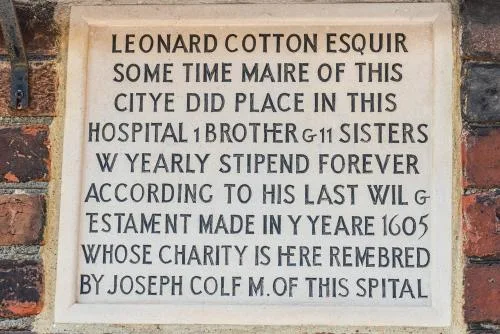
To the right of the doorway is a plaque with this inscription:
Leonard Cotton Esquir[e]
Some time Maire of this
Citye did place in this
Hospital 1 Brother and 11 Sisters
W[ith] yearly stipend forever
According to his last will[l] &
Testament made in y[e] yeare 1605
Whose charity is here remembered
by Joseph Colf M[aster] of this spital.
There is also a small stone plaque on the high brick wall on Stour Street inscribed with the words, 'Maynard's Spittal, 1818.'
Visiting
The Maynard and Cotton Hospital is a picturesque example of a medieval almshouse, added to over the centuries and now housed in 18th and 19th-century buildings. It won't take long to examine the hospital exterior, but it is worth taking a detour down Hospital Lane if you are exploring central Canterbury on foot.
About Maynard and Cotton Hospital
Address: 1-6 Hospital Lane, Canterbury, Kent, England, CT1 2PE
Attraction Type: Historic Building
Location: On the west side of Hospital Lane, off Stour Street. Exterior viewing only. Very limited parking along nearby streets. Access is much easier on foot.
Website: Maynard and Cotton Hospital
Location map
OS: TR146576
Photo Credit: David Ross and Britain Express
POPULAR POSTS
HERITAGE
 We've 'tagged' this attraction information to help you find related historic attractions
and learn more about major time periods mentioned.
We've 'tagged' this attraction information to help you find related historic attractions
and learn more about major time periods mentioned.
Find other attractions tagged with:
13th century (Time Period) - 14th century (Time Period) - 18th century (Time Period)
NEARBY HISTORIC ATTRACTIONS
Heritage Rated from 1- 5 (low to exceptional) on historic interest
Dane John Gardens - 0.1 miles (Garden) 
Dane John Mound - 0.1 miles (Castle) 
Canterbury City Walls - 0.1 miles (Historic Building) 
Beaney House of Art and Knowledge - 0.1 miles (Museum) 
Canterbury, St Mildred's Church - 0.2 miles (Historic Church)
Canterbury Castle - 0.2 miles (Castle)
Greyfriars Chapel and Franciscan Garden - 0.2 miles (Historic Building)
Canterbury Roman Museum - 0.2 miles (Museum)
Nearest Holiday Cottages to Maynard and Cotton Hospital: