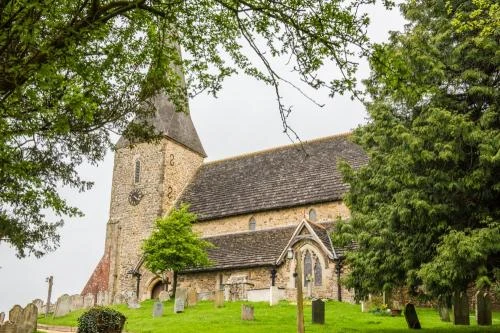
The hilltop church of St Peter ad Vincula in Wisborough Green dates to the 12th century, though there was very likely an earlier Saxon building on the same site. The church's location and the exceptionally thick stone walls suggest that the building may have begun as a Norman keep guarding the upper reaches of the River Arun.
This likelihood is supported by the fact that the north and south doors are large enough for a man on horseback to ride through.
History
Whilst we don't know much about the early use of the building, we know it was in use as a church by the reign of Henry I. The earliest records come from 1227, when Henry II granted the Archdeacon of Lewes the right to hold a weekly market and an annual fair at Wisborough.
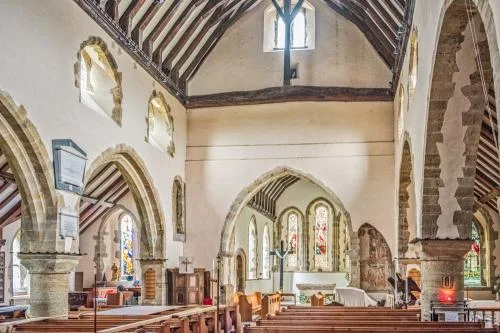
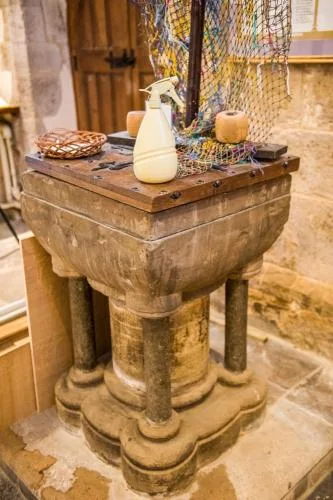
The present aisles were added around the same time, and the font was installed at the same time. The nave roof was raised in the 14th century, when the clerestory was inserted, and the tower was built adjoining the southwestern corner of the nave. Two porches were added in the 15th century and heavy brick buttresses in 1838.
In 1857 lightning struck the church spire and sent the spire cross tumbling to the ground. The shingled spire caught fire and the residents called for the nearest fire engine, which was based at Petworth. The fire engine lost a wheel on its journey, but it didn't matter, for the village constable, a man named George Smith, scaled the tower and put out the flames by hand.
The church was comprehensively restored by Ewan Christian in 1867-8.
Wisborough Green was a destination for pilgrims in the medieval period, for the church was supposed to hold sacred relics including milk of the Virgin Mary, St James's comb, and pieces of St Peter's hair and beard.
Huguenot Heritage
The Wisborough Green area was settled by Huguenot glassmakers from France during the 16th century. So many were settled here that the church was granted the right to hold services in French. The Huguenots migrated westward in the early years of the 17th century after the supply of timber for their furnaces ran short in Sussex.
A small window at the west end of the south aisle is known as the Huguenot window and showcases pieces of locally-made glass dating to around 1600.
Wisborough Tapestry
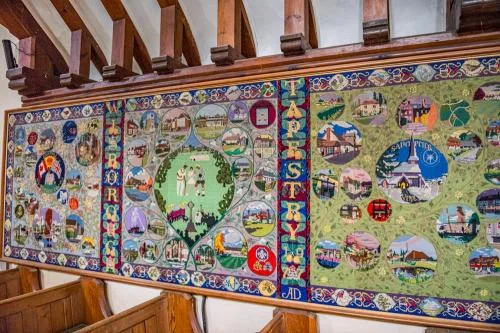
In the north aisle is a display case housing a beautifully-worked 20th-century tapestry. The tapestry is divided into three parts, depicting aspects of village life and social history in the east, west, and central areas of Wisborough Green. The tapestry was begun in 1977 to mark Elizabeth II's Silver Jubilee. It took 8 years to complete and was unveiled in 1985.
Medieval Wall Paintings
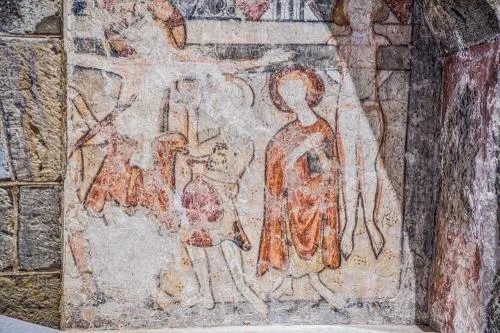
When the church was undergoing restoration in 1867 workmen uncovered medieval wall paintings in recesses either side of the chancel arch. The story goes that two workmen argued over a local girl and a fight ensued. During the course of the fight, one man threw a stone which missed his foe, struck one of the recesses, and broke through a layer covering the paintings.
The painting is divided into two parts, lower and upper, with both layers contained within the outline of a church. The lower part depicts the Crucifixion, with St John the evangelist standing beside Christ on the cross. One thief is shown on the cross, but the other half of the cross and the second thief is missing. The upper part of the painting shows St James the Great leading pilgrims to Compostella. The paintings have been dated to the reign of King John (i.e. 1199-1216).
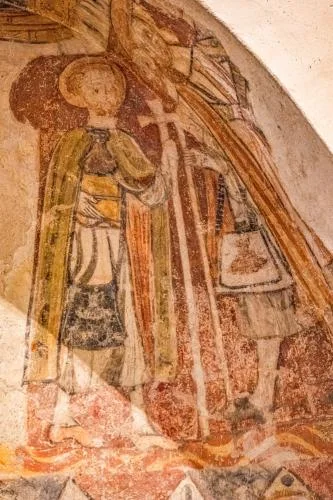
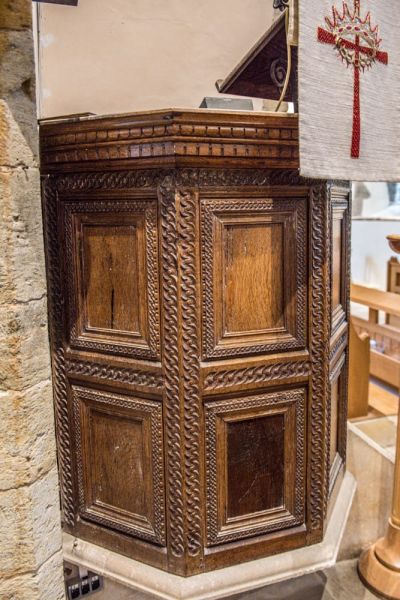
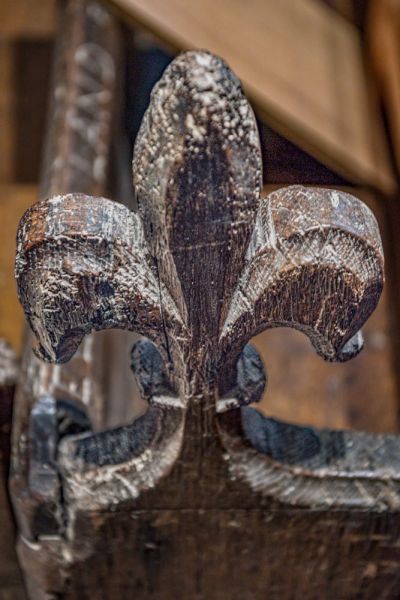
The wooden pulpit likely dates to the Victorian period, but it incorporates 17th-century wooden panels. Also from the 17th century is a painted cherub above the south aisle arch. Some of the nave benches are from the 16th century and boast fleur-de-lys finials. The south aisle benches bear the names of local families, a reminder of allocated seating in the Georgian period.
12th-century Altar
The stone altar is the original medieval one. It should have been destroyed at the Reformation, but the parishioners saved it from destruction by hiding it in plain sight in the new vicarage at Loxwood, where it served as the chimney breast.
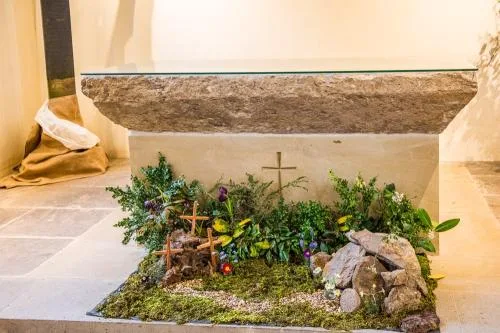
Henry VIII's commissioners were fooled, and the altar remained in Loxwood until the vicarage was pulled down in 1901. It was finally restored to the church in 1937.
The east window in the south aisle acts as a memorial to two brothers of the Helme family who fell in WWI. The altar frontal below the window bears the names of 22 men of Wisborough Green who fell in the conflict.
Remembering Dieppe
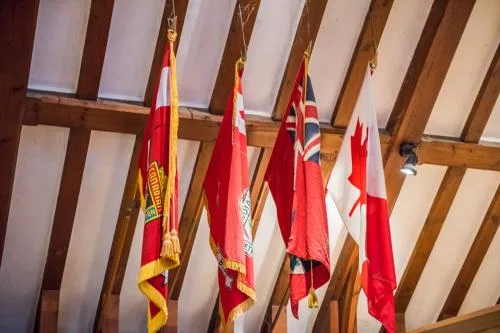
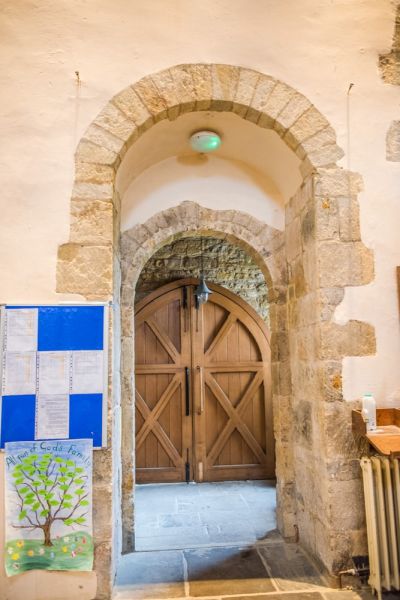
Wisborough Green has a place in the history of World War Two, for the famous raid on Dieppe was planned here at Hawkhurst Court. Most of the 5,000 Canadian troops who took part in the raid were billeted in Wisborough Green, and the tower doors are made of oak and were given by the Home Guard in honour of the men of 2nd Division, Canadian Army, who died in the raid. Two Canadian standards are displayed in the north aisle.
Visiting
The church stands at the end of a paved drive off School Road, but visitors are asked to use the village hall car park (RH14 0DX). The church was open when we visited.
More Photos
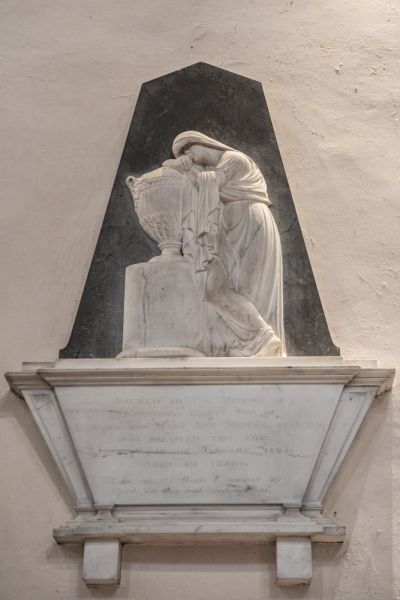
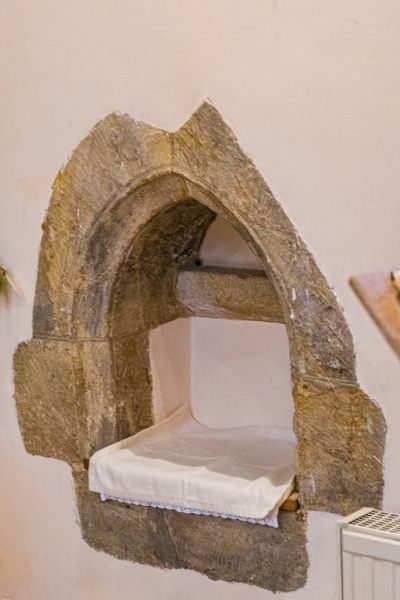
About Wisborough Green, St Peter ad Vincula Church
Address: School Road, Wisborough Green, West Sussex, England, RH14 0DU
Attraction Type: Historic Church
Location: Off School Road, in the heart of the village. Parking at the village hall car park.
Location map
OS: TQ051258
Photo Credit: David Ross and Britain Express
NEARBY HISTORIC ATTRACTIONS
Heritage Rated from 1- 5 (low to exceptional) on historic interest
Blue Idol Meeting House - 3.8 miles (Historic Church) 
West Chiltington, St Mary's Church - 5.2 miles (Historic Church)
Petworth, St Mary's Church - 5.3 miles (Historic Church) 
Petworth Cottage Museum - 5.3 miles (Museum) 
Petworth House - 5.3 miles (Historic House)
RSPB Pulborough Brooks Nature Reserve - 5.9 miles (Countryside)
Shipley Windmill - 6.2 miles (Historic Building)
Warminghurst, Holy Sepulchre Church - 7 miles (Historic Church)
Nearest Holiday Cottages to Wisborough Green, St Peter ad Vincula Church:

More self catering near Wisborough Green, St Peter ad Vincula Church