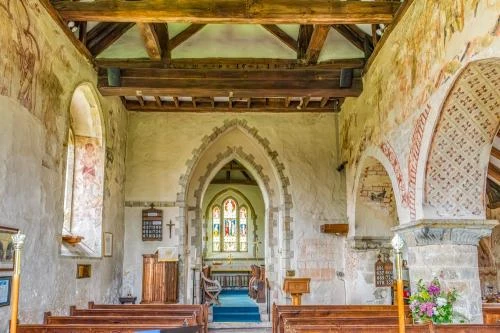
The rural 12th-century church of St Mary in the West Sussex village of West Chiltington boasts an extraordinary collection of medieval wall paintings as well as perhaps the oldest porch in the county.
History
A church was recorded here in the Domesday Book of 1086, but little remains of that Saxon building save perhaps parts of the nave and chancel walls. The present building was erected sometime between 1100 and 1150, with the south aisle and chancel arch added around 1200.
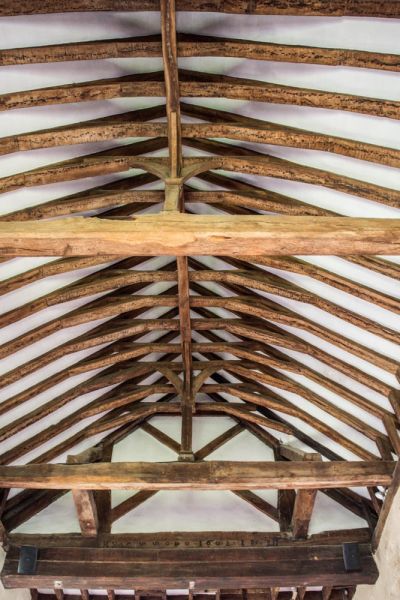
A chantry chapel was added in the early years of the 13th century. The elegant oak-shingled belfry and spire seems modern by comparison, installed in 1602. The date is gleaned from a carving on a timber supporting the belfry (though that carving has also been interpreted as 1662). The same date can be applied to the impressive king-post roof.
The church was heavily restored from 1880-82, when the west gallery was removed. The restoration revealed an extraordinarily rich sequence of medieval wall paintings, of which more in a moment.
Historical Highlights
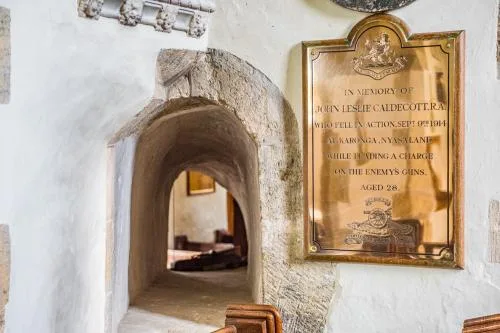
The church boasts an exceptionally long hagioscope, or squint, linking the south aisle to the chancel. The hagioscope extends fully 2.7m (roughly 9 feet), giving worshippers in the south aisle a glimpse of the high altar.
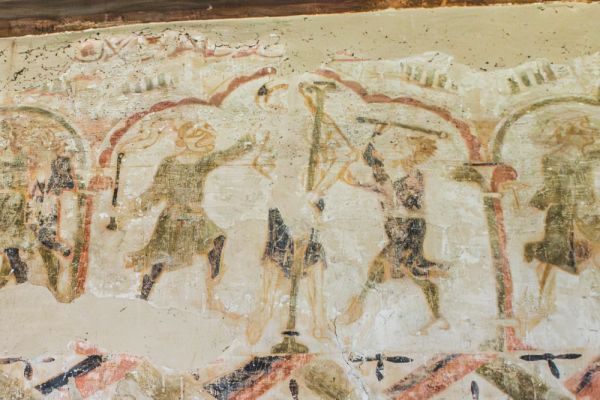
It is the wall paintings, however, that draw most visitors to West Chiltington Church. These paintings span two centuries, from the 12th to the 14th.
The oldest paintings must date to the time the church was built, in the first half of the 12th century. In the south aisle are depictions of apostles and angels, as well as a geometric design of a cross in the style of a rope without end.
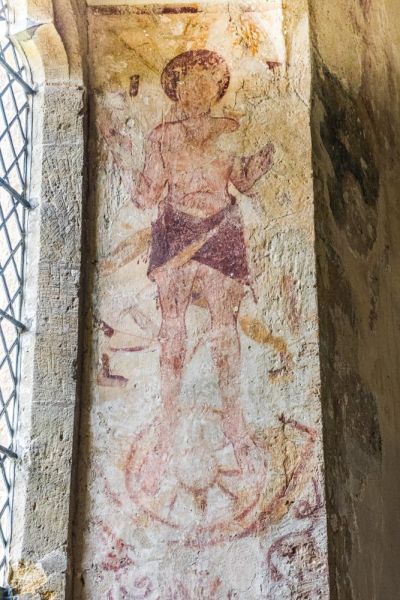
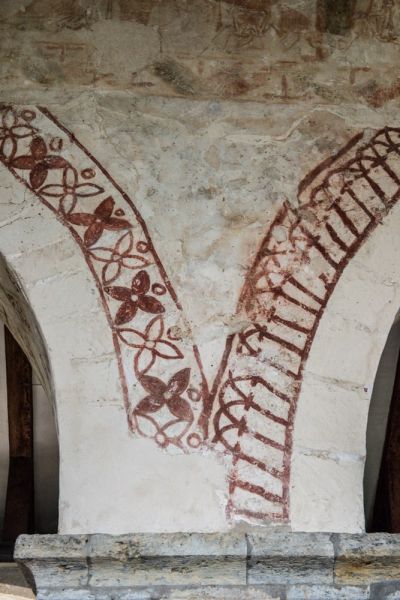
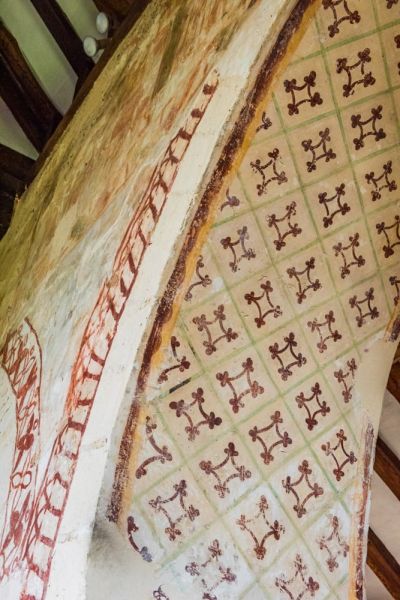
Later decorative designs embellish the easternmost pillar and arch of the south arcade. These are thought to be from the 14th century. Another 14th-century painting appears on the splay of the north nave window opening. This shows Christ standing atop a wheel, surrounded by tools of various trades, such as a carpenter's square, a weaver's shuttle, and a tailor’s shears.
Christ is shown with his arms raised to display his wounds. The symbolism is often interpreted as a warning to worshippers not to work on Sundays at the risk of inflicting new wounds on Christ.
13th-century Wall Paintings
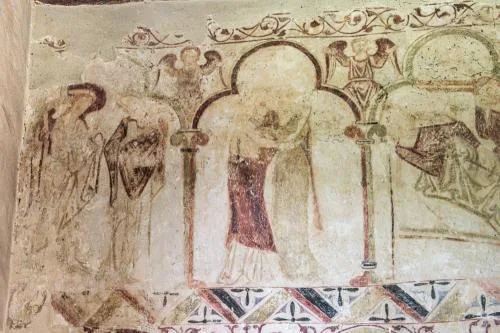
Even more memorable are the 13th-century sequences of paintings that decorate the north and south nave walls. On the north wall are scenes from the birth of Christ, with depictions of the Annunciation, the Visitation, and the Nativity. The final two paintings are too worn to decipher, but you can make out figures of an angel and a shepherd.
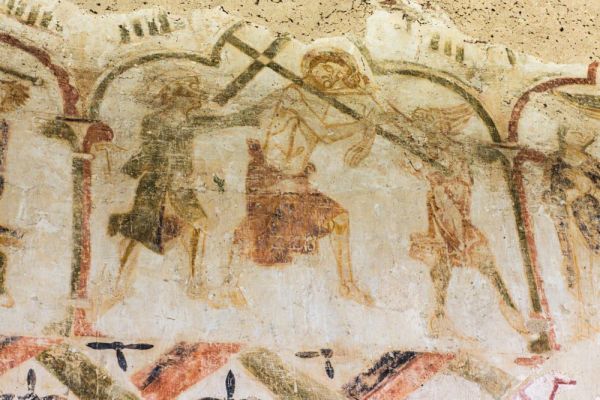
The south wall illustrates the Passion of Christ, with recognisable scenes showing the Entry into Jerusalem, the Last Supper, Christ washing his disciples' feet, Judas betraying Christ, the Flagellation, Christ carrying his cross, the Crucifixion, and the angel at the tomb of Christ.
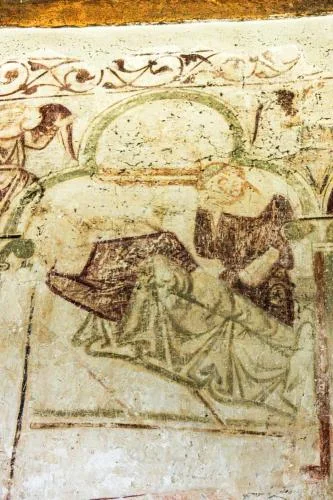
The wall paintings have been beautifully restored and are incredibly evocative, giving an insight into how richly-decorated the church must have appeared in the medieval period.
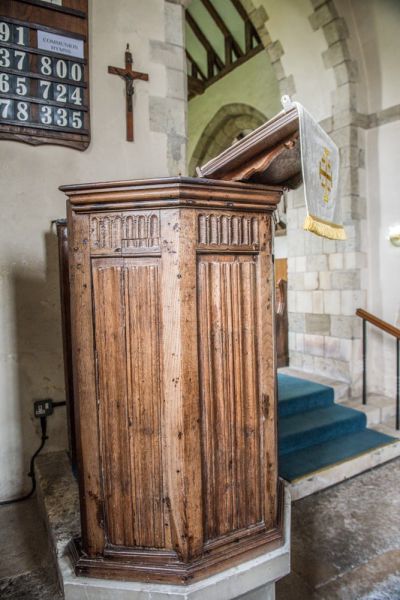
The octagonal font dates to the 13th or 14th century, while the wooden pulpit is Jacobean, and has lovely linenfold panelling. It was brought here from a church in Worthing.
The altar stone, made of Sussex marble, was removed at the Reformation and set into the floor, only to be restored four centuries later.
The Ancient Porch
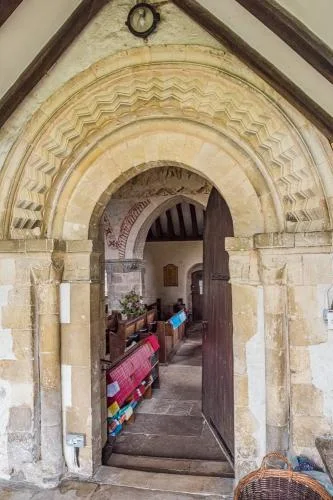
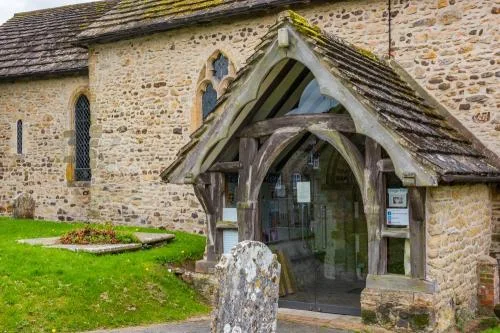
We've mentioned the porch, thought to be the oldest in Sussex. The timber-framing dates to the 12th century, with a suspicion that some large oak blocks may date to the older pre-Conquest church. The original bell-clappers are mounted on the porch wall.
West Chiltington Church is an absolute delight; an unpretentious country church blessed with an over-abundance of historical interest. The wall paintings are a delight, and the church repays a visit many times over.
Visiting
St Mary's Church stands on the west side of Church Street in the centre of the village. There is parking on Church Street immediately north of the churchyard, but there is also a dedicated car park at the bottom of the churchyard. Go past the church and turn right at the bottom of the hill. The church was open when we visited.
More Photos
About West Chiltington, St Mary's Church
Address: Church Street, West Chiltington, West Sussex, England, RH20 2JW
Attraction Type: Historic Church
Location: Parking on Church Street, north of the churchyard, and at the bottom of Church Street in the dedicated church car park.
Website: West Chiltington, St Mary's Church
Location map
OS: TQ090183
Photo Credit: David Ross and Britain Express
NEARBY HISTORIC ATTRACTIONS
Heritage Rated from 1- 5 (low to exceptional) on historic interest
Warminghurst, Holy Sepulchre Church - 2.1 miles (Historic Church) 
RSPB Pulborough Brooks Nature Reserve - 2.3 miles (Countryside) 
Storrington and District Museum - 2.7 miles (Museum)
Parham House and Gardens - 3.1 miles (Historic House)
Parham, St Peter's Church - 3.1 miles (Historic Church) 
Blue Idol Meeting House - 3.2 miles (Historic Church)
Shipley Windmill - 4 miles (Historic Building)
Chanctonbury Ring - 5 miles (Prehistoric Site)
Nearest Holiday Cottages to West Chiltington, St Mary's Church: