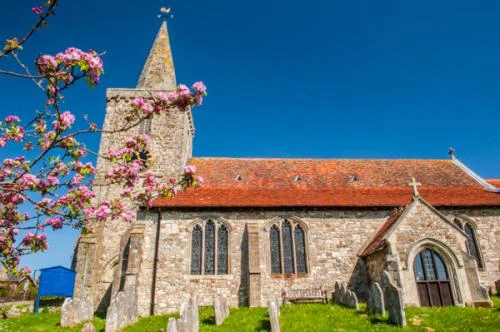
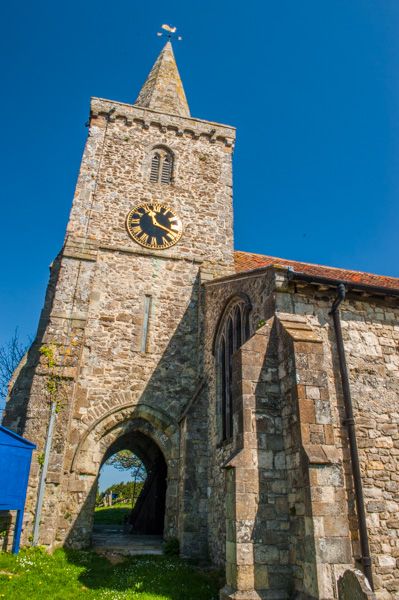
Standing on a rise of ground at the northern end of Brading's High Street is the 12th-century parish church, dedicated to St Mary. The church is large, with an aisled nave stretching five bays in length, a two-bay chancel, chapels to the north and south, a south porch, and a sturdy western tower topped with a spire.
History
The church was very likely founded in the latter half of the 12th century, with the aisles added in the following century, at the same time as the chancel.
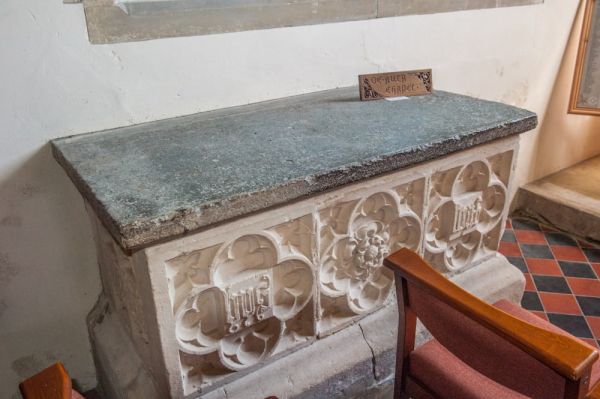
The north chapel, known as the De Aula Chapel, is of 14th century date. The chapel name comes from the presence of altar tombs to William Howles and his wife, though there is no documentary evidence to suggest that the Howles (De Aula) family founded the chapel.
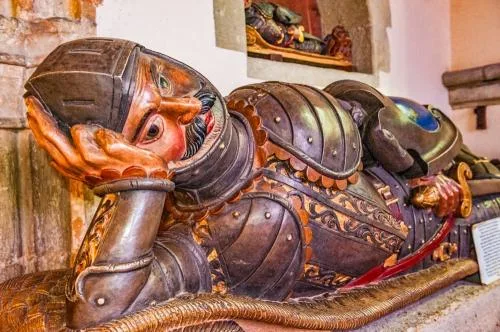
The south chapel has been dubbed the Oglander Chapel, for it holds tombs to medieval and Tudor members of that family.
The church was heavily remodelled in 1866.
Historical Highlights
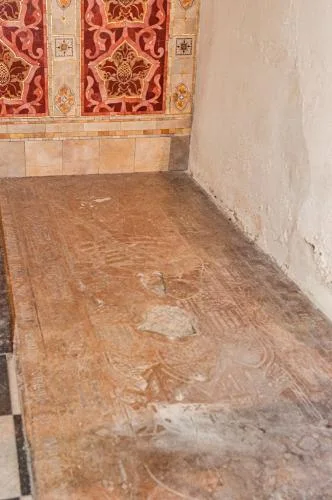
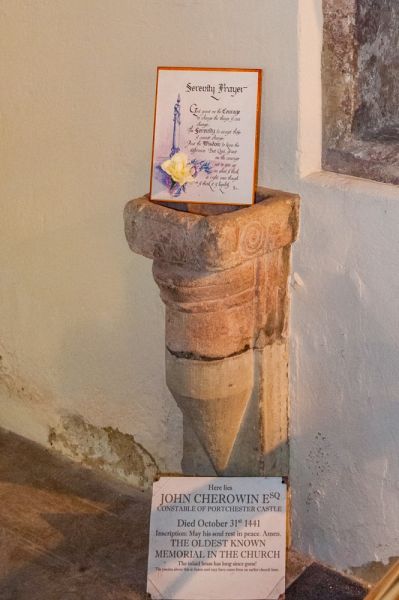
The oldest tomb inside the church is an incised slab of Purbeck marble, crafted in memory of John Curwen (d. 1441), the constable of Portchester Castle.
The stone was likely carved in the Low Countries and is greater than life-sized, measuring 8' long and 3'6" wide. The stone was originally inlaid with metal and enamel, though this has long since disappeared, leaving only the outline of the original carved figure.
Around the outside of the stone is the epitaph:
'Hic jacet nobilis vir Johannes Cherowin armiger dum vivebat connestabularius Castri de Porcestre qui obiit anno Domini millesimo quadringesmo quadrago primo die ultima mens Octobris anima ejus requiescat in pace Amen' which roughly translates as:
'Here lies the nobleman John Cherowin, knight, while he was still living, constable of the Castle of Portchester, who died on the first day of October in the year of our Lord one thousand four hundred and forty-one. May his soul rest in peace. Amen.'
Oglander Tombs
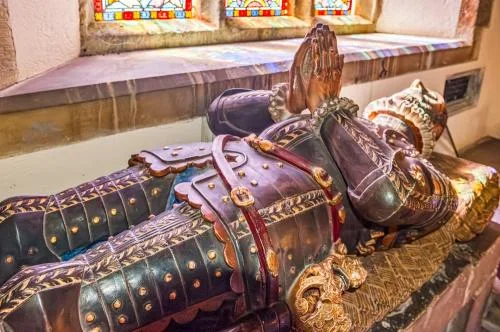
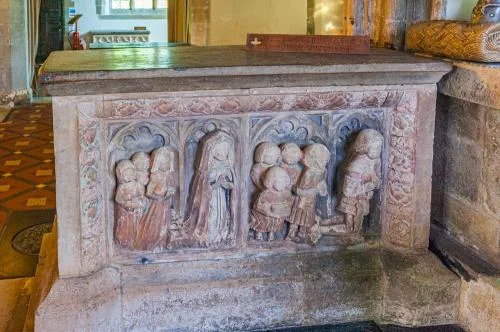
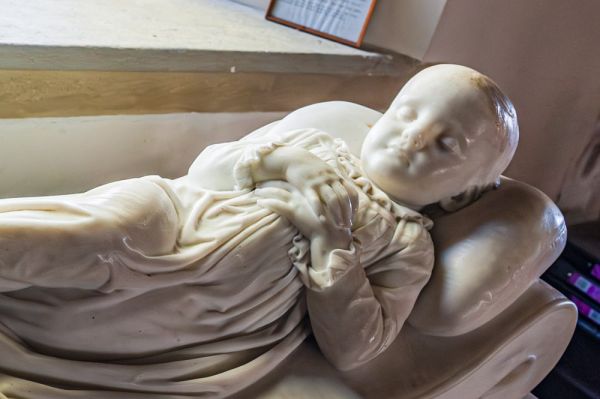
Also in the South (Oglander) Chapel is an altar tomb in memory of John Oglander (d. 1483). Opposite is a tomb in memory of John's son, Oliver Oglander (d. 1536), and nearby is a beautifully carved wooden effigy in honour of Sir William Oglander (d. 1608). Oliver Oglander served as Lieutenant Governor of Guernsey and is shown with his wife and seven children.
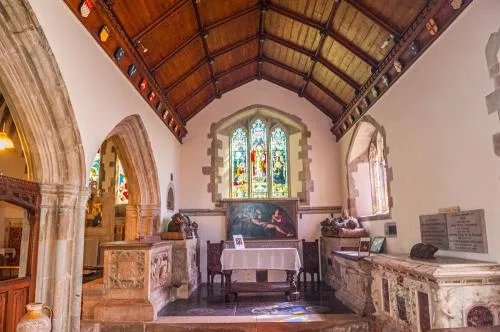
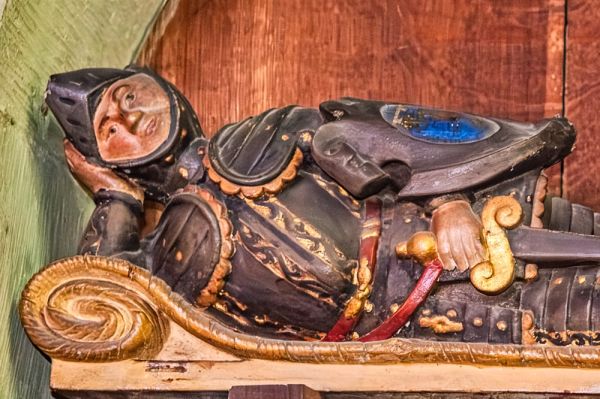
The most striking memorial, however, is a painted wooden effigy to Sir John Oglander (1655) and his son, George (d 1632), whose miniature-sized effigy is strikingly smaller than the life-sized version created for his father.
Neither effigy should be taken as a realistic depiction of the dead man; according to tradition, Sir john found both effigies in France and brought them home to be used upon his death. The effigies are made from oak and are beautifully painted.
Set into the chapel floor is a ledger stones to Ann Powlett, wife of the Second Lord Powlett, who died in 1710. There are further 17th and 18th century ledger slabs to members of the Knight and Oglander families.
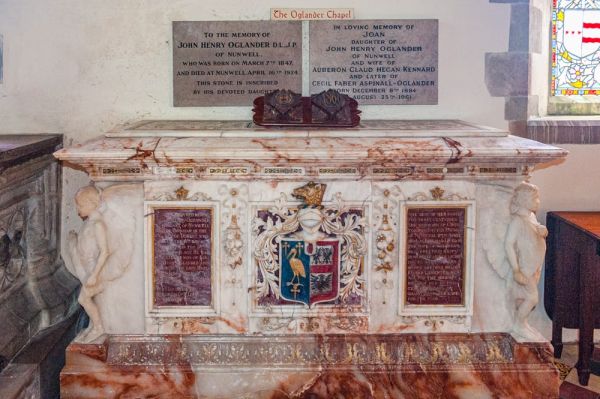
One of the most recent memorials is that of Sir Henry Oglander (d 1874). This wonderful altar tomb is crafted in an Arts and Crafts version of Jacobean style, using alabaster, marble, and mosaic. Sir Henry was the last baronet, and his tomb is a wonderful example of the period.
I've mentioned the De Aula Chapel and the altar tombs of William Howles (d. 1520) and his wife, Elizabeth. These tombs are almost identical and face each other across the width of the chapel, Elizabeth on the north wall and William on the south.
Hanging from the ceiling is a striking 18th-century candelabrum, given by a pair of churchwardens in 1798.
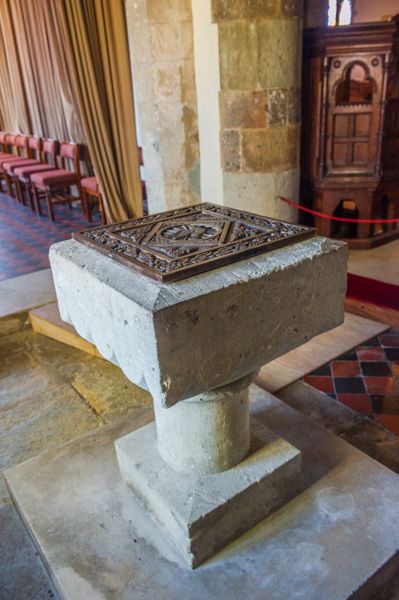
On the vestry wall is a painted royal coat of arms dating from the reign of William and Mary. There are two Jacobean oak chests, and the communion rails also date to the Jacobean period. The octagonal font has a 16th-century bowl, but the stem and base are much earlier, probably carved in the 13th century.
In the chancel is a 12th-century piscina which seems to incorporate an earlier carved stone, suggesting a possible 11th-century church on this site. In the north aisle is a funerary hatchment to a member of the Oglander family.
Look around the churchyard and you will see several 17th-century altar tombs and the base of a medieval churchyard cross, now used to support a sundial.
Brading's parish church is a delight from start to finish. The collection of historical memorials is unmatched on the Isle of Wight and stands amongst the very best of any country church in England. Highly recommended.
Visiting
St Mary's Church stands at the top of High Street, with the west door facing onto the street. There is a pay and display car park a stone's throw to the north of the church.
More Photos
About Brading, St Mary's Church
Address: High Street, Brading, Isle of Wight, England, PO36 0ED
Attraction Type: Historic Church
Location: At the top end of High Street. Paid parking immediately north of the church.
Website: Brading, St Mary's Church
Location map
OS: SZ607873
Photo Credit: David Ross and Britain Express
HERITAGE
 We've 'tagged' this attraction information to help you find related historic attractions
and learn more about major time periods mentioned.
We've 'tagged' this attraction information to help you find related historic attractions
and learn more about major time periods mentioned.
Find other attractions tagged with:
12th century (Time Period) - 13th century (Time Period) - 14th century (Time Period) - 15th century (Time Period) - 16th century (Time Period) - 17th century (Time Period) - 18th century (Time Period)
NEARBY HISTORIC ATTRACTIONS
Heritage Rated from 1- 5 (low to exceptional) on historic interest
Morton Manor Gardens - 0.6 miles (Garden) 
Brading Roman Villa - 0.7 miles (Roman Site) 
Nunwell House and Gardens - 0.8 miles (Historic House)
Bembridge Fort - 1.3 miles (Historic Building) 
Yarborough Monument - 1.9 miles (Historic Building)
Bembridge Windmill - 2 miles (Historic Building)
Appley Tower - 3.4 miles (Historic Building)
Binstead, Holy Cross Church - 3.9 miles (Historic Church)
Nearest Holiday Cottages to Brading, St Mary's Church:
Brading, Isle of Wight
Sleeps: 4
Stay from:£331 - £2,297
St Helens, Isle of Wight
Sleeps: 5
Stay from:£401 - £2,962