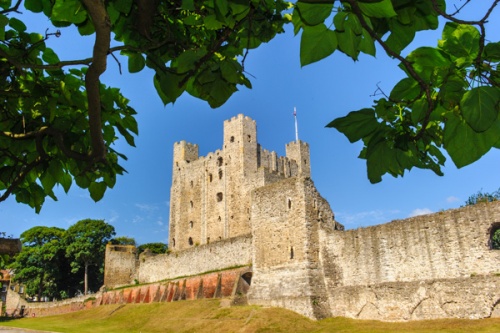
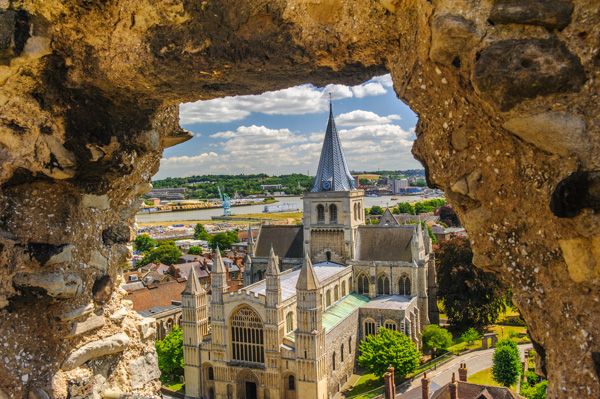
One of the finest Norman keeps in England, Rochester Castle stands near the Cathedral, overlooking the River Medway. The castle was built on the site of an earlier Roman fort, and the keep uses building materials from the old Roman city walls.
History
The city of Rochester grew up around an important crossing of the River Medway, where the Roman Watling Street struck north towards London. Soon after the Norman Conquest, a timber fortification was built to guard the crossing, situated on Boley Hill, just south of the current castle site.
In 1088 Bishop Odo of Bayeux rebelled against William II, and garrisoned the castle with his Norman supporters. In a curious twist for a Norman lord, William drew up an army of native English soldiers. He besieged the castle and forced the garrison to surrender. His rebellion crushed, Odo fled into exile.
At this point, Gundulf, Bishop of Rochester, took a hand. Gundulf agreed to rebuild the castle in stone, at his own expense, if William would confirm Rochester Cathedral's rights of a manor. The king agreed, and Gundulf took over.
The bishop was a talented builder; he did not just hire a master mason, he actually oversaw the work himself. Gundulf moved the castle to a more secure site, partly protected by the Roman defences. He built a great curtain wall to surround his new stone fortress, but it was left to William de Corbeil, Archbishop of Canterbury, to build the massive stone keep that is the centrepiece of the castle we see today.
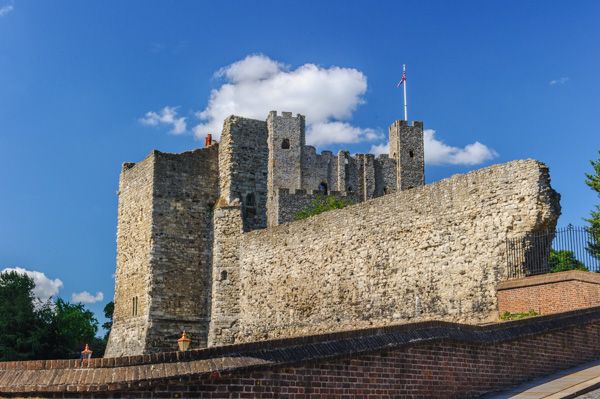
This is the largest keep in England, rising 113 feet from its base to the top of the four corner turrets. The keep is accessed through a huge forebuilding, which adds an extra set of defences for attackers to breach. The forebuilding originally gave access to the keep by a stair to the first-floor level and housed a chapel above a dungeon.
The Siege of Rochester 1215
The Archbishops of Canterbury continued to act as constables of Rochester Castle until 1215 when the most powerful nobles in the realm rebelled against King John. Archbishop Stephen Langton handed the castle over to the rebellious barons, who garrisoned the fortress against the king. King John raised an army and attacked Rochester.
A concerted bombardment failed to breach the walls, so John ordered his sappers to dig a tunnel under the castle walls. This they did, and a section of the curtain wall collapsed. The rebels retreated into the central stone keep, so John ordered the mine extended. When the tunnel was completed the attackers used the fat from 40 pigs to fire the mine, causing a corner of the keep to collapse. Even then, the rebels did not surrender but retreated behind a cross-wall that divided the keep in two. They only surrendered when food and water ran out.
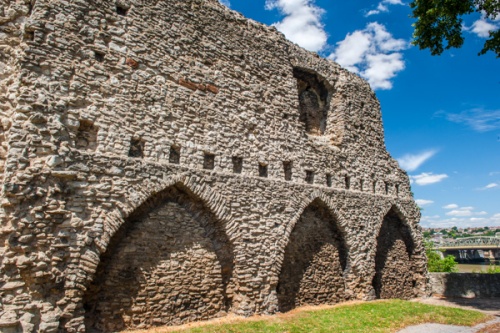
Henry III repaired the castle in the 1220s, but Rochester was again a focus for rebellion in 1264. Simon de Montfort led an army against the royal garrison and forced a breach in the curtain wall, but the defenders were saved when a royal army arrived and forced De Montfort's rebels to withdraw. The damage to the castle's defences was not restored until the reign of Edward III, who strengthened the walls against the threat of a French invasion.
The castle saw no further military action but remained a usable fortress until the 16th century. It passed into private ownership in the 17th century and was allowed to fall into disrepair. The corporation of Rochester bought the site in 1884 and turned the castle grounds into a public pleasure garden.
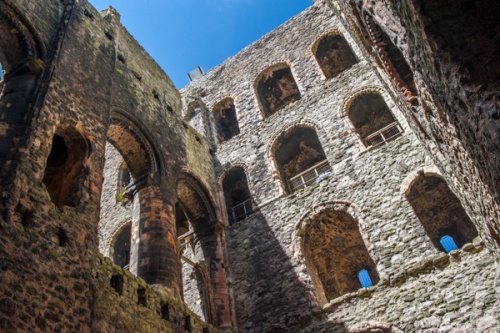
The 12th century keep built by Archbishop Corbeil remains essentially intact, just missing its floors and roof. It is 5 storeys high and includes a 'double storey' that houses a solar (private quarters for the lord) and the hall. The interior is divided by a cross-wall, at the base of which is a deep well.
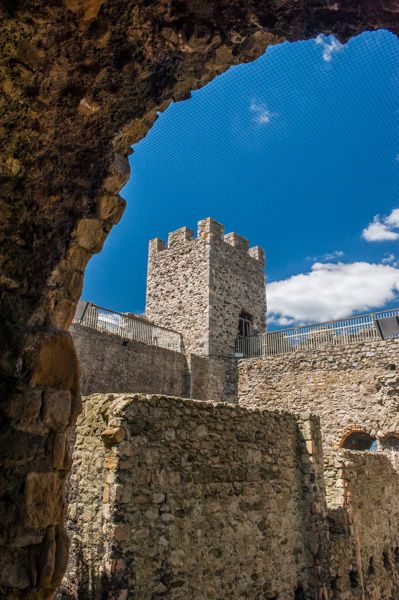
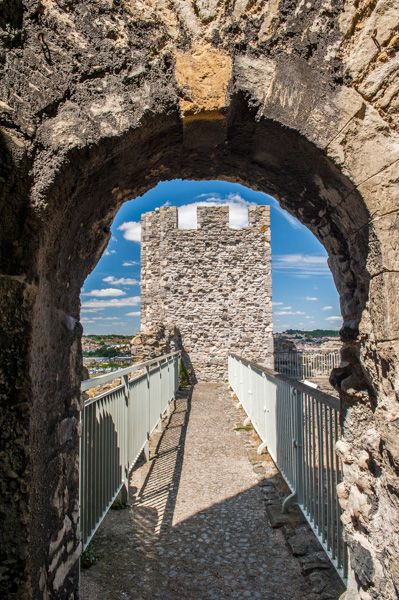
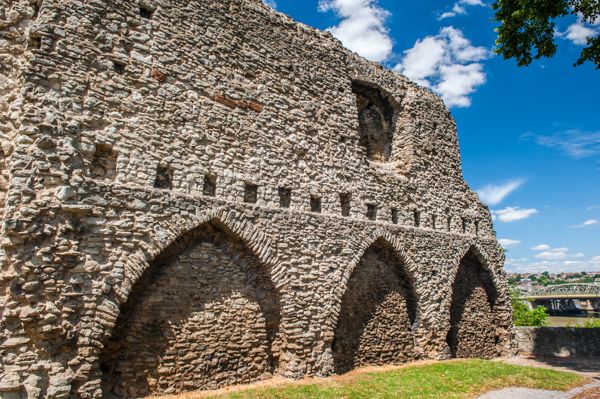
The well-shaft rises the full height of the dividing wall so that defenders at every level could always have access to fresh water. The original three corner turrets are square, but the turret restored by Henry III after the siege of 1215 is circular, an indication of how military architecture had changed in the century since the original keep was built. Long sections of the curtain wall still stand, some of it still following the line of the old Roman city walls.
Note: Though listed as an English Heritage property, the castle is actually managed by Medway Council.
More Photos


About Rochester Castle
Address: The Keep, Rochester, Medway, Kent, England, ME1 1SW
Attraction Type: Castle
Location: By Rochester Bridge, off the A2. No parking at the castle, but several signposted paid parking areas nearby.
Website: Rochester Castle
English Heritage - see also: English Heritage memberships (official website)
Location map
OS: TQ742684
Photo Credit: David Ross and Britain Express
POPULAR POSTS
HERITAGE
 We've 'tagged' this attraction information to help you find related historic attractions
and learn more about major time periods mentioned.
We've 'tagged' this attraction information to help you find related historic attractions
and learn more about major time periods mentioned.
Historic Time Periods:
Find other attractions tagged with:
12th century (Time Period) - 16th century (Time Period) - 17th century (Time Period) - castle (Architecture) - Edward III (Person) - GE Street (Person) - Henry III (Person) - King John (Person) - London () - Norman (Architecture) - Roman (Time Period) - William II (Person) - William II (Person)
NEARBY HISTORIC ATTRACTIONS
Heritage Rated from 1- 5 (low to exceptional) on historic interest
Rochester Cathedral - 0 miles (Cathedral) 
Restoration House - 0.1 miles (Historic Building) 
Rochester Guildhall Museum - 0.2 miles (Museum)
Temple Manor - 0.6 miles (Historic Building)
Historic Dockyard Chatham - 1.1 miles (Museum)
Royal Engineers Museum - 1.3 miles (Museum)
Upnor Castle - 1.7 miles (Castle)
Cobham Mausoleum - 3 miles (Historic Building)
Nearest Holiday Cottages to Rochester Castle:

Culverstone Green, Kent
Sleeps: 2
Stay from:£394 - £1,122