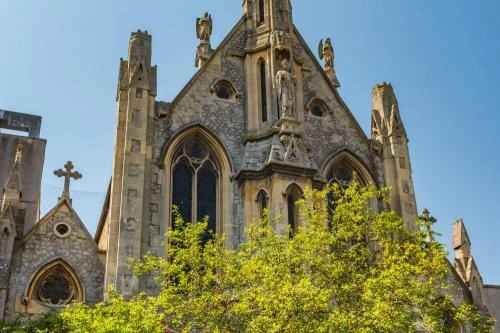
St Thomas of Canterbury Roman Catholic Church holds a special place in the history of Catholic worship in Canterbury; it was the first Catholic church in the city since the English Reformation.
History
Queen Elizabeth I's Act of Uniformity (1559) made the Catholic mass illegal and for the following two centuries most Catholics were forced to worship in private chapels and at foreign embassies with their own chapels attached.
The Second Catholic Relief Act was passed 232 years to the day after Elizabeth's act of Uniformity. The new Act allowed Catholics to worship as they pleased, as long as they took an oath to the king. The new act also permitted Catholic churches to be built, so long as they did not feature bells or steeples. Over time, these restrictions were also lifted, and a spate of new Catholic churches were erected.
In 1850, Mary Ann Wood gave a house at 60 Burgate for the use of a Catholic priest. There was at that time no official place of worship, and the priest often celebrated the Eucharist in his home. The house was later extended to create several small chapels.
The land beside the house was then purchased to provide space for a church and school. Part of that land was in use by a medieval chapel dedicated to St Mary Magdalene. The chapel was pulled down, but the tower was left standing and acts as a familiar landmark in the historic core of Canterbury.
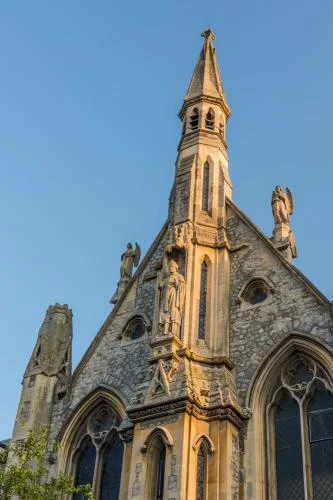
In 1870, Father Richard Power founded a new parish school and a church, both dedicated to St Thomas of Canterbury (St Thomas Becket). The church was finished in 1875 to a design by the architect John Hall, and Cardinal Henry Manning, Archbishop of Westminster, led the first service.
The restricted church site, set back from Burgate and wedged in beside the remaining tower of St Mary Magdalen, meant that the traditional layout of a west tower and an east altar had to be changed. The church is built of Kentish ragstone, grey brick, and window quoins of Bath stone.
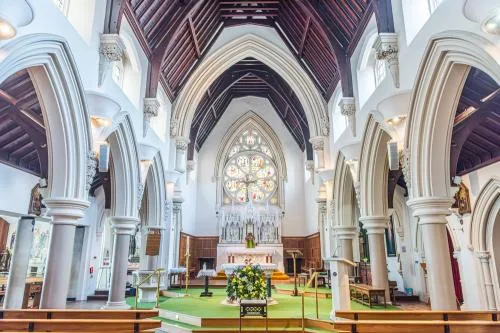
The Lady Chapel and high altar are the work of AE Purdie, and the overall design is influenced by EW Pugin, son of the famous Victorian architect AW Pugin, who worked on the Palace of Westminster. Like many Pugin designs, the style is that of Gothic Revival, hearkening back to the medieval period.
The church was damaged by bombs during a German 'Baedeker raid' in 1942.
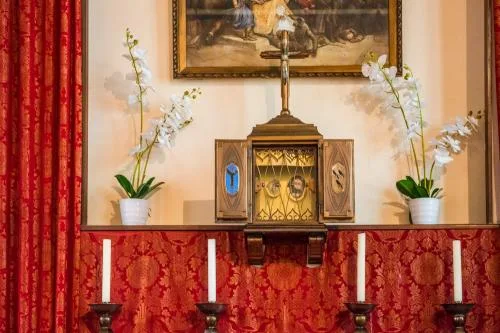
Shrine of St Thomas of Canterbury
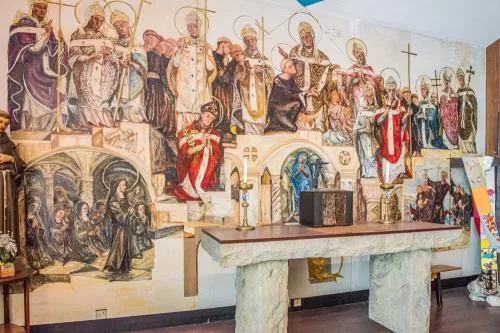
The Martyrs' Chapel holds the church's greatest treasures; two relics of St Thomas of Canterbury. One relic is a piece of St Thomas' vestment, while the other is a finger bone given in 1953 by a descendent of St Thomas. The relics are held in a reliquary before the altar in the Martyr's Chapel.
The reliquary is flanked by statues of St Thomas more and St John Fisher. In the chapel is a stained-glass window depicting the martyrdom of St Thomas in Canterbury Cathedral.
To one side of the window is another reliquary holding fragments of the mass vestments worn by Archbishop St Oscar Romero of San Salvador. These were gifted to the church in 1993. On the west wall of the chapel is a statue of St John Stone, one of the Forty Martyrs of England and Wales.
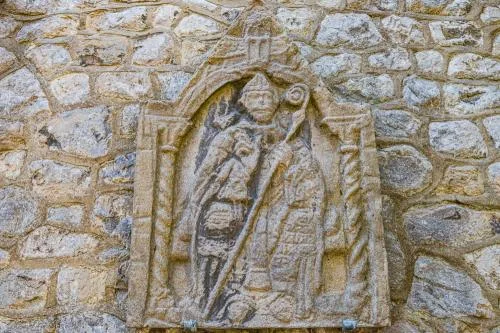
Look for an ancient carving depicting St Thomas of Canterbury on the church exterior. Curiously, the church website does not mention this weathered carving, which appears almost identical to the medieval carving at Godmersham which is thought to be the earliest depiction of St Thomas.
Visiting
The church is extremely easy to reach on foot from the city centre. It is set back from Burgate, immediately beside St Mary Magdalen tower. The church is normally open to visitors and was open when we visited.
About St Thomas of Canterbury RC Church
Address: 59 Burgate, Canterbury, Kent, England, CT1 2HJ
Attraction Type: Historic Church
Location: On the soth side of Burgate, next to St Mary Magdalene Tower. Easy access on foot from the city centre.
Website: St Thomas of Canterbury RC Church
Location map
OS: TR151577
Photo Credit: David Ross and Britain Express
NEARBY HISTORIC ATTRACTIONS
Heritage Rated from 1- 5 (low to exceptional) on historic interest
Zoar Chapel - 0.1 miles (Historic Building) 
Fyndon Gate - 0.1 miles (Historic Building)
Cemetery Gate - 0.1 miles (Historic Building)
Canterbury Cathedral - 0.1 miles (Cathedral) 
Canterbury, St Mary Magdalene Tower - 0.1 miles (Historic Church)
Canterbury, St Paul's Church Without the Walls - 0.1 miles (Historic Church)
St George's Tower - 0.1 miles (Historic Building)
St Augustine's Abbey - 0.1 miles (Abbey)
Nearest Holiday Cottages to St Thomas of Canterbury RC Church: