Shortly after William the Conqueror's invasion of 1066, the Normans threw up an earthwork fortification atop St Ann's Hill, overlooking a crossing of the River Rother, and the town of Midhurst grew up around the castle.
The castle builder may have been the Norman lord Savaric Fitzcane, or perhaps the powerful Roger de Montgomery, who was responsible for similar fortifications at Arundel and Chichester.
That first castle was little more than a bank and ditch encircling timber buildings, but sometime around 1160 the timber defences were rebuilt in stone to create a fortified manorial complex of buildings.
History
In 1185 the castle was granted to Frank de Bohun, a powerful Norman lord, but less than a century later, around the year 1280, the De Bohun family abandoned the castle in favour of a new house on the plain just east of St Ann's Hill. This new residence grew in time to become Cowdray House, one of the finest Tudor homes in England.
Midhurst Castle was pulled down around 1284 on the orders of Anthony Beck, Bishop of Durham, but the chapel, dedicated to St Denys, continued to serve as a place of worship for the townsfolk of Midhurst. The chapel's days were numbered, however, and it too was abandoned in turn and the present parish church became the town's religious focal point.
Stone from Midhurst Castle was used for nearby buildings and for Cowdray House, visible through a carefully-cut gap in the trees.
What to See
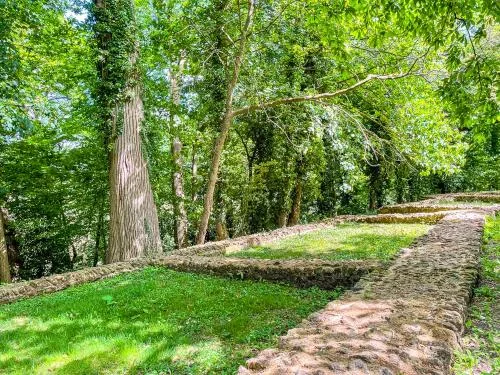
Investigation in 1913, under the direction of Sir W St John Hope, suggested that the castle was composed of a two-storey hall with an undercroft, a kitchen, and chapel within an inner courtyard, defended by a single tower, or keep, with a larger outer courtyard, or bailey, with more buildings, including a stable.
Later investigation cast doubt of some of the 1913 building identification, but until further investigation can confirm or deny the suggested castle layout, it's all we have to go on.
Kitchen
The kitchen stands in the north-east corner of the site, at an odd angle to the curtain wall. One section of the kitchen foundation wall appears to cut through the wall. This was possibly a single-storey building and may have served as the original castle hall.
Hall
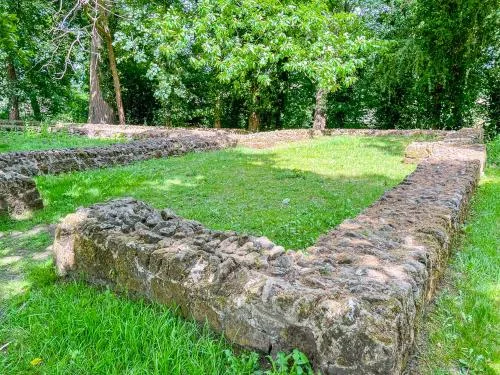
South of the kitchen and incorporating a section of the curtain wall is the hall divided into two chambers, with the southernmost chamber being slightly larger. The hall was the social and administrative hub of castle life. At ground level would have been an undercroft, used for storage. Above would have been a main hall and a smaller solar, used as a private living space by the lord of the castle and his family.
Chapel
Immediately south of the hall and at an angle to the curtain wall stood the chapel, dedicated to St Denys. The chapel was used by the lord and his family for private worship and would have been served by the family's own chaplain. This is a very simple single-cell building with a very obvious doorway opening in the west end. The building narrows slightly as you approach the altar, located at the eastern end.

Tower
At the southern end of the inner bailey is the tower. The uneven foundation outline suggests that the tower was built and rebuilt several times over the years. The tower may have provided accommodation to castle retainers as well as serving a defensive role.
Curtain Wall
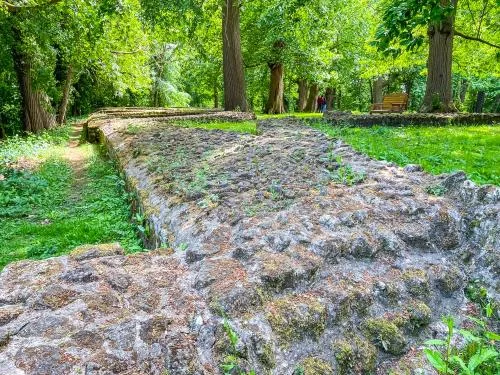
The wall defended the inner bailey, or courtyard. It was very likely built in several stages, with some sections dating to later than the kitchen. The wall is up to 1.7m thick in places.
Stables
The information panel atop St Anne's Hill shows the possible location of the stables, located on the path to the river, well outside the curtain wall.

Visiting
Midhurst Castle stands in a leafy glade atop St Ann's Hill. There is no vehicular access, but getting there on foot is easy. The simplest place to park is at the pay-and-display car park outside the leisure centre off Grange Road.
Head for Market Square, where you will see the cul-de-sac that leads to the castle site immediately behind the old town hall. Look for the pedestrian fingerpost sign with the castle symbol.
About Midhurst Castle
Address: St Ann's Hill, Midhurst, West Sussex, England, GU29 9NN
Attraction Type: Castle
Location: In a wooden glade just beyond the end of St Ann's Hill. Park on Market Square or at the nearby leisure centre off Grange Road.
Website: Midhurst Castle
Location map
OS: SU888214
NEARBY HISTORIC ATTRACTIONS
Heritage Rated from 1- 5 (low to exceptional) on historic interest
Midhurst, St Mary Magdalene & St Denys Church - 0.1 miles (Historic Church) 
Cowdray House - 0.2 miles (Historic House) 
Selham, St James Church - 2.6 miles (Historic Church)
Lodsworth, St Peter's Church - 2.7 miles (Historic Church)
Chithurst, St Mary's Church - 3.1 miles (Historic Church)
Trotton, St George Church - 3.4 miles (Historic Church)
Petworth House - 5.4 miles (Historic House)
Petworth, St Mary's Church - 5.4 miles (Historic Church)
Nearest Holiday Cottages to Midhurst Castle: