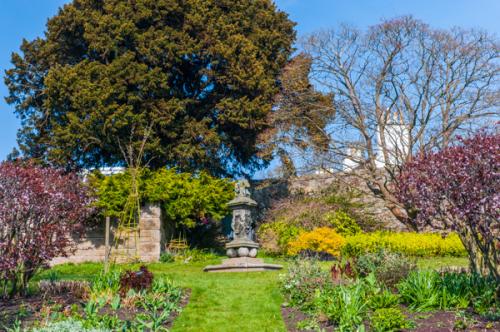
An award-winning terraced garden in the historic village of Inveresk features an Edwardian conservatory, old roses, shrubs, and herbaceous borders. Inveresk Lodge was named a Garden of Merit by the Royal Horticultural Society.
History
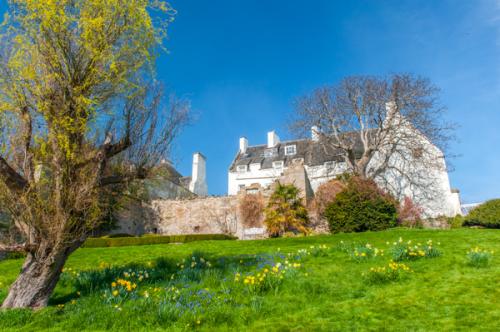
Inveresk Lodge is an L-plan tower house built in 1683. That date comes from a lintel on the stair tower, though there could be parts of the building that are much older. Most of the interior dates to the 18th century. From 1774 until 1911 the Lodge was owned by the Wedderburn family.
Sir John Wedderburn supported the Jacobite Rising in 1745 and paid for it with his life. His son fled overseas to Jamaica, where he made a fortune in sugar and on the slave trade.
The garden began to take shape in 1851 when James Hay laid out the grounds much as we see them today. In 1911 the Wedderburn family finally left Inveresk and sold the Lodge to a Quaker businessman named John Brunton.
Brunton made his money producing wire cable for aeroplane struts. Perhaps more famously, his company's cables were used to support the Forth Road Bridge.
The garden was used to grow vegetables during WWII, and after the war it fell into disuse. In 1958 the Brunton family left the Lodge and its garden to the National Trust for Scotland. The Trust lets out the house to tenants, but the gardens have been carefully restored and laid out so that they can be maintained by a single full-time gardener.
The Gardens
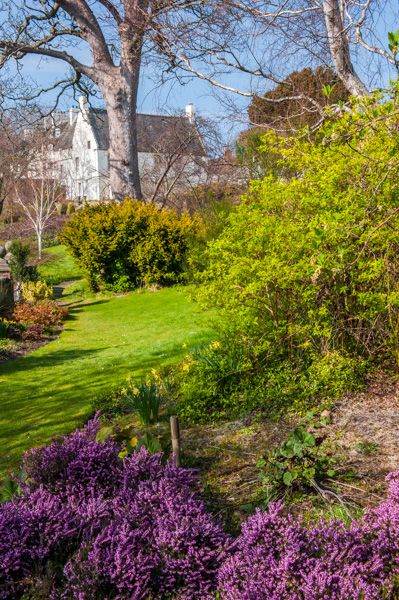
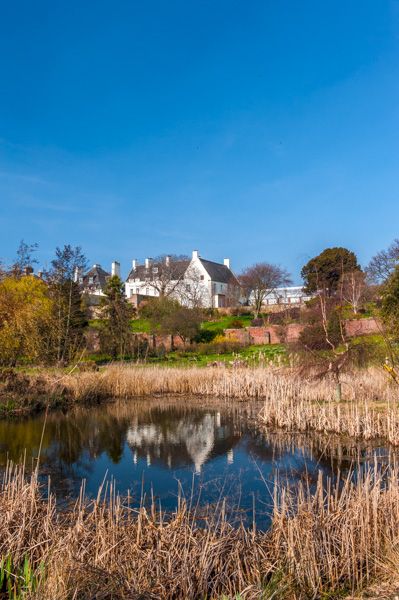
The Inveresk Lodge estate is situated on a sloping hillside, with lawns and colourful borders at the top of the slope, leading down to woodland interspersed with ponds at the bottom of the hill. The micro-climate is remarkably warm, so that surprising species flourish, especially a variety of climbing plants along the lower terrace.
The gardens are divided into separate garden areas, or rooms, in the style of an Arts and Crafts garden. Each garden room is planted with a unique theme and designed to be at its best in a particular season.
Seasonal highlights include tulips and snowdrops in Spring, shrub roses in Summer, and brightly coloured berries in autumn. Winter offers surprising scents, especially on sunny days, when winter honeysuckle and Christmas box fill the air.
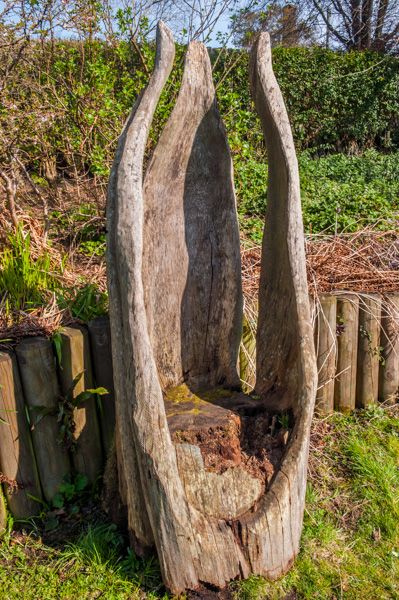
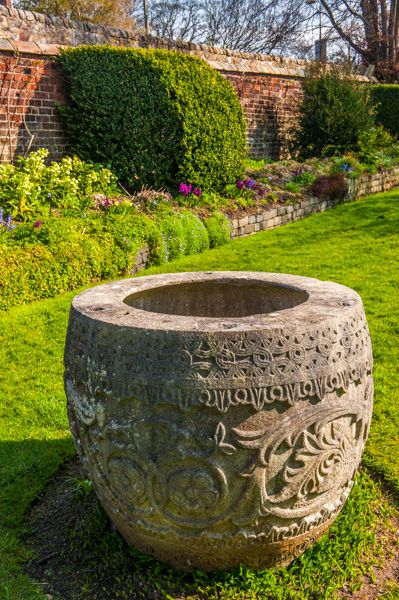
The garden's main focal point is a sundial begun in the 17th century. Among the best garden features are a Victorian greenhouse, Edwardian conservatory and aviary. There are woodland walks, a summer house meadow pond and herbaceous borders. There is also a rose border.
More Photos

About Inveresk Lodge Garden
Address: 24 Inveresk Village, Musselburgh, Lothian, Scotland, EH21 7TE
Attraction Type: Garden
Website: Inveresk Lodge Garden
Email: inveresk@nts.org.uk
National Trust for Scotland
Location map
OS: NT348 712
Photo Credit: David Ross and Britain Express
HERITAGE
 We've 'tagged' this attraction information to help you find related historic attractions
and learn more about major time periods mentioned.
We've 'tagged' this attraction information to help you find related historic attractions
and learn more about major time periods mentioned.
Historic Time Periods:
Find other attractions tagged with:
17th century (Time Period) - 18th century (Time Period) - 7th century (Time Period) - 8th century (Time Period) - Arts and Crafts (Architecture) - Edwardian (Historical Reference) - Iona (Place) - Jacobite (Historical Reference) - tower house (Architecture) - Victorian (Time Period)
NEARBY HISTORIC ATTRACTIONS
Heritage Rated from 1- 5 (low to exceptional) on historic interest
Newhailes - 1.4 miles (Historic House) 
Preston Mercat Cross - 3 miles (Historic Building) 
Craigmillar Castle - 4.1 miles (Castle)
St Triduana's Chapel - 4.3 miles (Historic Church)
Ormiston Market Cross - 4.5 miles (Historic Building)
Seton Collegiate Church - 4.8 miles (Historic Church)
Holyrood Abbey - 5 miles (Abbey)
Palace of Holyroodhouse - 5 miles (Historic House) 
Nearest Holiday Cottages to Inveresk Lodge Garden:

Cockenzie and Port Seton, Lothian
Sleeps: 6
Stay from:£475 - £1,624