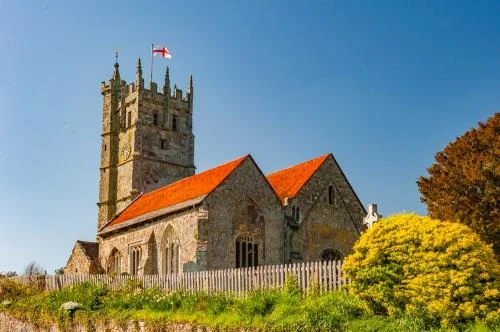
Perhaps the most important place of worship on the isle of Wight, St Mary's Church, Carisbrooke has a history going back deep into the Dark Ages, though the church we see today dates to around 1070.
History
It seems likely that there was a pagan place of worship at Carisbrooke as early as the 6th century, though we do not know where the church stood. In 1070 the Norman lord William FitzOsbern gave Carisbrooke church, along with six other churches on the Isle of Wight, to the Abbey of Lyra in Normandy, which he had founded.
Sometime around 1150, the Abbot of Lyra expanded Carisbrooke Church to form a priory. This was less a spiritual decision than an economic one; the abbey needed an easier means of collecting tithes and property rents for their possessions on Wight.
Before Carisbrooke Priory was established, the abbey had to send monks from Normandy across the Channel every year to collect their dues. Establishing the priory gave them an administrative base on the island and made good economic sense.
Carisbrooke Priory
The new priory was established by extending the existing south aisle to serve as the parish church, while the monks used the nave and chancel as their priory church. Thus, St Mary's was a church in two parts, one parochial and one monastic, divided by a wooden screen and served by different priests. You can still see marks made on the nave pillars to support this screen.
This division of the church into two parts led to troubled relations between the Prior of Carisbrooke and the De Redvers family, patrons of the parish church, for each thought they should have the right to present the parish priest.
Things got even more complicated under Edward III, when the monarch seized the priory. Richard II then granted the priory to Montgrace in Yorkshire, only to have Henry IV restore it to Lyra when the French complained. Henry did, however, keep the right of presentation to the parochial (parish) church.
The Priory Destroyed
Henry V removed Carisbrooke from Lyra entirely and granted the priory to Charterhouse at Sheen, which he had founded. The Carthusians of Sheen promptly dissolved Carisbrooke Priory and pulled down most of the priory buildings, renting out the rest.
To give the Carthusians their due, they did erect the marvellous west tower, one of the finest 15th-century towers in southern England.
One new tenant to take up a lease on the old priory buildings was an ancestor of Sir Francis Walsingham, Secretary of State under Queen Elizabeth I. When Walsingham inherited his family's property at Carisbrooke, he also became a lay rector of the church. In this role he had the chancel torn down instead of spending money to repair the decaying building.
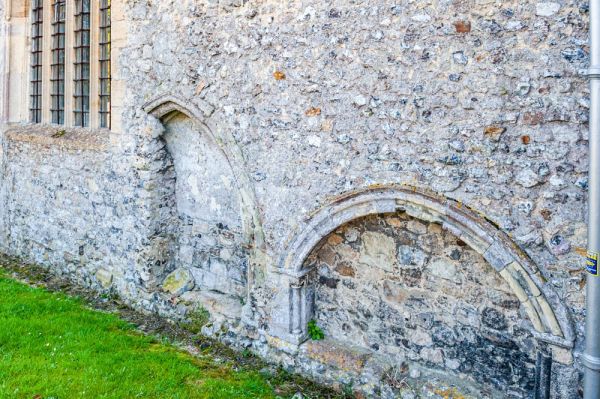
The final remnants of the medieval priory were pulled down in the 19th century, leaving little above ground save the church itself, now united into one parochial building. You can still see two rounded tomb arches on the exterior of the north wall. These date to the 13th century and would originally have faced onto the priory cloister.
Historical Highlights
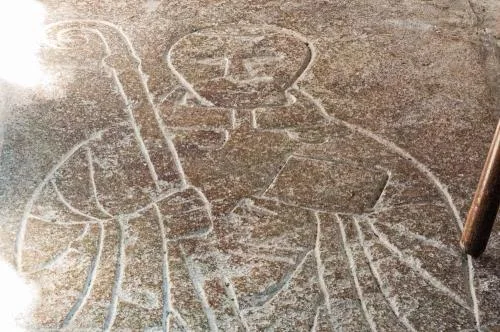
The most intriguing historical treasures inside the church are a pair of medieval grave slabs. One was made to mark the burial place of a prior, for it is carved with the likeness of a monastic figure carrying a curved staff of office in the shape of a shepherd's crook. This grave slab was found at Priory Farm, where it was used as a door lintel. It is thought to be 12th century in date.
Though the grave slab is typically described as depicting a prior of Carisbrooke, there is an alternative theory that suggests it is meant to depict an abbot of Lyra who died while visiting the priory.
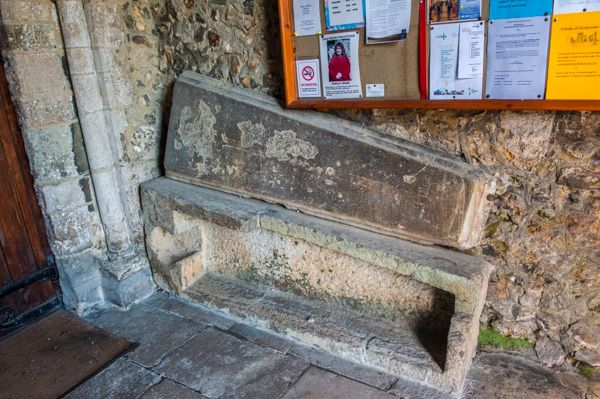
The other grave slab, now displayed in the church porch, is decorated with a foliated cross in low relief. It is thought to be 13th-century in date. Also displayed in the porch is a stone coffin with a cut-out meant to take a human head.
Discovered during restoration work in 1891 was a tapering slab of Purbeck marble. This is carved with the letters 'CUBE AVELINE DAME EWE', suggesting that it was made in memory of a woman named Aveline from Eu (across the Channel in Normandy).
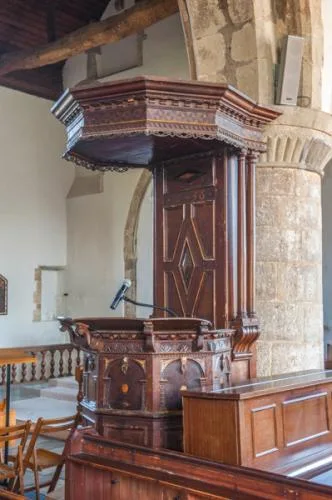
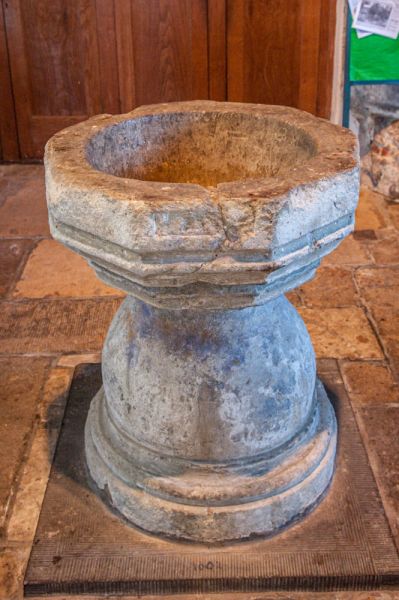
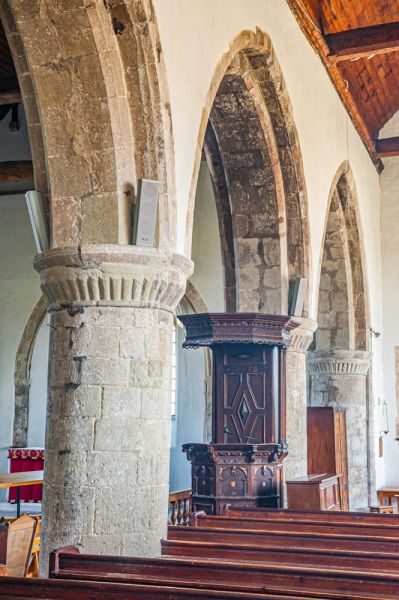
The lovely wooden pulpit dates to 1658, which is unusual as that means it was installed installed during the period of Cromwell's Commonwealth. The font is possibly of Tudor date, topped with an early 17th-century wooden cover.
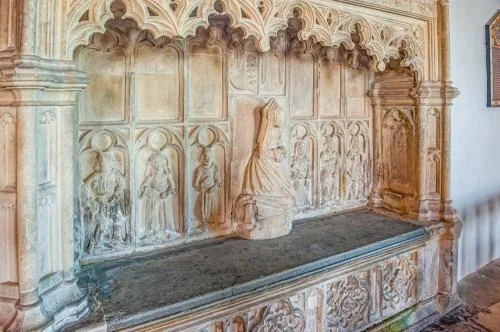
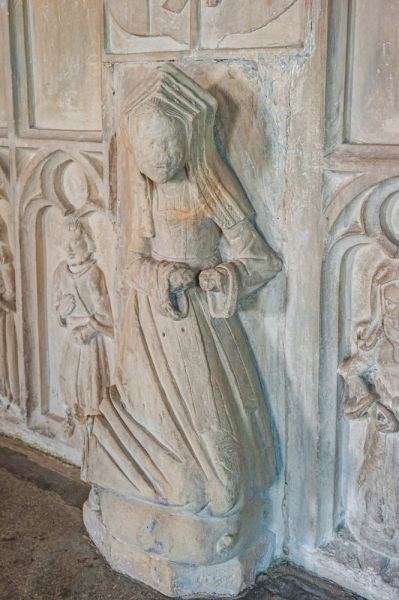
The finest memorial inside the church, though, is that of Lady Wadham (d. 1520), wife of the governor of Carisbrooke Castle.

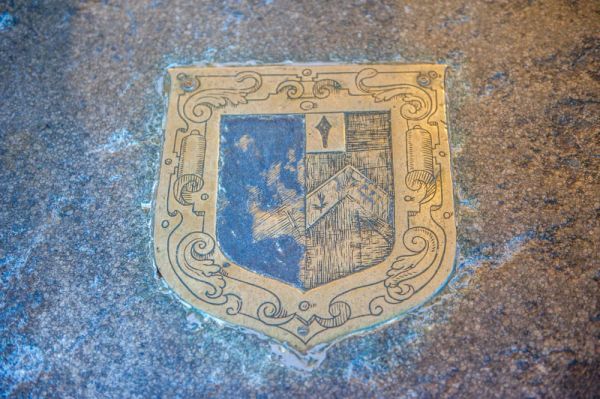
Another memorial of note is the small brass in honour of William Keeling (d. 1619). Keeling was an adventurer with the East India Company. The Keeling islands are named for him.
Keeling’s effusive epitaph reads (edited for clarity):
Here lies the body of the Right worthy William Keeling Esquire, Groom of the Chamber to our Sovereign King James, General for the East India Adventurers whether he was thrice by them employed and dying in this isle at the age of 42 Anno 1619 Sept. 19 has this remembrance here fixed by his loving & sorrowful wife Anne Keeling.
Forty and two years in this vessel frail
On the rough seas of life did Keeling sail,
A merchant fortunate, a captain bold,
A courtier gracious, yet (alas) not old.
Such wealth, experience, honour & high praise
Few win in twice so many years or days.
But what the world admired, he deemed but dross
For Christ; without Christ all his gains but loss,
For him, and his dear love, With merry cheer
To the Holy Land, his last course did steer.
Faith served for sails, the sacred word for card
Hope was his anchor, glory his reward,
And thus with gales of grace, by happy venture,
Through straights of Death, heaven's harbour he did enter.
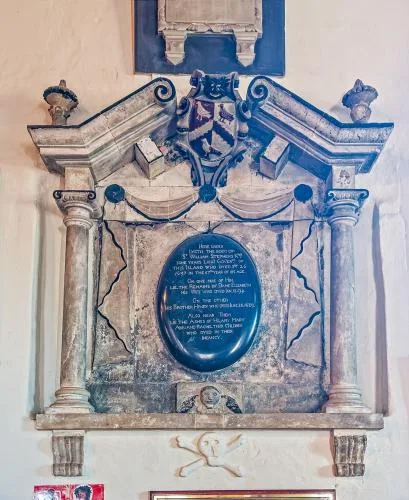
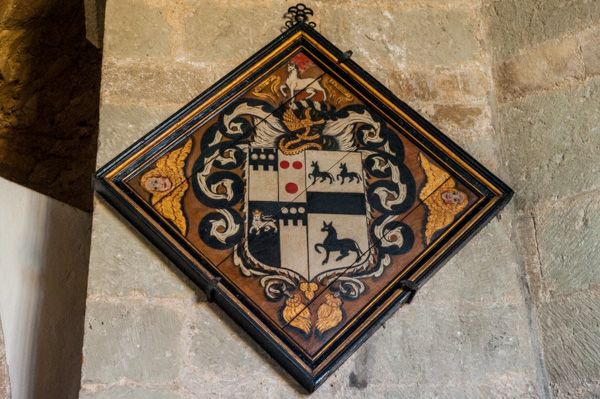
On the wall is a rather crudely painted royal coat of arms bearing the initials of Queen Anne and dated 1704. Also wall mounted is an ornate memorial to Sir William Stephens (d. 1697). Stephens served as Lieutenant-Governor of the Isle of Wight.
The epitaph tells a sad tale, for the names of three children who died in infancy are recorded:
'On one side of him lie the remains of Dame Elizabeth his wife who died Jan. 12 1692/3.
On the other his brother Henry who died June 28 1689.
Also near them lie the ashes of Hilary, Mary Ann, and Rachel, their children who died in their infancy.'
In the churchyard is a fenced enclosure protecting the grave of Reverend Edward Scott, Vicar of Carisbrooke, who died in 1857.

St Mary's is a delight, and well worth making time to visit. Don't visit Carisbrooke Castle without making time to explore the church.
Visiting
St Mary's Church stands on Carisbrooke's High Street. There is paid parking a short distance away and it might be possible to find free parking along nearby roads. The church is normally open to visitors and was open when we visited.
More Photos
About Carisbrooke, St Mary's Church
Address: High Street, Carisbrooke, Isle of Wight, England, PO30 1NR
Attraction Type: Historic Church
Location: On High Street. Paid parking a stone's throw away.
Website: Carisbrooke, St Mary's Church
Location map
OS: SZ486883
Photo Credit: David Ross and Britain Express
POPULAR POSTS
HERITAGE
 We've 'tagged' this attraction information to help you find related historic attractions
and learn more about major time periods mentioned.
We've 'tagged' this attraction information to help you find related historic attractions
and learn more about major time periods mentioned.
Find other attractions tagged with:
11th century (Time Period) - 12th century (Time Period) - 13th century (Time Period) - 17th century (Time Period) - 19th century (Time Period)
NEARBY HISTORIC ATTRACTIONS
Heritage Rated from 1- 5 (low to exceptional) on historic interest
Carisbrooke Castle - 0.3 miles (Castle) 
Gatcombe, St Olave's Church - 2 miles (Historic Church) 
Arreton Manor - 3.1 miles (Historic Building)
Newport Roman Villa - 3.1 miles (Roman Site)
Arreton, St George's Church - 3.1 miles (Historic Church)
The Shipwreck Centre & Maritime Museum - 3.2 miles (Museum) 
Whippingham, St Mildred's Church - 3.7 miles (Historic Church)
Shorwell, St Peter's Church - 3.7 miles (Historic Church)
Nearest Holiday Cottages to Carisbrooke, St Mary's Church:
Carisbrooke, Isle of Wight
Sleeps: 8
Stay from:£841 - £3,691