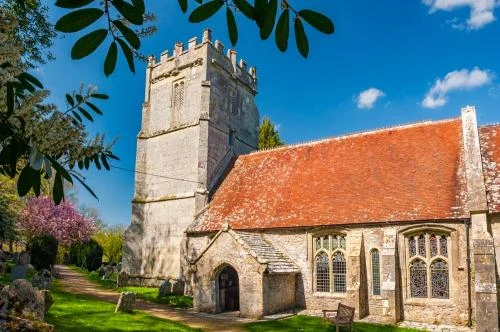
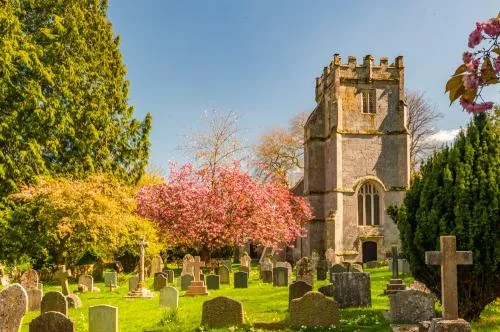
St Olave's Church, Gatcombe, began as a 13th-cenury manorial chapel for the Estur family of Gatcombe Manor. The church consists of a nave, chancel, and west tower, and has remained largely untouched since it was built.
History
You might well ask why a Norwegian king is the patron saint of a church on the Isle of Wight, but the answer is unclear. We do know that Gatcombe seems to have been built as a daughter church of nearby Carisbrooke.
It seems likely that the masons responsible for Gatcombe also worked on the nearby church of Carisbrooke at the same time.
The chancel was pulled down in 1864 and extended to form the church we see today.
Historical highlights
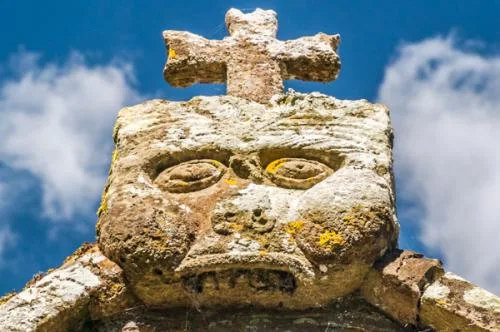
One of the most intriguing features of Gatcombe's church is a grotesque head carved over the apex of the church porch. This shows a strange face with deeply set eyes and an open mouth, showing rows of teeth. One source suggests that the head dates to the late 12th century.
Take a moment to examine the roof timbers inside the church porch. These come from the HMS Thunderer, a warship at the Battle of Trafalgar in 1803. They were inserted into the porch when it was restored in 1910.
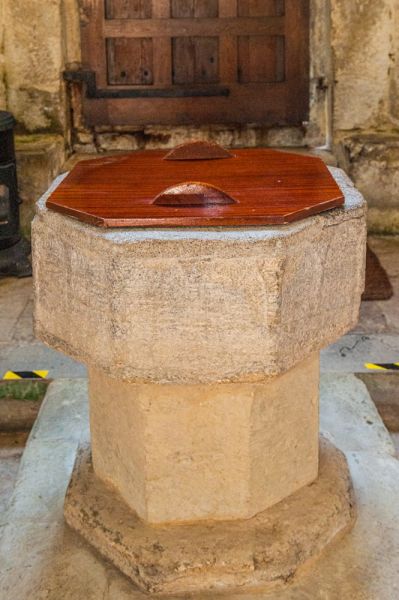
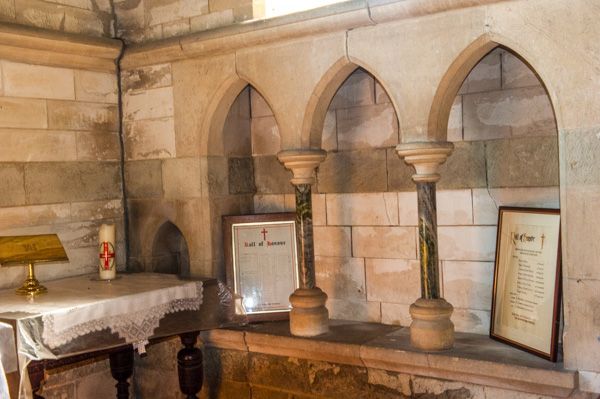
The font is made of Purbeck marble and dates to the 13th century. The organ was installed in the aftermath of the First World War as a memorial to the men of the Isle of wight Rifles who perished in the war.
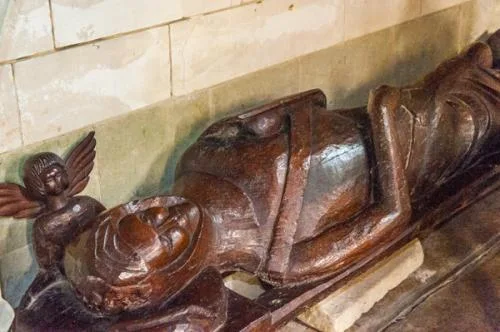
A Wooden Crusader Effigy
To the left of the altar is a wooden effigy of a crusading knight bearing a shield, though no one is sure who the effigy depicts or when it was installed in St Olave's Church. It has been identified, with no certainty, as Sir Edward Estur of Gatcombe Manor, though some historians suggest that it may be a modern replica of a medieval effigy.
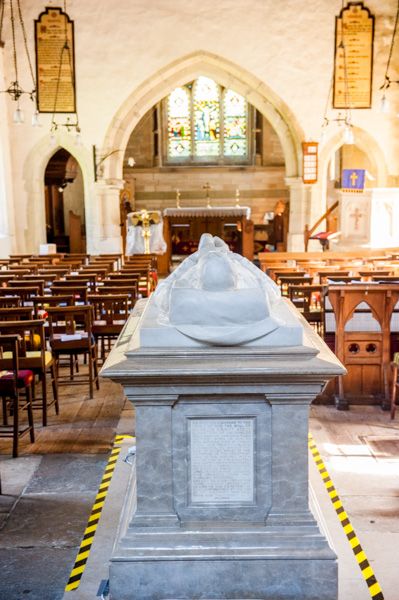
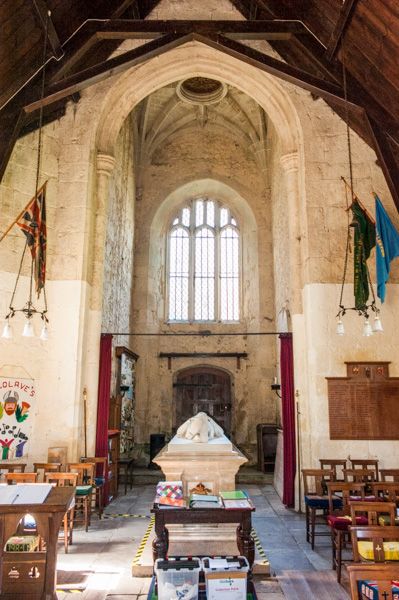
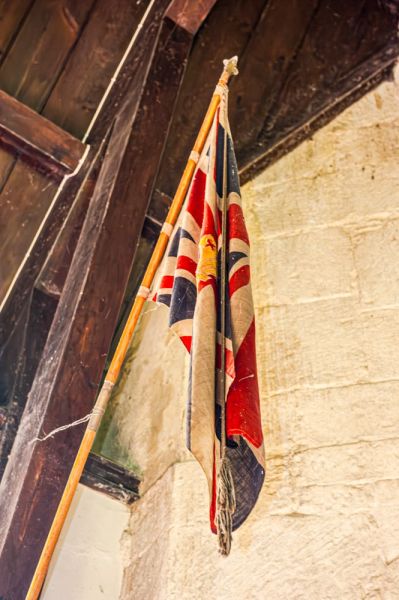
More impressive is the tomb of Captain Charles Seely of Gatcombe Park. Seely died in action in Gaza in 1917. The effigy bears the scars inflicted by a local woman who took offence at the ornate memorial when her brother, who also died in the war, remained uncelebrated. Above the effigy hang the colours of the First Brigade, Isle of Wight Rifles.
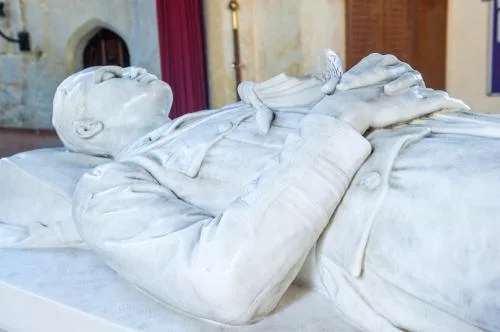
Note that Seely's effigy has its legs crossed in conscious imitation of medieval crusading knights. The effigy was sculpted by Sir Thomas Brock and was the last commission to be completed before his death.
The tower screen incorporates 16th-century communion rails and there is a Jacobean altar table in the chancel.
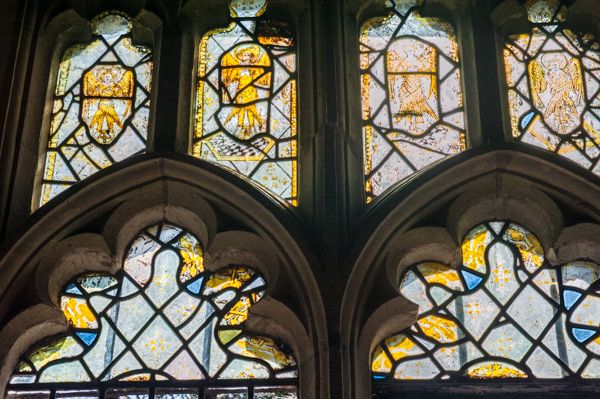
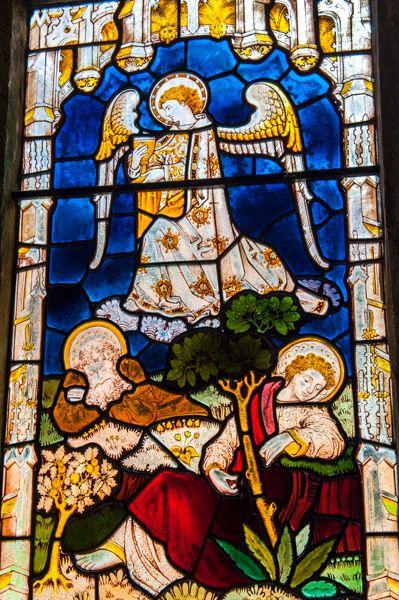
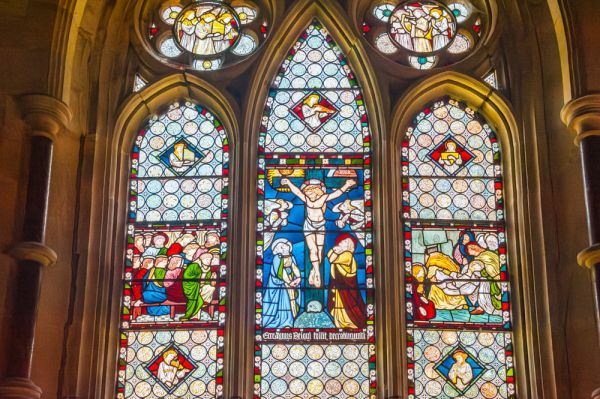
The east window is the work of William Morris, but of more interest is the small window to the left of the south door. This is thought to be the oldest glass on the Isle of Wight and it depicts an angel on a wheel. Other windows bear glass by Pre-Raphaelite artists including Edward Burne-Jones, Dante Gabriel Rosetti, and Ford Madox Brown.
Lucy Lightfoot
The magical story of Lucy Lightfoot has fired the imagination of generations. The story goes that in 1831 a local girl by that name disappeared in the aftermath of a total eclipse of the sun and her horse was found tethered to the church gate.
A misericord adjoining the wooden effigy of Edward Estur inside St Olave's Church was found to be shattered and a valuable gemstone was missing from Estur's effigy.
No trace of Lucy Lightfoot was ever found, but manuscripts showed that a girl of that name accompanied Sir Edward Estur on Crusade in 1363, leading to speculation about Lucy's possible time travel, or 'time slip'.
A rector of Gatcombe, the Reverend James Evans, later admitted to inventing the story, but that hasn't stopped people from visiting St Olave's Church to see the place where Lucy Lightfoot disappeared. To give Evans his due, he simply wanted to sell interesting stories to raise money for worthy causes.
Visiting
The church is just off Gatcombe Road and there is parking along the verge, outside the churchyard. The church was open when we visited and is, as far as we can determine, normally open to visitors.
More Photos
About Gatcombe, St Olave's Church
Address: Gatcombe Road, Gatcombe, Isle of Wight, England, PO30 3EJ
Attraction Type: Historic Church
Location: The church is on Gatcombe Road, with parking along the verge.
Website: Gatcombe, St Olave's Church
Location map
OS: SZ492851
Photo Credit: David Ross and Britain Express
POPULAR POSTS
HERITAGE
 We've 'tagged' this attraction information to help you find related historic attractions
and learn more about major time periods mentioned.
We've 'tagged' this attraction information to help you find related historic attractions
and learn more about major time periods mentioned.
Find other attractions tagged with:
13th century (Time Period) - 19th century (Time Period) - Pre Raphaelite (Architecture) - William Morris (Person)
NEARBY HISTORIC ATTRACTIONS
Heritage Rated from 1- 5 (low to exceptional) on historic interest
Carisbrooke Castle - 1.7 miles (Castle) 
Carisbrooke, St Mary's Church - 2 miles (Historic Church)
Shorwell, St Peter's Church - 2.5 miles (Historic Church)
Arreton Manor - 2.7 miles (Historic Building)
Newport Roman Villa - 2.7 miles (Roman Site) 
Arreton, St George's Church - 2.8 miles (Historic Church)
The Shipwreck Centre & Maritime Museum - 2.8 miles (Museum) 
Godshill, All Saints Church - 3 miles (Historic Church)
Nearest Holiday Cottages to Gatcombe, St Olave's Church: