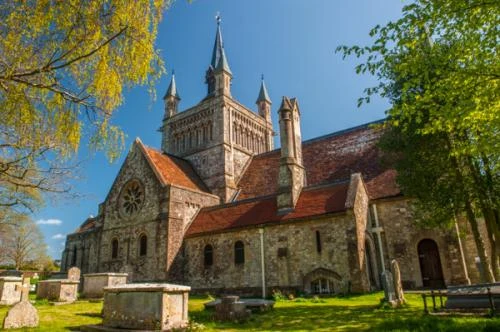
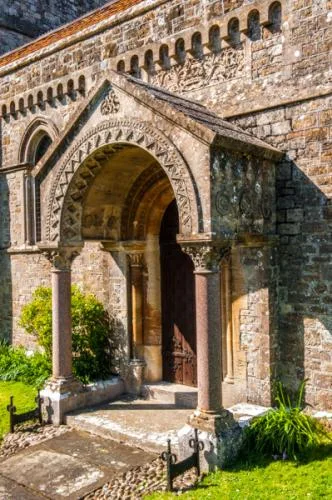
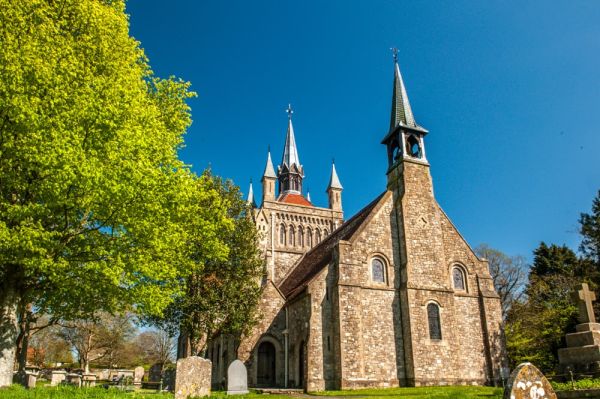
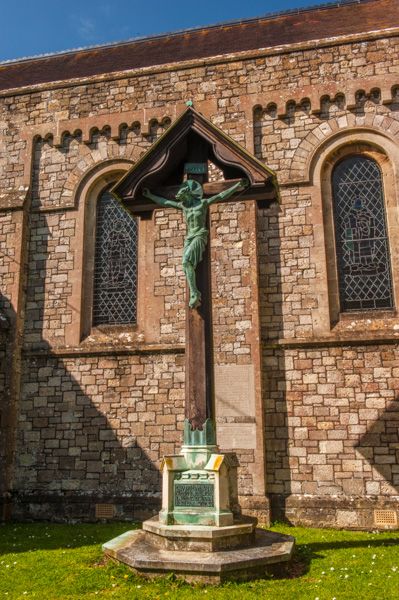
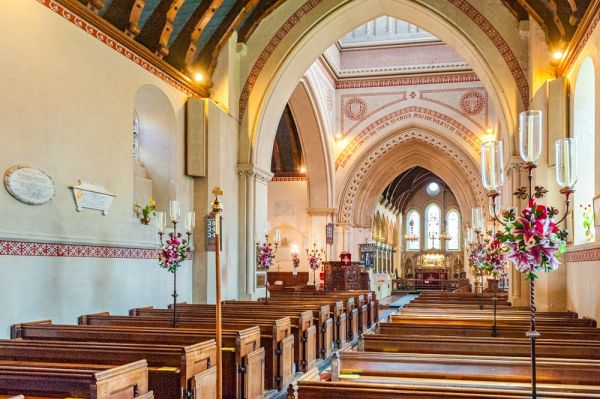
St Mildred's Church in Whippingham is an ornate 19th-century church, closely linked with Queen Victoria and her extended family. St Mildred's lies within the estate of Osborne House, and the queen and her family worshipped at Whippingham when they resided at Osborne.
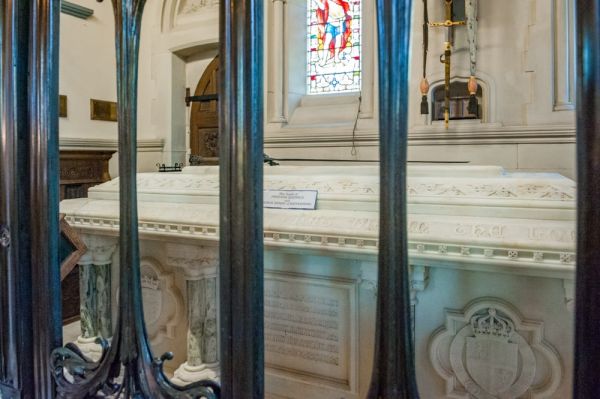
The church boasts memorials to members of the Battenberg/Mountbatten family, including Princess Beatrice, Queen Victoria's youngest daughter, and her husband, Prince Henry of Battenberg. The royal couple were married in St Mildred's Church and are also buried here. You can see their monuments in the Battenberg Chapel, on the north side of the chancel.
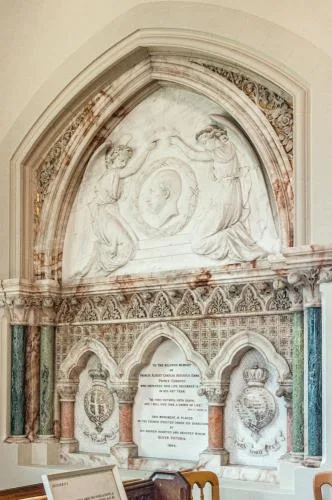
Visitors can see the royal pew, with the chair used by Queen Victoria when attending services. Another highlight is an ornate memorial to Prince Albert.
Queen Victoria is said to have become tired of tourists gawking at her during services at Whippingham. As a result, she retreated to her private chapel at Osborne House and did not attend services at Whippingham after 1880.
History
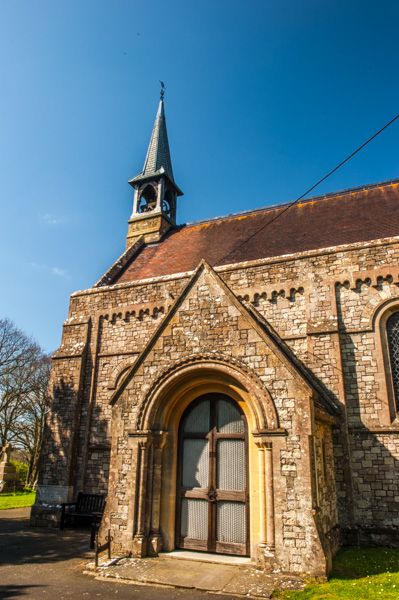
This is the fourth church in Whippingham. The earliest church was erected here in the Saxon period, and you can see a Saxon carving of knights on horseback set into the exterior west wall of the church porch.
The Saxon church was rebuilt in the early Norman period, and it is this church that is recorded in the Domesday Book of 1086. The Norman church lasted until 1804, when it was rebuilt by John Nash, architect of the Royal Pavilion in Brighton.
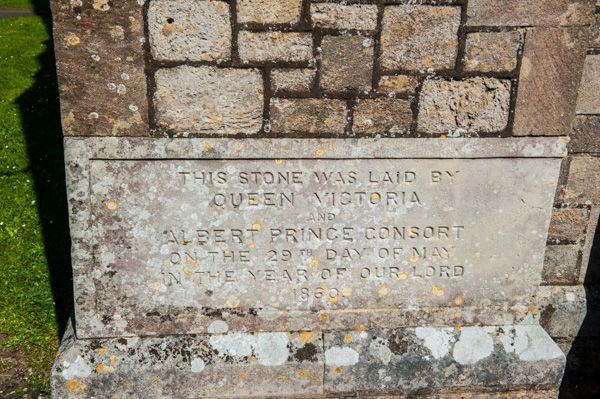
Queen Victoria and Prince Albert purchased Osborne House in 1845, but the queen decided that Nash's church was too small, unattractive, and lacked privacy. The royal couple called in the architect Albert Humbert, assisted by Prince Albert, to rebuild Nash's church on a larger scale. Work began in 1854 and was finished in 1862.
The first service in the new church took place in January 1862, only one month after Albert's death.

The royal pew stands on the south side of the chancel. Opposite, on the north side, was the Household Chapel, reserved for staff from Osborne House. This area was later turned into the Battenberg Chapel and separated from the chancel by an ornate stone screen.
The font was designed by Princess Louise, Queen Victoria's sixth child. Princess Louise also designed and embroidered the carpet that surrounds the font.
During Victoria's lifetime, the chancel had only plain chairs. These were replaced with pews by King Edward VII after his mother's death.
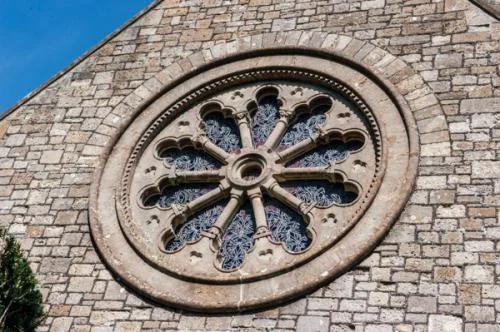
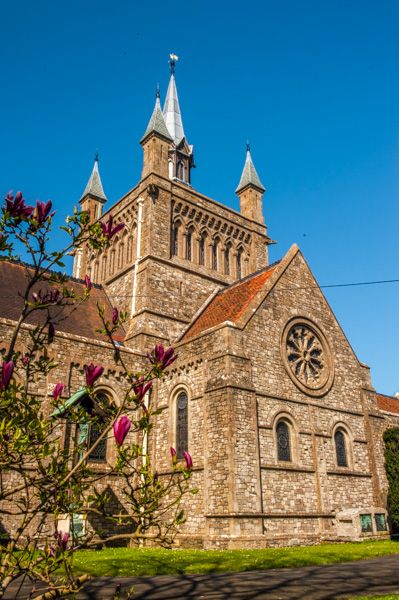
There are two rose windows, one adorning each of the transepts. These are copies of the rose windows at Notre Dame in Paris, which the queen admired.
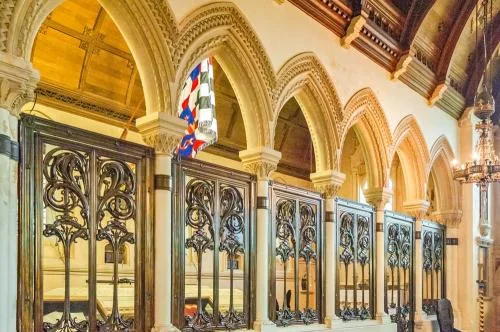
Battenburg Chapel
Princess Beatrice, Queen Victoria's ninth child, was married to Prince Henry of Battenberg at Whippingham on 23 July 1885. The prince died in 1896 after contracting malaria whilst on campaign on the on the Gold Coast of Africa during the Ashanti War.
He was buried beneath a large marble sarcophagus. Princess Beatrice survived as a widow until her death in 1945. She was buried beside her husband.
On the wall is a painting installed by Princess Beatrice in memory of her son, Prince Maurice of Battenberg who was killed in action at Ypres in 1914.
Look for the glass case containing two Bibles given to Princess Beatrice to celebrate her wedding to Prince Henry.
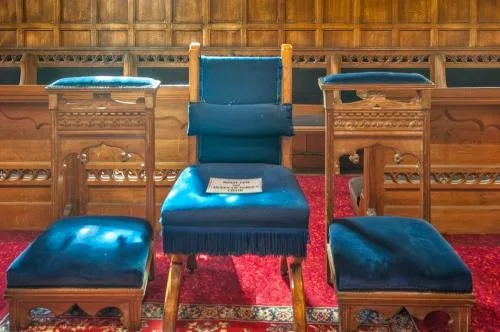
Royal Pew
Opposite the Battenberg Chapel, on the south side of the chancel, is the Royal Pew. This pew has its own entrance. The pews that adorn the chapel now were installed by the order of King Edward VII after his mother's death, but the plain blue chair favoured by the queen was retained.
To the left is a memorial to Prince Leopold, Duke of Albany, the queen's youngest son. Over the entrance is a plaque in memory of Prince Sigismund and Prince Waldemar of Prussia, the queen's grandsons, both of whom died in childhood.
More Historical Highlights
On the west wall is an ornate memorial to Prince Albert, erected by Queen Victoria. Other memorials in the Royal Pew include those of Princess Alice, the queen's second daughter.
The reredos behind the high altar was given by King Edward VII in memory of Queen Victoria. The carving is white marble and depicts The Last Supper.
The ornate pulpit is worth noting; it was given in memory of Queen Victoria by the parishioners of Whippingham. The copper panels depict the Beatitudes. The wrought-iron candelabra in the nave were a gift of Queen Victoria.
It is worth taking the time to explore the churchyard, where you will find the grave of Prince Louis of Battenberg and his wife, Princess Victoria of Hesse, Queen Victoria's granddaughter. Near the north wall you will find the grave of Uffa Fox, a prominent yachtsman.
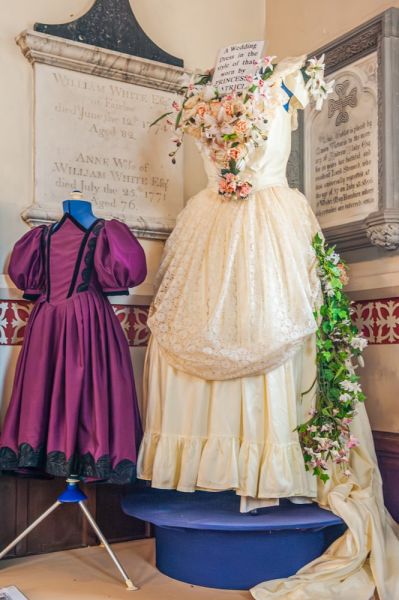
The church boasts a permanent exhibit of royal paraphernalia. This includes a copy of the dress worn by Princess Beatrix for her wedding to Prince Henry, as well as royal photographs and architectural drawings that illustrate the long history of Whippingham and its church over the centuries.

Visiting
As of this writing, Whippingham Church is only open seasonally, between the end of March and the end of October. It is worth checking the official website before making plans to visit.
Far too many visitors enjoy Osborne House but forget to explore Whippingham. The church is well worth a side-trip to explore, if for no other reason than to see the royal monuments. Highly recommended.
More Photos
About Whippingham, St Mildred's Church
Address: Beatrice Avenue, Whippingham, Isle of Wight, England, PO32 6LW
Attraction Type: Historic Church
Location: The church is signposted off Whippingham Road, just south of East Cowes. There is a dedicated car park on Beatrice Avenue, and further parking in a lay-by along the lane.
Website: Whippingham, St Mildred's Church
Location map
OS: SZ511936
Photo Credit: David Ross and Britain Express
POPULAR POSTS
HERITAGE
 We've 'tagged' this attraction information to help you find related historic attractions
and learn more about major time periods mentioned.
We've 'tagged' this attraction information to help you find related historic attractions
and learn more about major time periods mentioned.
Historic Time Periods:
Find other attractions tagged with:
19th century (Time Period) - Norman (Architecture) - Queen Victoria (Person) - Saxon (Time Period) - Victorian (Time Period)
NEARBY HISTORIC ATTRACTIONS
Heritage Rated from 1- 5 (low to exceptional) on historic interest
Osborne House - 0.8 miles (Historic House) 
Cowes Maritime Museum - 1.7 miles (Museum) 
Carisbrooke, St Mary's Church - 3.7 miles (Historic Church) 
Carisbrooke Castle - 4 miles (Castle)
Binstead, Holy Cross Church - 4 miles (Historic Church) 
Arreton Manor - 4.5 miles (Historic Building)
Newport Roman Villa - 4.5 miles (Roman Site)
Arreton, St George's Church - 4.5 miles (Historic Church)
Nearest Holiday Cottages to Whippingham, St Mildred's Church:
East Cowes, Isle of Wight
Sleeps: 10
Stay from:£860 - £6,088