The parish church of Yarmouth dates to the early years of the 17th century and stands on the site of an earlier medieval building. Highlights include the Holmes Chapel, erected in 1692 to house a memorial to Sir Robert Holmes, Governor of the Isle of Wight from 1667-1692.
History
The medieval church of Yarmouth was badly damaged in a French raid on the Isle of Wight in 1377 and was rebuilt in its current location, only to be damaged again by another French raid in 1543. Only the nave pillars remain from that second medieval building and the remainder of the church we see today was erected between 1614 and 1626.
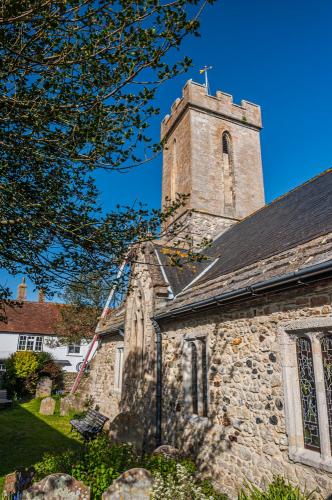
The top stage of the tower was added in 1831 at the expense of Daniel Alexander, partly as a memorial to Alexander's son and partly as an aid to mariners. The church was heavily remodelled in 1832-33 and restored twice more during the 19th century.
The church consists of an aisled nave, chancel, and west tower. South of the chancel is the Holmes Chapel, home to memorials to generations of the Holmes family. The pulpit dates to 1873 and is carved from Caen stone, as is the font, which dates to the same period.
The Holmes Memorial
Perhaps the most important figure in Yarmouth's history is Sir Robert Holmes (1622-1692). Holmes was a successful naval commander and adventurer. He was also close to King Charles II and the king is known to have stayed with Holmes on two visits to Yarmouth.
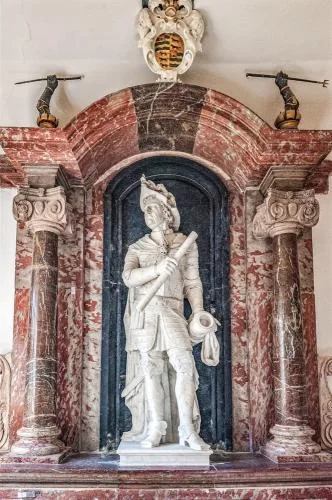
In the Holmes Chapel stands an extraordinary life-sized sculpture of Sir Robert Holmes, though the story of how the sculpture came to be here is even more extraordinary than the sculpture itself.
According to tradition, the sculpture was made as a likeness of King Louis XIIV of France. The sculptor had completed the body and was waiting until he arrived in France and could view his subject in person to complete the head, but the ship conveying the sculpture and its sculptor to France was captured by Holmes.
When Holmes learned that the sculpture was intended for the King of France, he commanded the sculptor to finish the carving but substitute his own head for the king's.
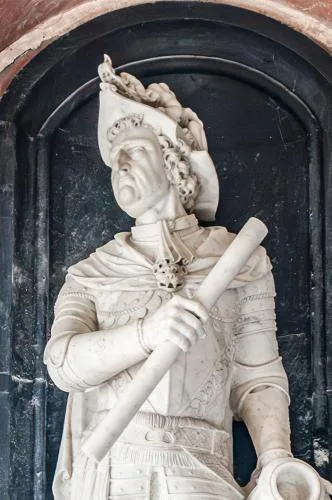
At least, that's the traditional version of the story.
Some historians think that the sculpture's head looks unlike other portraits of Holmes and very much like other likenesses of King Louis, so it is entirely possible that Holmes simply used a captured statue for his own memorial.
Other historians suggest that the statue is nowhere near grand enough for a monarch of France and, therefore, the whole legend is fabricated.
The verbose epitaph is in Latin, but there is a handy information plaque beside the monument that gives the translation (I have expanded the epitaph into distinct paragraphs for readability):
Robert Holmes, Knight
The third son of Henry Holmes, Gentleman, of Mallow in the County of Cork in Ireland being from his early youth determined on winning fame by [feats of] arms enlisted for military service, and under the standards of his most serene [Majesty] King Charles [I] he fought bravely and successfully against [his country's] enemies.
Then with equal spirit and equal success he involved himself in naval encounters and served with distinction under the auspices of the most noble Prince Rupert. But when he saw that the Royal cause could not be defended further with arms, he offered his services to foreign princes, and after successfully campaigning in France, Germany and Flanders he became famous.
[When] at length King Charles II had been happily and properly restored he received from him the office of Governor of the castle of Sandown on the Isle of Wight [as a reward for his former service] and thereupon in the year 1666 he was honoured with the title of Knight.
Having been appointed to one of the two commanders of naval forces which were identified by red banners [Admirals of the Red] he entered the Dutch port of Vlie with a small squadron, and when he had burned a hundred and eighty ships there he made an attack on Terschelling and destroyed with fire [Branderium?] the principle town of that Island.
Because of these and many other splendid feats of arms his most serene Majesty honoured him with not undeserved rewards for his courage and loyalty, and appointed him as Captain and Governor of the Isle of Wight for the rest of his natural life.
Indeed [?] instructed that he should add the lion of England to his armorial bearings, and that his coat of arms should also have the crest of a naval crown and bear a trident.
This very gallant man guarded these honours with the same zeal as he had obtained them, indeed very well deserved, and with always faithful devotion to his monarchs and his country. He died on November 18th in the year of Our Lord 1692.
This memorial tablet to his most distinguished uncle, buried below, was set up by Henry Holmes, Gentleman, holding the position of Governor of the Isle of Wight by royal authority.
Despite the effusive epitaph, what really happened is that Holmes bought the governorship of the Isle of Wight from a cash-strapped king. This post gave him the right to claim 2/3 of all wreckage from shipwrecked vessels and the booty of any foreign vessels captured in waters of Wight's shores. As a result, Holmes grew enormously wealthy.

To give Holmes his due, he strengthened Yarmouth Castle and the defences at Sandown and Cowes. His grandson, also named Robert, erected the statue we see today. He also established charities to aid the poor and assist apprentices on the island.
Historical Highlights
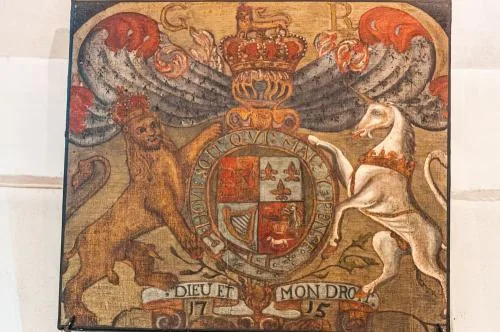
In the north aisle is a painted royal coat of arms to King George I, dated 1715. Set into the floor are several 17th-century ledger slabs and on the wall is a poignant memorial to Henry Holmes, who died in 1751 at just five years old. An epitaph to Henry's father, Thomas Holmes (d. 1764) has been appended to the base of the memorial.
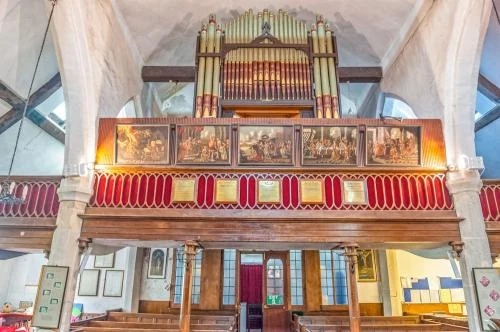
In the south aisle is a memorial to Daniel Alexander, his wife, and two sons. In the west gallery is a striking 19th-century organ crafted by Henry Speechly & Son of London.
Look for the wall bracket next to the pulpit; though the hourglass it holds is Victorian, the bracket itself dates to 1625. On the walls are funeral hatchments to the Rushwork and Holmes families. On the south wall is a monument by Joseph Nollekens in memory of Captain John Urry (d. 1802).
Visiting
The church stands at the northern end of St James Street, a very short stroll from the ferry terminal and the castle. The church is usually open to visitors and was open when we visited.
About Yarmouth, St James Church
Address: St James's Street, Yarmouth, Isle of Wight, England, PO41 0NP
Attraction Type: Historic Church
Location: At the northern end of St James's Street. Parking in the town centre.
Website: Yarmouth, St James Church
Location map
OS: SZ355897
Photo Credit: David Ross and Britain Express
POPULAR POSTS
NEARBY HISTORIC ATTRACTIONS
Heritage Rated from 1- 5 (low to exceptional) on historic interest
Yarmouth Castle - 0 miles (Castle) 
Freshwater, All Saints Church - 1.6 miles (Historic Church) 
Farringford - 1.8 miles (Historic House)
Hurst Castle - 2.3 miles (Castle)
Freshwater Bay, St Agnes Church - 2.4 miles (Historic Church) 
Shalfleet, St Michael the Archangel Church - 3.7 miles (Historic Church)
The Needles Park - 3.9 miles (Family Attraction)
Brook, St Mary's Church - 4.1 miles (Historic Church)
Nearest Holiday Cottages to Yarmouth, St James Church: