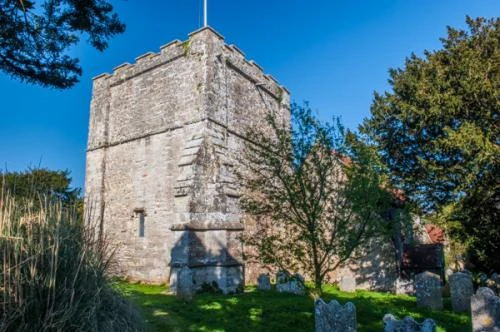
In the words of the Shalfleet parish council, the ancient Church of St Michael the Archangel 'breathes history'. They are right.
History
There was almost certainly a church here in the Saxon period, for skeletons dating to the late 7th century were discovered in the burial ground and in the garden of the Old Vicarage.
The current building was erected in the immediate aftermath of the Norman Conquest, sometime between 1070 and 1086. It may have been built by the Norman lord William FitzOsbern (d. 1071) or his son, Roger de Breteuil. It was certainly in existence at the time of the Domesday Book in 1086.
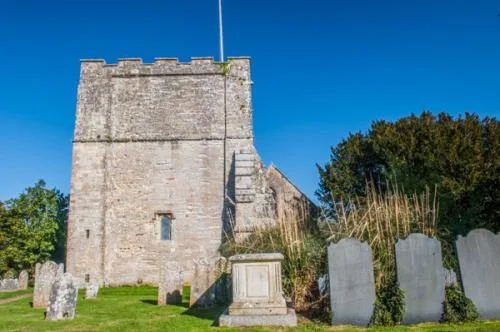
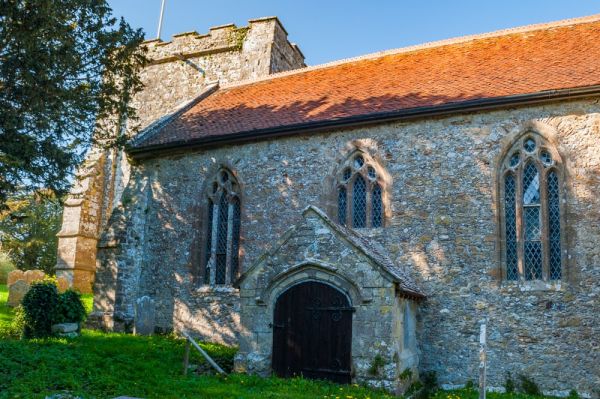
The oldest part of the church is the dominant west tower, which looks more like a castle keep than a church tower, with thick walls and a crenelated parapet. One theory suggests that the tower began as a local stronghold and the church was later built onto it. The military structure of the tower would certainly support this theory.
Not only does the tower look the part of a military structure; it has acted the part, too. For several centuries a three-pounder gun was kept in the tower as a measure against foreign invasion, and was only removed in 1779.
Aside from the tower, the oldest parts of the present church are the base of the north nave wall and the north doorway.
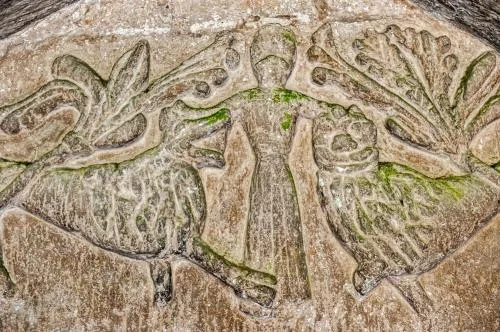
The Medieval Tympanum
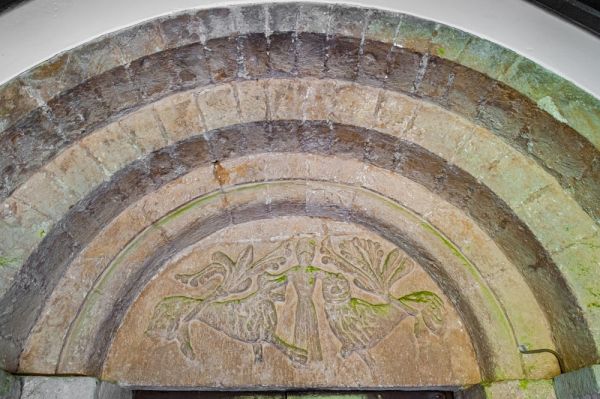
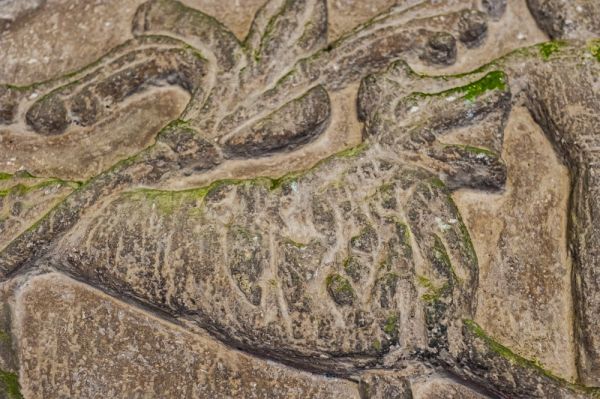
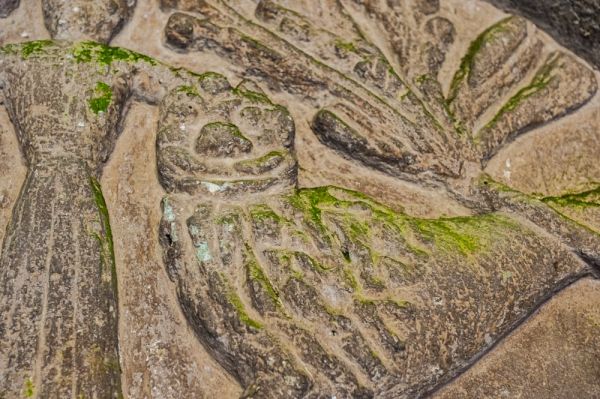
Ah, the doorway. It is why most people come to Shalfleet Church, for it boasts an exceptional 12th-century carved tympanum over the door. Exceptional, yes, but no one knows quite what to make of it! The carving appears to show a bearded man with his hands on the heads of two lions, but how to interpret the symbolism is a matter of constant debate.
Historians have put forward at least five theories that I am aware of to explain the carving. These are, in no particular order:
- Daniel in the Lion's Den
- St Mark with lions
- David defeating the lion and the bear
- The tree of Life
- Adam naming the Animals
As for the body of the church, the south aisle was inserted in 1270 and supported on Purbeck marble pillars. The south aisle may have been built under the patronage of Isabella de Fortibus, who served as Lord of the island from 1283-1293.
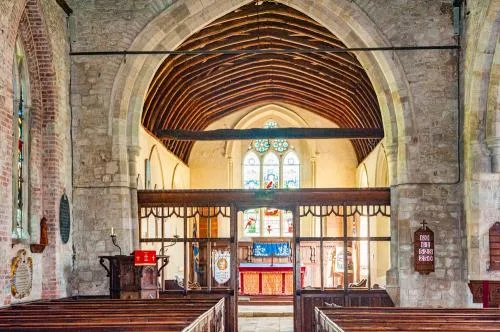
The church was extended with the present chancel around 1290. The buttresses supporting the tower are a product of the 14th century and the south porch was added in the following century. The church did not gain a north porch until 1754, and a shingled steeple was added to the tower in 1800.
The cost of the new steeple seems to have been borne by the parishioners selling church bells, for a traditional local rhyme remembers the event like this:
Shalfleet poor and simple people
Sold their bells to build a steeple
Unfortunately, no one thought to strengthen the tower when the steeple was installed, and the steeple's weight caused instability, forcing the residents to remove the steeple in 1912.
Historical Highlights
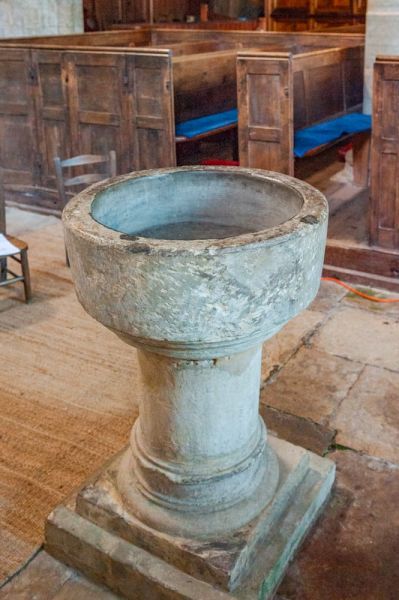
The circular font dates to the Tudor period, while the oak pulpit is Jacobean. The altar rails date to the Georgian period and an Elizabethan communion table is incorporated into the reredos behind the high altar. The panelling is an amalgamation of woodwork from St Nicholas Chapel at Carisbrooke Castle, Arreton Church, and HMS Nettle.
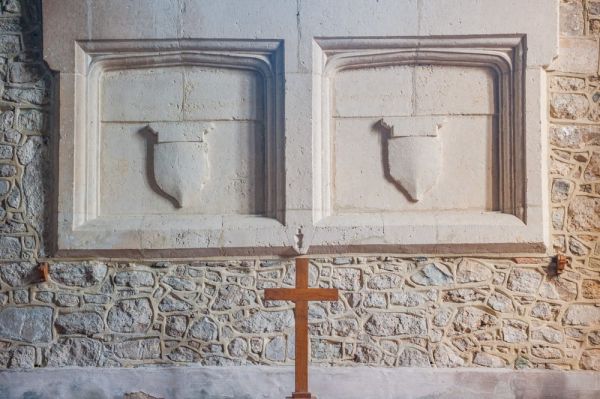
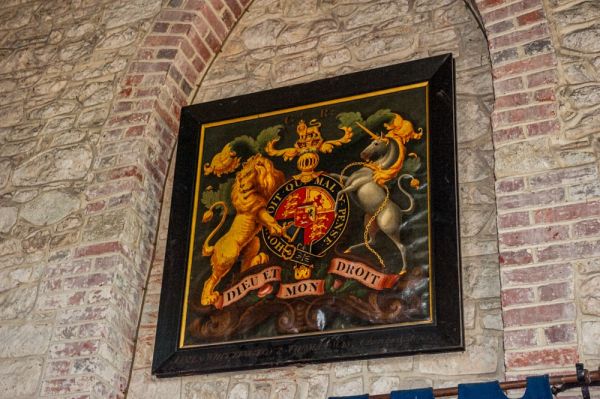
The box pews in the nave date to the 18th century. In the chancel is a 14th-century piscina set into the south wall, near the altar. On the wall is a painted royal coat of arms from the reign of George I.
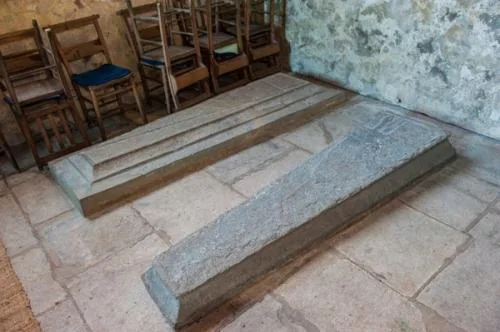
Two grave slabs lie on the floor at the western end of the south aisle. The oldest of the grave slabs dates to the 13th century and is thought to have been made for a member of the Trenchard family, lords of the manor.

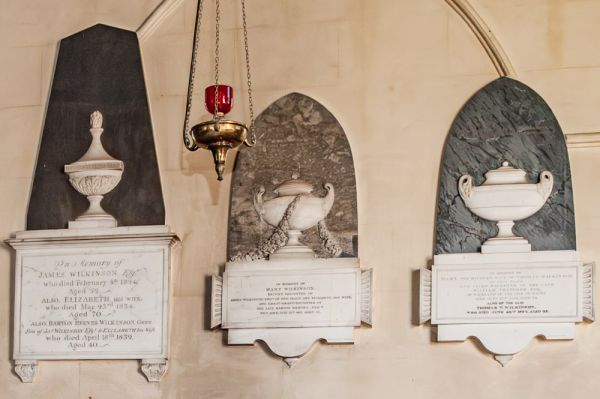
On the east wall is a tablet to an unknown person, possibly a member of the Worsley family, dated to 1630. More mural tablets to members of the Wilkinson family of Parsonage Farm decorate the chancel.
Visiting
St Michael's Church is on Church Lane, off the A3054. The church is usually open during daylight hours and was open when we visited. We could not find a dedicated car park, but there is parking at the village hall and in a lay-by outside the churchyard gate.
The tower is usually open annually on the August Bank Holiday weekend, when the village fete is held.
More Photos
About Shalfleet, St Michael the Archangel Church
Address: 1 Church Lane, Shalfleet, Isle of Wight, England, PO30 4NF
Attraction Type: Historic Church
Location: On Church Lane. Parking in a lay-by outside the churchyard gate, along nearby lanes, or at the village hall on Church Lane.
Website: Shalfleet, St Michael the Archangel Church
Location map
OS: SZ414892
Photo Credit: David Ross and Britain Express
HERITAGE
 We've 'tagged' this attraction information to help you find related historic attractions
and learn more about major time periods mentioned.
We've 'tagged' this attraction information to help you find related historic attractions
and learn more about major time periods mentioned.
Historic Time Periods:
Find other attractions tagged with:
12th century (Time Period) - 13th century (Time Period) - 18th century (Time Period) - Georgian (Time Period) - Norman (Architecture)
NEARBY HISTORIC ATTRACTIONS
Heritage Rated from 1- 5 (low to exceptional) on historic interest
Newtown Old Town Hall - 1.1 miles (Historic Building) 
Calbourne, All Saints Church - 1.8 miles (Historic Church)
Long Stone Neolithic Burial Mound - 3.1 miles (Prehistoric Site)
Castle Hill (Mottistone) Hillfort - 3.2 miles (Prehistoric Site) 
Brook, St Mary's Church - 3.2 miles (Historic Church)
Mottistone Manor Garden - 3.4 miles (Garden)
Mottistone, St Peter & St Paul Church - 3.5 miles (Historic Church)
Yarmouth, St James Church - 3.7 miles (Historic Church)
Nearest Holiday Cottages to Shalfleet, St Michael the Archangel Church:
Freshwater, Isle of Wight
Sleeps: 8
Stay from:£1,260 - £8,187
More self catering near Shalfleet, St Michael the Archangel Church