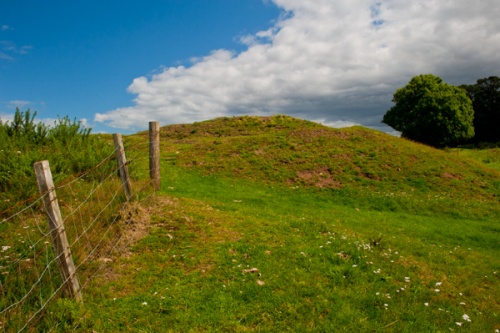
Historic Envirnoment Scotland, who look after Chesters Hill Fort, call it an Iron Age fort. That may be slightly misleading, for the site is quite different from the usual sort of hill fort.
For a start, the hilltop earthworks are overlooked by a nearby hill, making it a very poor location for a defensive fort. It would have been very easy for anyone occupying the higher hill to launch volleys of slingshot stone down upon the inhabitants of Chesters.
Village or Fort?
That is one of the main reasons to think that Chesters was not intended as a defensive hill fort but as a permanent village.
If so, it was a village that had little need for defence. Why would that be? Well, the best theory is that the site was occupied during the Roman period, by the Votadini, a tribe friendly to the Romans. With the might of Rome behind them, perhaps the inhabitants of Chesters felt no need for an elaborate set of defences. Perhaps, instead, Chesters was intended to make a 'statement', an expression of status.
Elaborate Earthworks
Whatever the reason for the peculiar location, the earthwork approaches to the settlement are quite elaborate, with a system of overlapping ditches and banks on each elongated end of a low hill. Within the earthworks is evidence of wooden buildings, belonging to two distinct phases of occupation. Some of the later wooden buildings overlay the earthen ramparts.
There are several other Iron Age enclosures in the area and it seems possible they were part of an agricultural system of subdivided plots.
The earthworks are quite worn by erosion and the passage of time. I couldn't say that Chesters is the most impressive Iron Age site I've ever visited, but it is quite interesting to speculate as to the reasons behind the peculiar location chosen for the village!
Visiting
Reaching Chesters is fairly easy; it is located up a narrow lane off the minor road that links the B1377 and the B1343, about a mile west of Drem. There is a small parking area at the end of the lane, then a very short uphill walk to the site.
More Photos
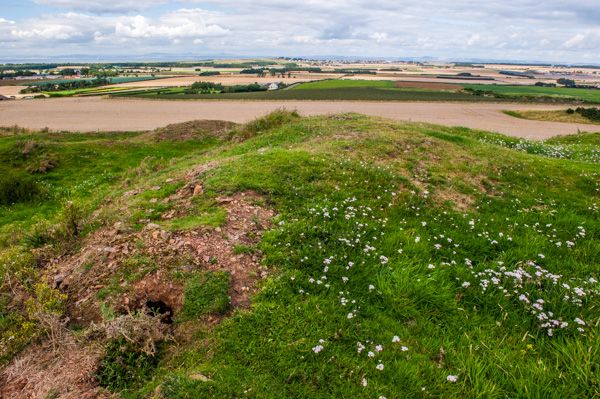
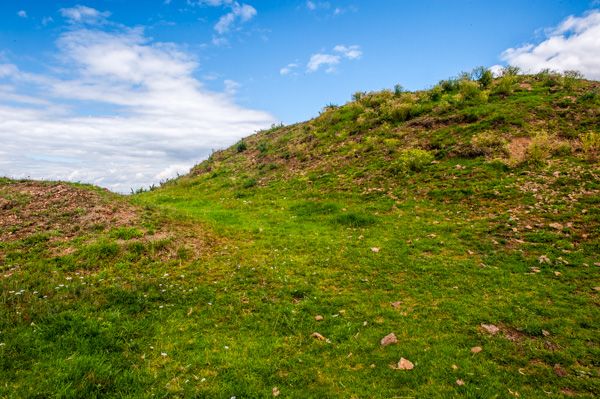

About Chesters Hill Fort
Address: Drem, Lothian, Scotland
Attraction Type: Prehistoric Site
Location: 1 m (1.6 km) S Drem, on the B1377
Website: Chesters Hill Fort
Historic Scotland
Location map
OS: NT507 782
Photo Credit: David Ross and Britain Express
Opening Details: Open access site, usually accessible at any reasonable time
POPULAR POSTS
HERITAGE
 We've 'tagged' this attraction information to help you find related historic attractions
and learn more about major time periods mentioned.
We've 'tagged' this attraction information to help you find related historic attractions
and learn more about major time periods mentioned.
Historic Time Periods:
Find other attractions tagged with:
hill fort (Historical Reference) - Iron Age (Architecture) - Roman (Time Period)
NEARBY HISTORIC ATTRACTIONS
Heritage Rated from 1- 5 (low to exceptional) on historic interest
National Flag Heritage Centre - 1.7 miles (Museum) 
Haddington, St Mary's Church - 2.6 miles (Historic Church)
National Museum of Flight - 2.6 miles (Museum) 
Lauderdale Aisle - 2.9 miles (Historic Church) 
St Martins Kirk, Haddington - 3 miles (Historic Church)
Gosford House - 3.2 miles (Historic House)
Dirleton Castle - 3.6 miles (Castle)
Lennoxlove - 3.8 miles (Historic House)
Nearest Holiday Cottages to Chesters Hill Fort:

Cockenzie and Port Seton, Lothian
Sleeps: 6
Stay from:£475 - £1,624