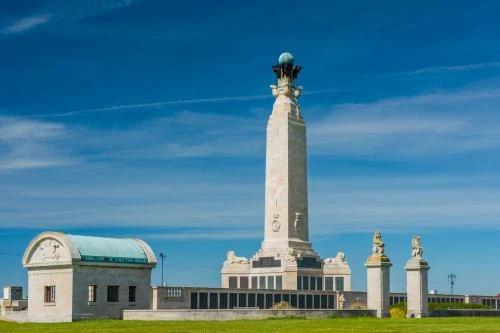
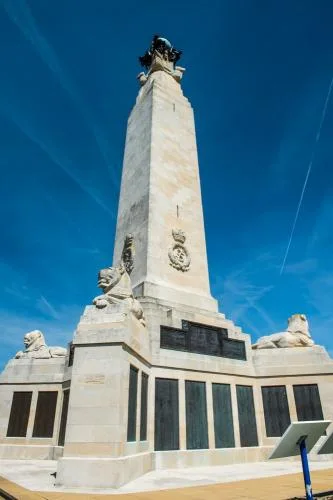
The Royal Naval War Memorial stands on Southsea Common, between Southsea Castle and the historic city core of Portsmouth. The memorial commemorates nearly 25,000 members of the Royal Navy who were lost or buried at sea during World War One and World War Two.
History
In the aftermath of WWI, the Admiralty decided that it needed a way to commemorate those members of the Royal Navy who had no other memorial but the sea. These memorials were built and maintained by the Imperial War Graves Commission (now known as the Commonwealth War Graves Commission).
Memorials were erected at the manning ports of Chatham, Plymouth, and Portsmouth, with the mandate that each of the three memorials should follow the same format; an obelisk that might also serve as a landmark to shipping.
The three naval memorials were designed by Sir Robert Lorimer, with the sculptured decoration executed by Henry Poole, who was then the Master of the Royal Academy’s Sculpture School. Although primarily known for his work on historic houses and castles, Lorimer also designed the Scottish National War Memorial at Edinburgh Castle.
The Portsmouth memorial was unveiled to the public by the Duke of York (later to become King George VI) in 1924. The design of the new memorials was inspired by columns erected to celebrate Roman naval victories.
The Design
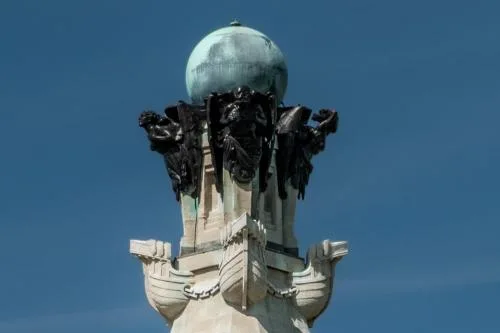
Lorimer's design consists of a slender obelisk topped by a copper globe. Beneath the globe are four sculptures depicting the prows of ships that project from the stone column. The obelisk stands on a stepped base, with buttresses extending out from the base at the corners.
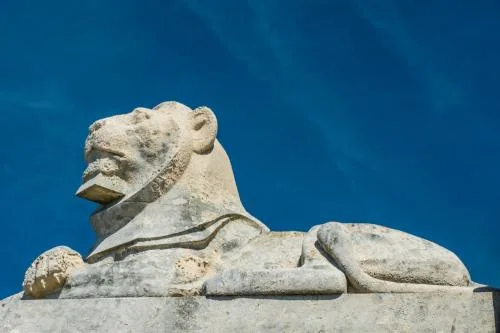
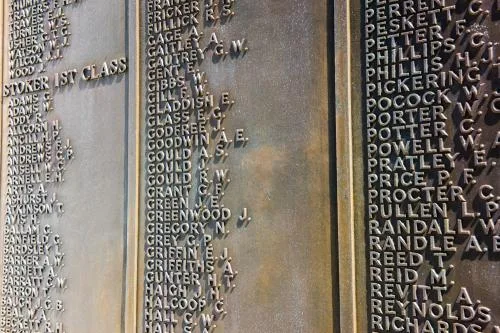
These buttresses, in the form of thick stone walls, hold bronze plaques with the names of the dead and the action during which they fell. Atop each wall is a sculpture of a crouching lion.
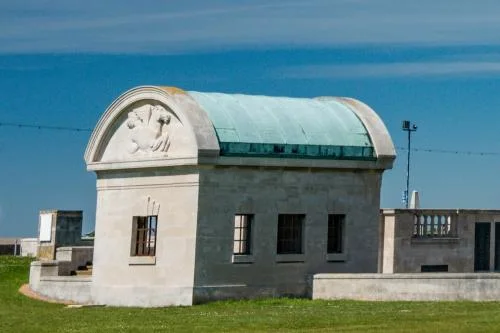
Following WWII, an extension to the memorial was added to include members of the Royal Navy who had no other memorial. This extension takes the form of a sunken garden with a pair of small pavilions buildings linked by a low stone wall.
On the wall are bronze plaques carrying the names of the fallen. On the centre of the wall, their backs to the obelisk, are life-sized sculptures of two men, one a member of the maritime regiment of the Royal Artillery and the other a Royal Marine.
This WWII extension was designed by Sir Edward Maufe, who is perhaps better known for the Air Forces memorial at Runnymede. The extension was unveiled by Queen Elizabeth, the Queen Mother in 1953.
The original memorial and the extension are built of Portland stone ashlar.
How Many Personnel are Commemorated?
In researching this article I found that different sources list differing totals for the number of Royal Navy personnel commemorated by the memorial. When I visited, I somehow neglected to count each name, so I can't verify any total.
Every source agrees that there are just under 10,000 names recorded from WWI and under 15,000 for WWII, but the exact numbers aren't clear. One reputable source lists the totals as 9,666 from WWI and 14,922 from WWII, for a total of 24,588.
I found the Royal Naval Memorial very moving. To see the vast number of names listed, row upon row, brings home in poignant terms the devastating human cost of war.
There are numerous other naval memorials stretched along Clarence Esplanade, including individual memorials to the personnel of the HMS Aboukir, HMS Trident, HMS Chesapeake, and HMS Shannon, as well as a Crimean war memorial and Battle of Trafalgar memorial.
Visiting
The Royal Naval Memorial stands in the western section of Southsea Common, between Serpentine Way and the ferry terminal. There is parking along Clarence Esplanade, directly in front of the memorial. It is an easy stroll away from Southsea Castle and from the D-Day Museum. The memorial is an open site, accessible at any time.
About Royal Naval War Memorial
Address: Clarence Esplanade, Southsea Common, Portsmouth, Hampshire, England, PO5 3SB
Attraction Type: Historic Building - Monument
Location: On Southsea Common, off Clarence Esplanade. Parking along the Esplanade.
Website: Royal Naval War Memorial
Location map
OS: SZ639985
Photo Credit: David Ross and Britain Express
POPULAR POSTS
HERITAGE
 We've 'tagged' this attraction information to help you find related historic attractions
and learn more about major time periods mentioned.
We've 'tagged' this attraction information to help you find related historic attractions
and learn more about major time periods mentioned.
Find other attractions tagged with:
20th century (Time Period)
NEARBY HISTORIC ATTRACTIONS
Heritage Rated from 1- 5 (low to exceptional) on historic interest
Portsmouth Trafalgar Memorial - 0 miles (Historic Building) 
Southsea Castle - 0.4 miles (Castle) 
Royal Garrison Church - 0.6 miles (Historic Church) 
Portsmouth Museum - 0.6 miles (Museum)
Portsmouth Cathedral - 0.7 miles (Cathedral)
Landport Gate - 0.8 miles (Historic Building)
King James Gate - 1 miles (Historic Building)
The Mary Rose - 1.5 miles (Museum) 
Nearest Holiday Cottages to Royal Naval War Memorial: