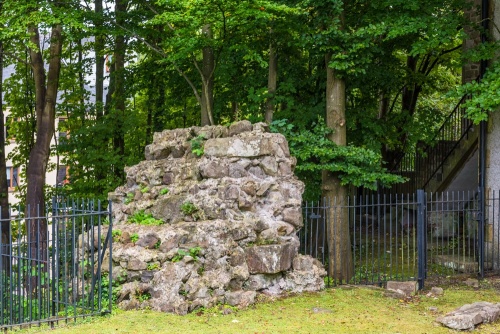
A small section of Roman wall survives on the slope below Lancaster Castle. The wall is near the rear of Mitre House and is thought to have been part of the last Roman fort on the site, erected some time in the 4th century, probably around AD 330. What we see today is the core of the wall, as all the facing stones have disappeared.
Only four meters of walling remains, up to three metres high, on a north/south alignment running along a steep bank. The wall is thought to have been part of an external bastion, connected to the main fort wall.
The first fort on this site may date to as early as AD 80, but this was rebuilt on at least six occasions over the ensuing centuries until the last fort was abandoned in the early 5th century. The final rebuilding took place in AD 367 when the fort was contracted in size as a typical Saxon Shore type of defensive enclosure encompassing 9 acres.
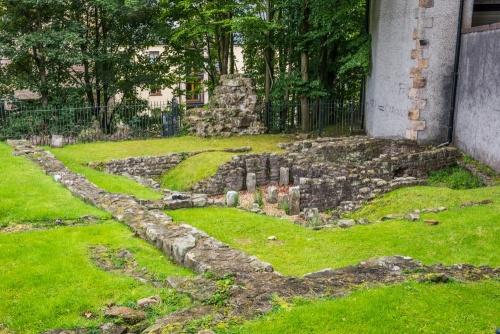
There is also an obvious earthwork rampart in Vicarage Field that follows closely the foundations of the Roman fort, but the earthwork is not, in fact, Roman. It is probably of medieval date and associated with either the castle or Lancaster Priory church.
The Bath House
Next to the wall are the foundations of a small Roman bath house, uncovered in 1973. The bath house formed part of a large courtyard house. This was thought to be the Praetorium, or official residence for the commanding officer of the 3rd-century fort.
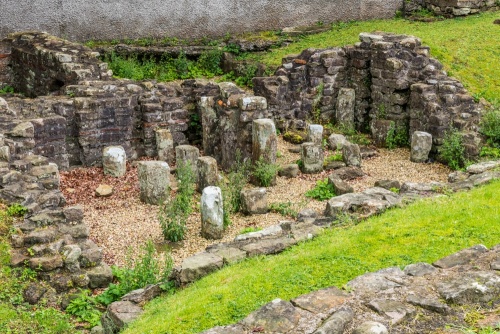
Another theory suggests that the bath house was part of a mansio, a form of hotel. Archaeologists found evidence of painted plaster that was remodelled several times, the last time around AD 330. It was around that time that the Wery Wall and ditch were erected over and through earlier chambers. Remains of another bath house have been found near Mitre House, on the hillside above.
Within the bath house foundations, you can see pilae stones used to support the stone floor above. These pilae stones allowed space for hot air to circulate, heating the stone floor.
Getting There
It is very easy to find the Wery Wall. A footpath leads from the west end of Lancaster Priory down the slope of Castle Hill towards St George's Quay. A signed trail leads off to the right into Vicarage Field where you will see the wall and bath house ahead. Good footwear is advisable in wet weather (I speak from sad experience!).
About Wery Wall and Roman Bath House
Address: Off St Georges Quay, Lancaster, Lancashire, England, LA1 1YZ
Attraction Type: Roman Site
Location: On the east slope of Castle Hill near the rear of Mitre House. The Roman bath is at Vicarage Field.
Website: Wery Wall and Roman Bath House
Email: lancastercitymuseum@lancaster.gov.uk
Location map
OS: SD473619
Photo Credit: David Ross and Britain Express
Opening Details: Open access site, usually accessible at any reasonable time
POPULAR POSTS
HERITAGE
 We've 'tagged' this attraction information to help you find related historic attractions
and learn more about major time periods mentioned.
We've 'tagged' this attraction information to help you find related historic attractions
and learn more about major time periods mentioned.
Historic Time Periods:
Find other attractions tagged with:
4th century (Time Period) - 5th century (Time Period) - castle (Architecture) - Medieval (Time Period) - Roman (Time Period) - Saxon (Time Period)
NEARBY HISTORIC ATTRACTIONS
Heritage Rated from 1- 5 (low to exceptional) on historic interest
Lancaster Priory - 0 miles (Historic Church) 
Lancaster Castle - 0 miles (Castle)
Cottage Museum - 0.1 miles (Museum) 
City Museum - 0.2 miles (Museum)
Lancaster, St John the Evangelist Church - 0.2 miles (Historic Church)
Halton, St Wilfrid's Church - 2.3 miles (Historic Church)
Gresgarth Hall Gardens - 3.7 miles (Garden)
Heysham, St Peter's Church - 3.9 miles (Historic Church)
Nearest Holiday Cottages to Wery Wall and Roman Bath House: