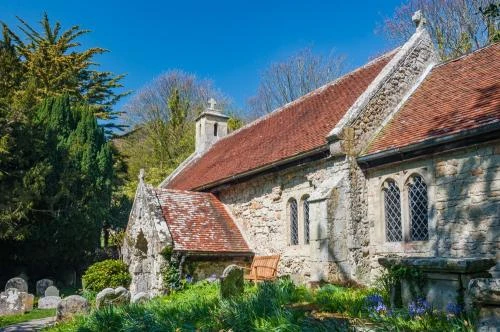
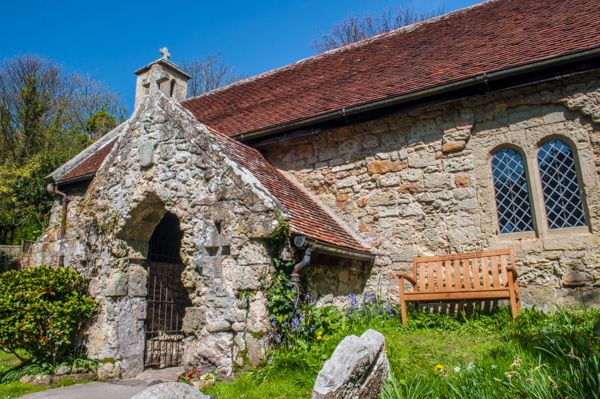
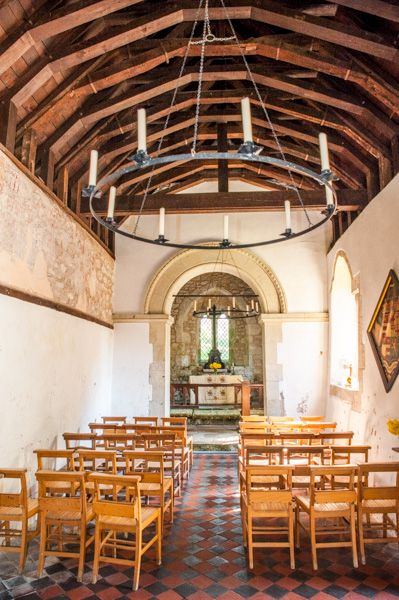
St Boniface Old Church, Bonchurch, is one of the most complete Norman churches on the Isle of Wight and an outstanding example of a small 11th-century country church.
History
There was a church here during the Saxon period, dedicated to St Boniface, who was born around AD 675 in Crediton, Devon. Not only was the church dedicated to St Boniface, it was said to have been founded by him.
According to local legend, Boniface stopped on the Isle of Wight on his missionary journey to Germany in the early 8th century. He is said to have taught the locals better fishing methods and established a church here at Bonchurch. Whether the story has any basis in fact is debatable, but its Saxon origins make this one of the oldest churches on the island.
The building we see today began around 1070 when monks from Lyra Abbey in France rebuilt the earlier Saxon church in Norman style. The monks from Lyre were sponsored by William FitzObern, the Norman Earl of Wessex and, later, Earl of Hereford.
The chancel was added in the 13th century and the porch and bellcote in the 19th century. By the early Victorian period the church was too small and decrepit for the expanding population, so a new church was built in 1848. The old church was slated to be pulled down, but it survived and services are still held here throughout the year.
In 1545 a French fleet attacked Portsmouth but were repelled. The French sailed for home, but had to put ashore on the Isle of Wight to look for water. Some of the group, commanded by the Chevalier D'Aux, were attacked by local militia, and the Chevalier was killed. He was buried in an unmarked grave in the burial ground at Bonchurch, but in 1548, when war between France and England ceased, his body was exhumed and taken home to France for reburial.
During Charles I's imprisonment at Carisbrooke Castle, he was allowed to attend the burial service for Sir Ralph Camberlayne here at Bonchurch. Also, the poet Algernon Charles Swinburne was baptised here in 1837.
What to See
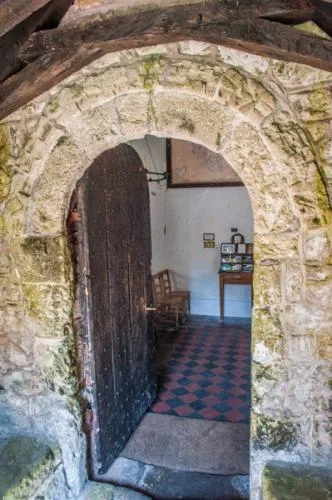
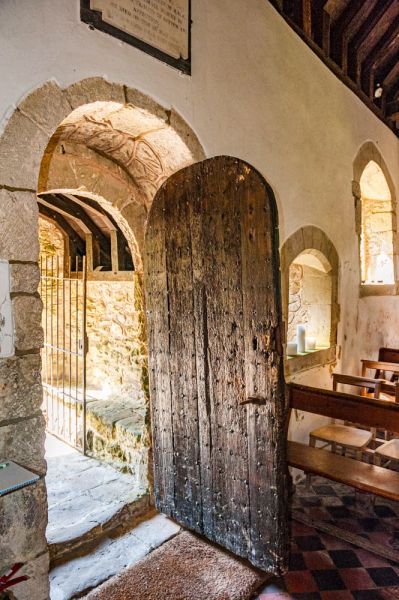
Highlights include the south doorway, which has Norman stonework. The door itself is very likely to be 17th century.
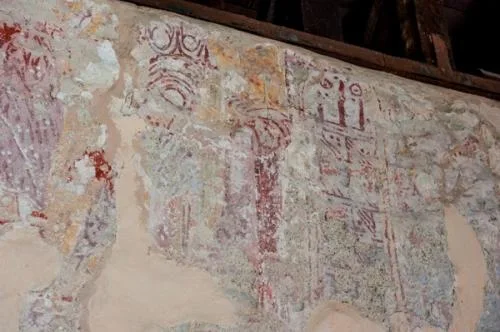
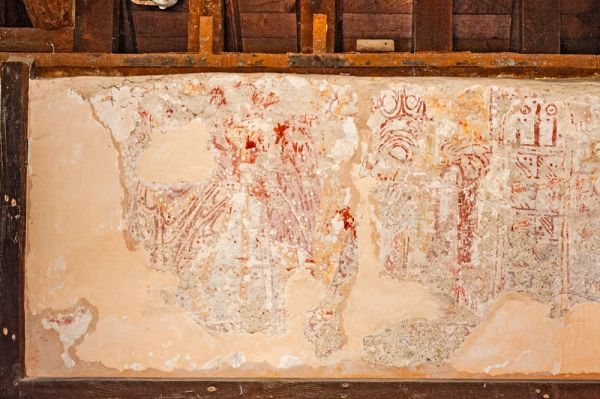
On the north wall are traces of medieval wall painting, thought to date to the first half of the 12th century . The scene has been truncated, the top edge lost when the roof level was lowered. The paintings show a pair of draped figures and a building that may represent a tower. The meaning is unclear; it has been variously interpreted as the Last Supper or, alternatively, St Christopher and the Christ Child.
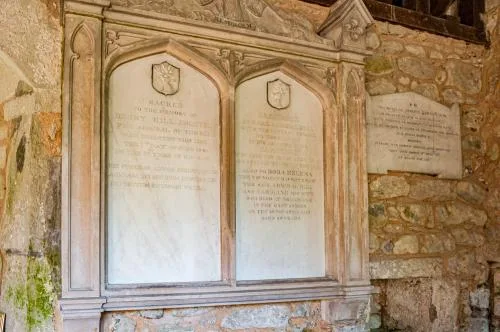
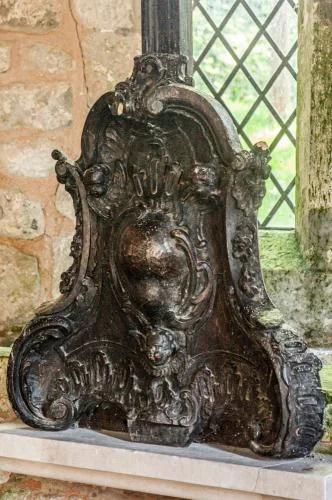
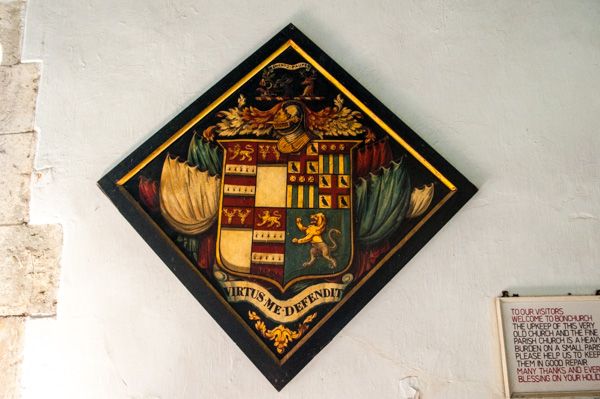
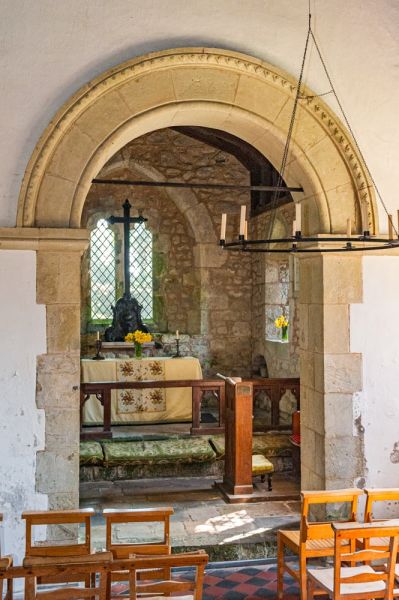
The altar cross dates to the 17th century and is carved in Flemish style. The altar rails are made from timbers salvaged during roof repairs in the early 20th century. On the south wall is a funerary hatchment to a member of a Hill family.
Remembered in a wall plaque is Henry Hill, Vice Admiral of the Red, who died in 1849.
Buried at Bonchurch is Charles Wilcox, Lewis Carroll's godson, who came here to convalesce after contracting tuberculosis. Also buried here is Reverend Frederick Hamilton, who fought at the Battle of Waterloo.
Look also for a memorial in honour of Sir James Douglass, famous for designing some of Britain's most important lighthouses. Douglass was buried here in 1898 but later disinterred and reburied alongside his wife at St Petrox Church in Dartmouth.
This is a delightful little church with an ancient history, full of interest.
Visiting
Bonchurch Old Church stands at the very end of Bonchurch Village Road. Do not mistake it for the Victorian parish church, a few hundred yards away on Bonchurch Shute! There is parking outside the church, which was open when we visited. As far as we can determine, it is normally open to visitors.
More Photos
About Bonchurch Old Church
Address: Bonchurch Village Road, Bonchurch, Isle of Wight, England, PO38 1RQ
Attraction Type: Historic Church
Location: At the end of Bonchurch Village Road. Parking outside the churchyard.
Website: Bonchurch Old Church
Location map
OS: SZ57780
Photo Credit: David Ross and Britain Express
POPULAR POSTS
HERITAGE
 We've 'tagged' this attraction information to help you find related historic attractions
and learn more about major time periods mentioned.
We've 'tagged' this attraction information to help you find related historic attractions
and learn more about major time periods mentioned.
Historic Time Periods:
Find other attractions tagged with:
11th century (Time Period) - 13th century (Time Period) - 17th century (Time Period) - 19th century (Time Period) - 7th century (Time Period) - Norman (Architecture) - Saxon (Time Period)
NEARBY HISTORIC ATTRACTIONS
Heritage Rated from 1- 5 (low to exceptional) on historic interest
Shanklin, St Blasius Church - 1.6 miles (Historic Church) 
Ventnor Botanic Garden - 2.1 miles (Garden) 
St Lawrence Church - 2.7 miles (Historic Church)
Appuldurcombe House - 2.7 miles (Historic House)
St Lawrence Old Church - 2.7 miles (Historic Church)
Godshill, All Saints Church - 3.9 miles (Historic Church) 
Niton, St John the Baptist Church - 4.6 miles (Historic Church)
St Catherine's Oratory - 5.2 miles (Historic Building)
Nearest Holiday Cottages to Bonchurch Old Church: