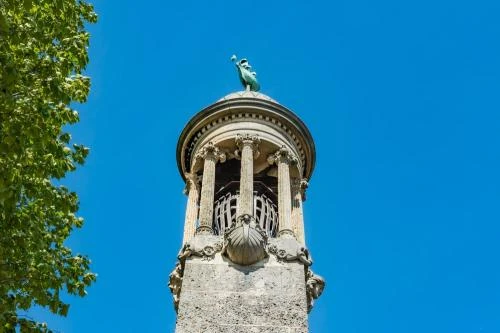
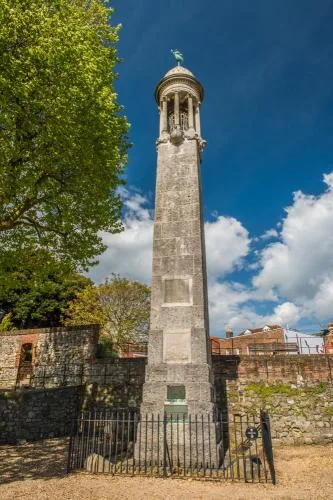
On 15 August 1620, the Speedwell and the Mayflower set sail from Southampton Quay on their voyage to America, a voyage that would end with the establishment of Plymouth Colony. A slender stone memorial on Town Quay celebrates the voyage of the Pilgrim Fathers and their historical ties to the city of Southampton.
History
The voyage of the Speedwell can be said, with some poetic licence, to have begun in Babworth, Nottinghamshire. In 1606 a congregation of Puritans from Babworth moved to Scrooby in Lincolnshire, only to move on to Amsterdam in 1608 and to Leyden in 1609.
On 1 August 1620 ,they boarded the Speedwell and sailed to Southampton where they met a similar congregation of Puritans from London aboard the Mayflower.
On 15 August, the two ships sailed from Southampton, but they were quickly forced to seek shelter in Dartmouth for repairs. Once more they set out and once more they had to put into harbour, this time in Plymouth.
It was obvious by this point that the Speedwell was not up to the demands of an Atlantic crossing, so the Speedwell was abandoned and all the prospective colonists packed onto the Mayflower. One hundred and two colonists sailed to America from Plymouth on 16 September, where they found a deserted native American village which they occupied and renamed as Plymouth Colony.
The establishment of Plymouth Colony was one of the most important moments in the beginnings of the United States of America as we know it today.

The Memorial
The Pilgrim Fathers' Memorial was erected in 1913 and was designed by RM Lucas and executed by the firm of Garret and Haysom. It was unveiled in an official ceremony attended by the US Ambassador, Dr William H Page, and the Bishop of Winchester.
The memorial was the brainchild of historian and author Fossey Hearnshaw and was funded by donations from members of the public in both the USA and Great Britain at a cost of £600.
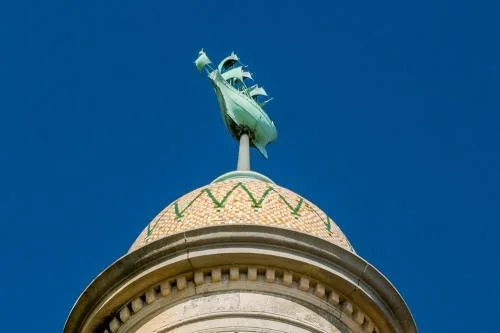
The memorial consists of a four-sided column of Portland stone that rises up through five tiers to a domed cupola supported on eight Ionic columns. On top of the cupola is a copper weathervane symbolising the Mayflower. From top to bottom the memorial stands 50 feet high (roughly 15.2m). The cupola is beautifully decorated with white and gold glass mosaic.
Carved corbels embellish alternate columns. Three corbels are in the shape of female heads, representing Faith, Hope, and Charity. The fourth is in the shape of a ship's prow, aligned to face towards the sea.
Commemoration Plaques
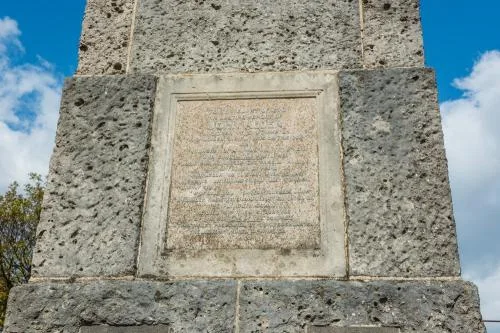
The monument initially had plaques commemorating the Pilgrim Fathers and two of the individual passengers on the Mayflower, William Brewster and John Alden. To these, other plaques were added as time went on.
One additional plaque was presented by the US Army to commemorate the two million men and women of the US Forces who sailed from Southampton between D Day and VE Day 'in order that the freedom for which the Pilgrim Fathers strove should not be lost.'
Another plaque commemorates the visit in 1955 of 104 members of the General Society of Mayflower Descendants Society.
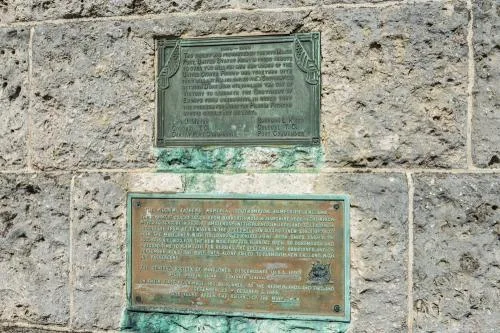
A more recent plaque was unveiled in 2020 to mark the 400th anniversary of the Mayflower voyage, but this plaque remembers a different part of the Mayflower story; the story of the Wampanoag, native Americans whose village of Patuxet, deserted after European-borne diseases decimated the native population, was occupied by the Pilgrims and renamed as Plymouth Colony.
The plaque commemorates the story of the Wampanoag in these words:
People of the Dawn
In memory of the Wampanoag of Patuxet who perished in the "Great Dying" plague of 1616 to 1619 introduced by European and English invaders.
The decimated village of Patuxet - a graveyard - was settled by the pilgrims who arrived on the Mayflower in 1620.
They renamed the village Plymouth Colony.
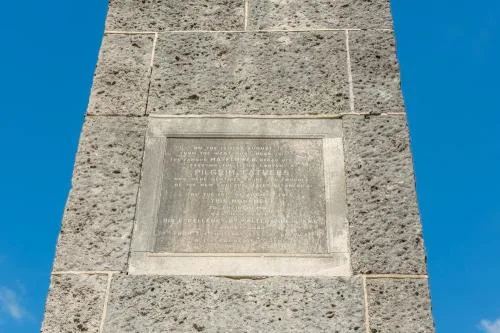
The location chosen for the Pilgrim Fathers Memorial is as close as realistically possible to the exact spot where the Mayflower and the Speedwell sailed.
Visiting
The Pilgrim Fathers Memorial stands on the east side of Town Quay, between Bugle Street and the Mayflower Roundabout, opposite Mayflower Park. There are several paid parking areas within easy walking distance. This is an open site, accessible at any time.
About Pilgrim Fathers Memorial
Address: Town Quay, Southampton, Hampshire, England, SO14 2AP
Attraction Type: Historic Building - Monument
Location: On Town Quay, between Bugle street and the Mayflower Roundabout. There are several paid parking areas within easy walking distance.
Location map
OS: SU418111
Photo Credit: David Ross and Britain Express
HERITAGE
 We've 'tagged' this attraction information to help you find related historic attractions
and learn more about major time periods mentioned.
We've 'tagged' this attraction information to help you find related historic attractions
and learn more about major time periods mentioned.
Find other attractions tagged with:
17th century (Time Period)
NEARBY HISTORIC ATTRACTIONS
Heritage Rated from 1- 5 (low to exceptional) on historic interest
Medieval Merchant's House - 0.1 miles (Historic Building) 
King John's Palace - 0.1 miles (Historic Building)
Tudor House Museum - 0.1 miles (Museum)
Southampton, Holyrood Church - 0.2 miles (Historic Church) 
Netley Abbey - 2.6 miles (Abbey)
Eling Tide Mill Experience - 3.4 miles (Historic Building)
Beaulieu - 5.6 miles (Historic House) 
Exbury Gardens and Steam Railway - 6.8 miles (Garden) 
Nearest Holiday Cottages to Pilgrim Fathers Memorial: