King John's Palace, Southampton, is a 12th-century fortified townhouse and one of the finest examples of Norman architecture in England.
But despite the name, it was never a palace and it has nothing to do with King John.
History
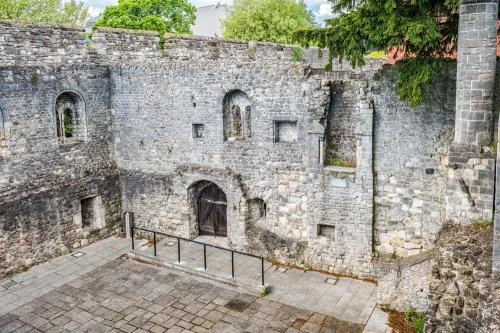
The two-storey 'palace' was begun somewhere between 1170 and 1180 by a wealthy Southampton merchant. At the time it was built, the house was on Southampton's busy quayside, though it is now well inland.
The house was a structure in two parts, with an undercroft at ground level for storing goods, and living quarters, centred around a great hall, on the first floor. The ground floor has very small windows compared to the first floor. This was by design, for the small windows made it harder for thieves to enter the building and steal goods.
We do know the name of one early owner of King John's Palace; John Wytegod, Mayor of Southampton, lived here in the early 13th century. Wytegod imported wine from France and stored it in the ground-floor storage area.
The Palace Transformed
In 1338 a devastating French raid left Southampton in flames. To counter the threat of fresh raids, Edward III ordered the city's defences to be strengthened. A stone wall was erected to encircle the city, replacing a timber-built perimeter wall. Rather than destroy the merchant's house, which stood on the line of the proposed wall, the city's engineers instead decided to incorporate the existing building into the new wall.
The city wall was built onto the western wall of the house, doors and windows facing the quay were blocked, and two circular gun ports were opened up near ground level. These were perhaps the earliest gun ports in England, made to use a very simple form of firearm known as a hand cannon.
As time went on, the 12th-century palace fell out of use, becoming little more than a crumbling curiosity behind the neighbouring Tudor House's timber-framed facade, though the stone wall remained part of the city defences.
The palace passed through several incarnations over the ensuing centuries. It served as a coach house and stable, a coal merchant's shop, tenement flats, and a private museum. The roof was removed in the early 20th century and the building was allowed to decay.
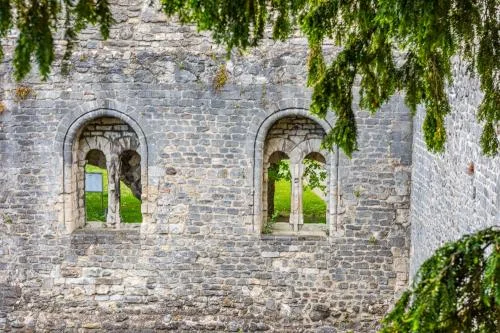
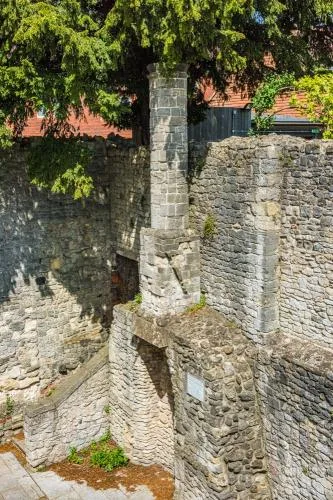
Rescue was at hand, however, and though the building remains roofless, the structure is solid, with the main walls still standing to roof height. Original 12th-century window openings can be seen on the north and west facades and three blocked archways that once led to the quay.
The Norman Chimney
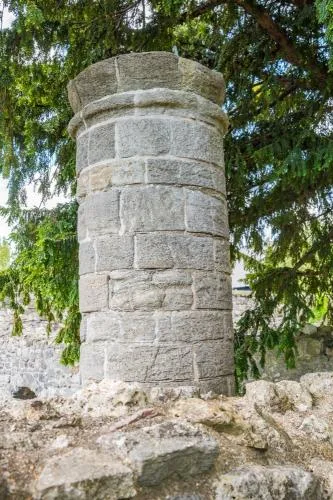
On the north wall you can still see the remains of a first-floor fireplace. Against the east wall is perhaps the most impressive feature of King John's Palace; a Norman chimney rising from ground level to above the wall.
This chimney, square at the base but round at the top, came from an ancient building on High Street and was disassembled and rebuilt within the palace walls. It is thought to date to around 1200.
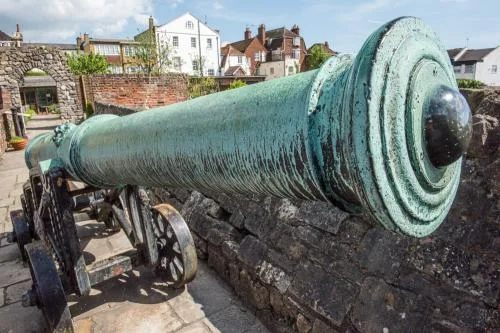
One of the best ways to see King John's Palace is from the wall walk, which lets you look down into the building. An ancient cannon sits on the wall walk, a reminder that, for much of its life, King john's Palace was an essential part of Southampton's defences.
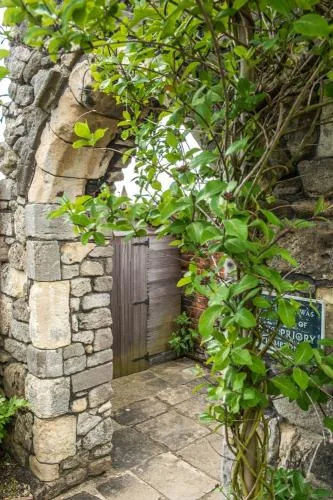
Outside the palace is a medieval archway from the Augustinian priory of St Denys, which stood near the River Itchen. The gateway is one of the rare surving priory remnants and was re-erected in the Tudor House grounds.
King John
But why the association with King John?
There seems to be no simple answer to this question, but it appears that sometime in the 18th or 19th century the story got about that King John had stayed here in the early years of the 13th century. This belief was based on little more than the impressive size of the building but the story gained traction and thereafter the house was known as King John's Palace.
Visiting
Admission to King John's Palace is through the Tudor House Museum, with the entrance on Bugle Street. It is well worth exploring the museum, and the combination of King john's Palace and the Tudor House is really two historical attractions in one.
King John's Palace is within easy walking distance of the quayside and there are numerous paid parking areas within a short stroll.
About King John's Palace
Address: Tudor House Museum, Bugle Street, Southampton, Hampshire, England, SO14 2AD
Attraction Type: Historic Building
Location: In the grounds of the Tudor House Museum, with access on Bugle Street. There are several paid parking areas within an easy walk.
Website: King John's Palace
Location map
OS: SU419113
Photo Credit: David Ross and Britain Express
HERITAGE
 We've 'tagged' this attraction information to help you find related historic attractions
and learn more about major time periods mentioned.
We've 'tagged' this attraction information to help you find related historic attractions
and learn more about major time periods mentioned.
Find other attractions tagged with:
12th century (Time Period) - 14th century (Time Period) - King John (Person)
NEARBY HISTORIC ATTRACTIONS
Heritage Rated from 1- 5 (low to exceptional) on historic interest
Tudor House Museum - 0 miles (Museum) 
Medieval Merchant's House - 0.1 miles (Historic Building)
Pilgrim Fathers Memorial - 0.1 miles (Historic Building) 
Southampton, Holyrood Church - 0.1 miles (Historic Church) 
Netley Abbey - 2.6 miles (Abbey)
Eling Tide Mill Experience - 3.4 miles (Historic Building)
Beaulieu - 5.7 miles (Historic House) 
Broadlands - 6.9 miles (Historic House)
Nearest Holiday Cottages to King John's Palace: