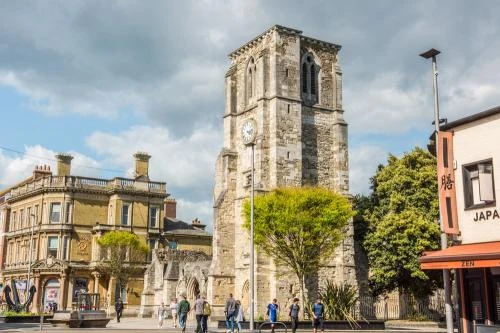
The partial ruins of Holyrood Church stand on Southampton's High Street, a reminder of a once-impressive 12th-century church that now acts as a memorial to the dead of the Merchant Navy.
History
The origins of Holyrood Church probably stretch back into the Saxon period, but the earliest record of a church here comes from 1160, when Henry II gave it, along with three other churches, to St Denys Priory.
The first church dedicated to the Holy Rood, or Holyrood, stood in the centre of High Street, then known as English Street. Unfortunately, the church's location in the centre of Southampton's busy main street made it a traffic hazard, so in 1320 the church was dismantled stone by stone and reassembled in its present location at the junction of High Street and Bernard Street.
Holyrood survived the devastating French raid in 1338, when other city churches were sacked and burned.
Southampton was the point of embarkation for ships crossing the channel, and it seems very likely that soldiers who fought at the pivotal battles of Crecy and Agincourt prayed in Holyrood Church before taking ship for France.
Holyrood's moment of the European stage came in 1554 when Prince Philip of Spain, on his way to marry Queen Mary, came ashore in Southampton. His first act after setting foot on English soil was to attend a service at Holyrood Church.
Holyrood Church also played a prominent part in local government. Until the 1770s, official proclamations were read out from the church's west porch.
The church was restored in 1848, though at the cost of a labourer's life, when an arch collapsed on him. Another fatal accident was narrowly avoided in 1862, when crowds gathered to see Lord Palmerston make his way through Southampton. Some enthusiastic onlookers climbed the church tower to get a good look at the Prime Minister and one managed to dislodge a stone ball decorating the tower's corner.
The stone fell to the ground, narrowly missing the crowds below, and smashed to pieces on the pavement. A small brass cross on the pavement marks the spot where the stone landed.
Holyrood Church was a favourite place for New Year’s Eve celebrations, but was more widely known for its links to seafaring, and the church became widely known as 'the church of the sailors'.
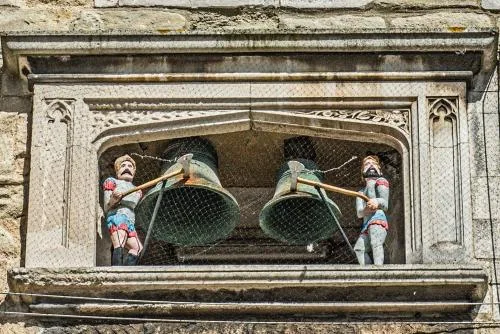
One of the most memorable features of Holyrood Church is a pair of quarterjacks set into an alcove facing onto High Street. These quarterjacks are linked to the large clock face above. These small mechanical figures strike a bell every quarter hour. We do not know how old they are, but the quarterjacks were first recorded in 1760 when they were described as ancient.
From Church to Memorial
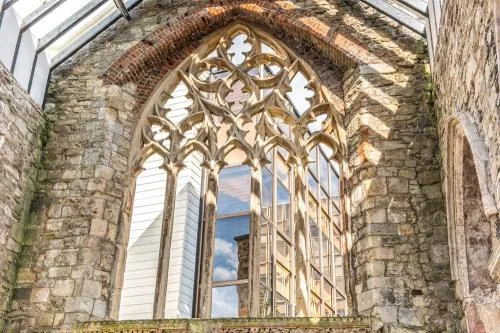
The end for historic Holyrood Church came on 30 November 1940, when German bombs left the church a smouldering ruin. Unlike other Southampton churches, however, Holyrood was not pulled down.
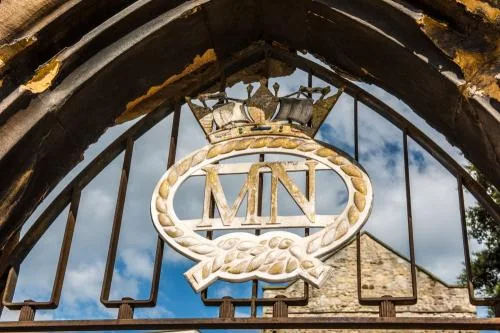
In 1949 it was decided to create a garden of remembrance within the church ruins, and to let the church itself act as a memorial to the seafarers of the Merchant Navy who lost their lives in the war.
The church, in its new form as a Merchant Navy memorial, was unveiled in 1957, with the Bishop of Southampton in attendance.
Titanic Fountain
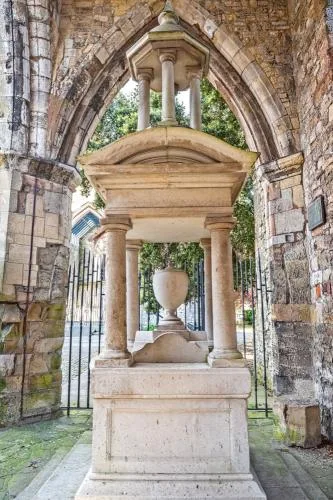
Inside the tower is a memorial to the crew of the Titanic. The memorial was created with money given by the families and friends of those who died in the famous wreck. Fully 542 men and women, residents of Southampton, died when the Titanic sunk.
The Titanic memorial takes the form of an ornate stone fountain supported by columns, with a cupola above. The fountain was moved to Holyrood from Southampton Common.
The memorial inscription reads:
This memorial fountain
was erected in memory of the crew,
stewards, sailors, and firemen
who lost their lives in the SS Titanic disaster
April 15th 1912.
It was subscribed for by the
widows, mothers, and friends of the crew.
Alderman Henry Bowyer, Mayor 1912-1913
Another memorial was erected in memory of Captain Charles Fryatt, executed by the Germans in 1916 after his merchant vessel, the SS Brussels, rammed a German U-boat.
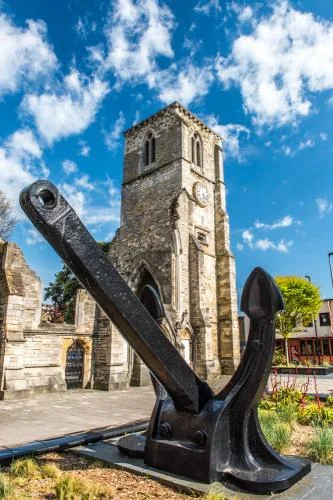
Other memorial plaques commemorate the members of the Merchant Navy who played a part in the Falklands War. Outside the church tower is an anchor from the Queen Elizabeth II. The anchor was given by Cunard in 2010 'to commemorate the long association between the city and this iconic liner.' Southampton was the QE2's home port and it was from Southampton that the liner made its maiden voyage in 1969.
1837 Fire Memorial
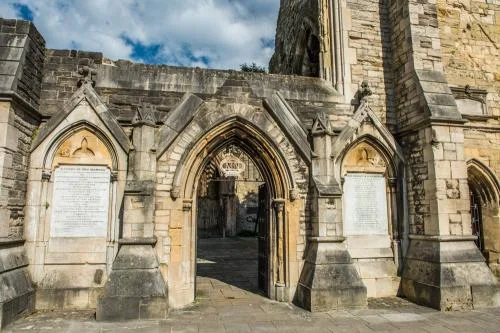
In 1837 a devastating fire tore through the historic core of Southampton. Twenty-two men and boys, the youngest just sixteen years old, died trying to put of the fire. In 1838 two tablets were installed on the front facade of Holyrood Church in their honour. One tablet lists the names of the dead while the other tells the story of their heroism in these poignant words:
Sacred to the memory
of twenty-two brave and disinterested
men
commemorated by name in a corresponding
tablet
Who in attempting to check the ravages
of a calamitous fire
In this parish
On the night of November the 7th 1837
Either perished in
the flames
Or survived but a short time
The injuries the received.
The sympathyzing public
who have
protected the widows and orphans
of those who had families,
erect this grateful but melancholy
memorial
Of their intrepidity,
Their sufferings,
And their awfully sudden removal
Into an eternal state.
Prepare to meet thy God.
The list of the dead is as follows:
Henry Ball, 21
George Bell, 16
John Budden, 21
Robert Cheater, 22
George diaper, 27
Charles Edney, 19
William Ford, 27
James Gosney, 28
Thomas Hapgood, 21
John Harley, 50
Joseph Hawkins, 39
Thomas Henwood, 32
William Jones, 26
Edward Ludford, 36
William Marshall, 25
George Maton, 21
William Oakley, 29
William Powell, 30
Richard Rose, 34
Robert Ransom, 46
Thomas Selwood, 23
Charles Tanner, 22
The only parts of Holyrood Church still standing are the tower, the east end of the chancel, and a portion of the north wall.
Visiting
The church stands at the meeting of High Street and Bernard Street. There are several pay and display car parks within easy walking distance. The church is an open site and is accessible at any time.
About Southampton, Holyrood Church
Address: High Street, Southampton, Hampshire, England, SO14 1HF
Attraction Type: Historic Church
Location: At the junction of High Street and Bernard Street. Paid parking nearby. Open site, access at any time.
Website: Southampton, Holyrood Church
Location map
OS: SU420113
Photo Credit: David Ross and Britain Express
HERITAGE
 We've 'tagged' this attraction information to help you find related historic attractions
and learn more about major time periods mentioned.
We've 'tagged' this attraction information to help you find related historic attractions
and learn more about major time periods mentioned.
Historic Time Periods:
Find other attractions tagged with:
12th century (Time Period) - 14th century (Time Period) - 16th century (Time Period) - 19th century (Time Period) - Tudor (Time Period)
NEARBY HISTORIC ATTRACTIONS
Heritage Rated from 1- 5 (low to exceptional) on historic interest
Medieval Merchant's House - 0.1 miles (Historic Building) 
Tudor House Museum - 0.1 miles (Museum)
King John's Palace - 0.1 miles (Historic Building)
Pilgrim Fathers Memorial - 0.2 miles (Historic Building) 
Netley Abbey - 2.5 miles (Abbey)
Eling Tide Mill Experience - 3.5 miles (Historic Building) 
Beaulieu - 5.7 miles (Historic House) 
Exbury Gardens and Steam Railway - 6.9 miles (Garden)
Nearest Holiday Cottages to Southampton, Holyrood Church: