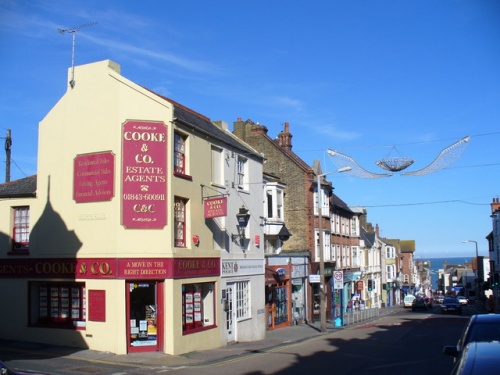
A seaside town on the Isle of Thanet, in northeastern Kent, Broadstairs was settled as early as the Roman occupation. The village was initially a fishing port, but later became prosperous a centre of shipbuilding.
History
As early as the Saxon period a shrine stood atop the cliffs overlooking the wide bay. The site was known as Bradstow, meaning a wide place. In the 14th century, a small fishing community grew up at the base of the cliffs. It was called Broadstairs after a set of steps leading up the cliffs to the shrine. From this small fishing village the modern town of Broadstairs developed.
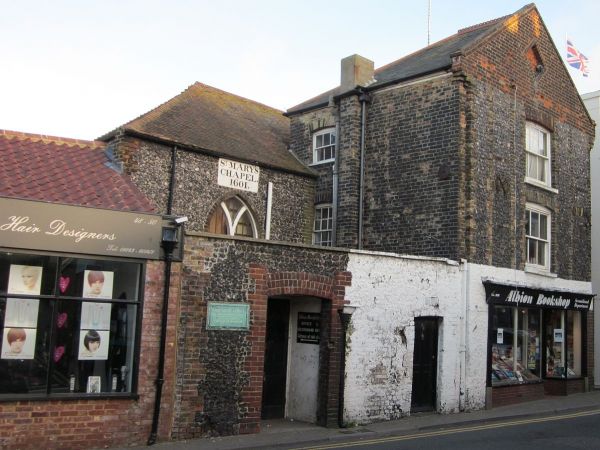
The Saxon shrine lives on the shape of St Mary's Chapel, built in 1601 on the site of the Shrine of Our Lady, Bradstowe (otherwise known as the Shrine of Our Lady Star of the Sea). The shrine was a major destination for medieval pilgrims.
When sailing past the shrine, ships would dip their topsails as a mark of respect. The shrine and chapel are the oldest buildings in Broadstairs and stand near the harbour on Albion Street, at its junction with Alexandra Road.
The 16th century York Gate was part of defences erected to protect the shipyards at Broadstairs. You can still see the wishing well on Harbour Street that was used by 18th-century smugglers to hide their illegal goods from customs officers.
The Dickens Connection
The town has strong connections with author Charles Dickens, who was a regular visitor, and there is an annual Dickens festival.
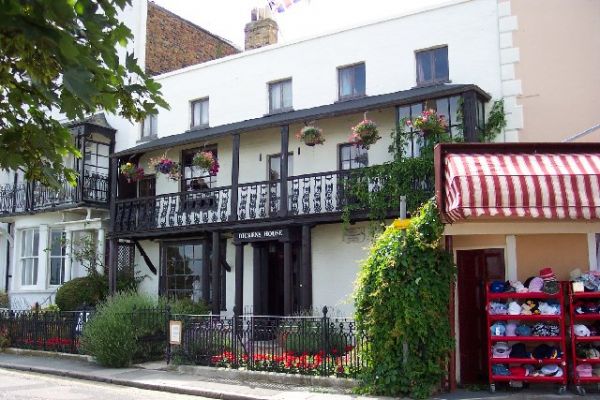
On Victoria Parade is the Dickens House Museum. Despite the name, the author did not reside here during his time in Broadstairs; it was the residence of Miss Mary Pearson Strong, used by Dickens as the model for Miss Betsey Trotwood in his novel David Copperfield. The museum traces the life and career of the writer and his strong links to Broadstairs.
Bleak House
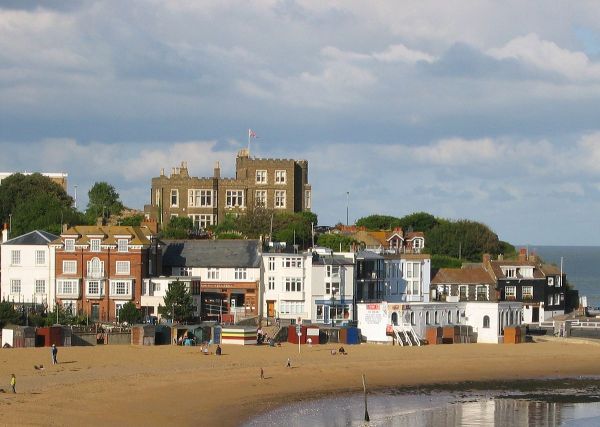
Rising above the harbour is the bulk of Bleak House, renamed because its owner believed it to be the one used by Dickens in his tale of the same name.
Whether or not it truly is the house that inspired Dickens is a matter for debate, but the owner believed it was so, so he renamed the house! It now operates as a guest house, with the added attraction of a smuggling museum and 'Dickens' Study'.
Crampton Tower Museum
Located in a flint tower beside Broadstairs rail station, this small museum looks at the life and career of Thomas Crampton, a designer of railroads, locomotives, water works, and underground telegraph cables.
It was Crampton who designed the first underwater telegraph cable across the English Channel. The tower itself served as part of the town's first water supply. One of the prize displays is an original 1860s Broadstairs stage coach.
More Photos
About Broadstairs
Address: Broadstairs, Kent, England
Attraction Type: Town
Location map
OS: TR38136896
Photo Credit: Colin Smith, licensed for reuse under the Creative Commons Licence
HERITAGE
 We've 'tagged' this attraction information to help you find related historic attractions
and learn more about major time periods mentioned.
We've 'tagged' this attraction information to help you find related historic attractions
and learn more about major time periods mentioned.
Historic Time Periods:
Find other attractions tagged with:
14th century (Time Period) - 16th century (Time Period) - 18th century (Time Period) - GE Street (Person) - Medieval (Time Period) - Roman (Time Period) - Saxon (Time Period) - St David (Person)
NEARBY HISTORIC ATTRACTIONS
Heritage Rated from 1- 5 (low to exceptional) on historic interest
Ramsgate, St Laurence in Thanet Church - 2.4 miles (Historic Church) 
St Augustine's Cross - 4 miles (Historic Building) 
Powell-Cotton Museum, Quex House and Gardens - 4.5 miles (Museum)
Minster Abbey - 5.1 miles (Abbey)
Minster-in-Thanet, St Mary the Virgin Church - 5.2 miles (Historic Church)
Richborough Roman Fort - 6.5 miles (Roman Site)
Sandwich, St Mary's Church - 7.3 miles (Historic Church)
Sandwich, St Peter's Church - 7.4 miles (Historic Church)
Nearest Holiday Cottages to Broadstairs: