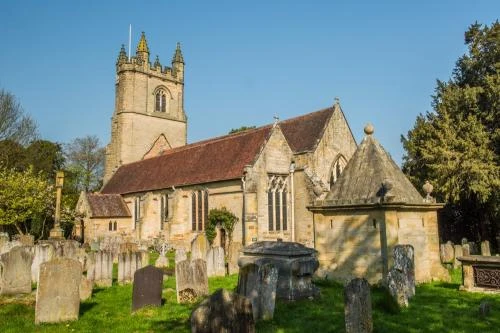
The first written record of a church in Chiddingstone comes from the early 12th century but it seems certain that there was an earlier Saxon church on the same site.
The oldest part of the present church was built in the 13th century, but much of the structure we see today was built by Sir Bartholomew Burghersh the elder, Constable of Dover Castle and Warden of the Cinque Ports, who died in 1355.
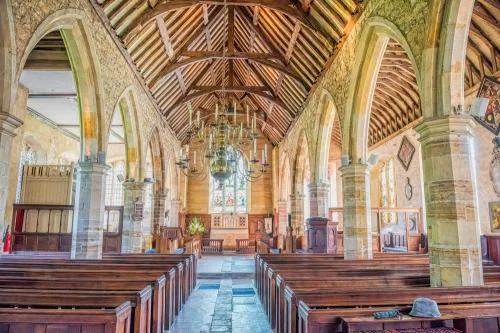
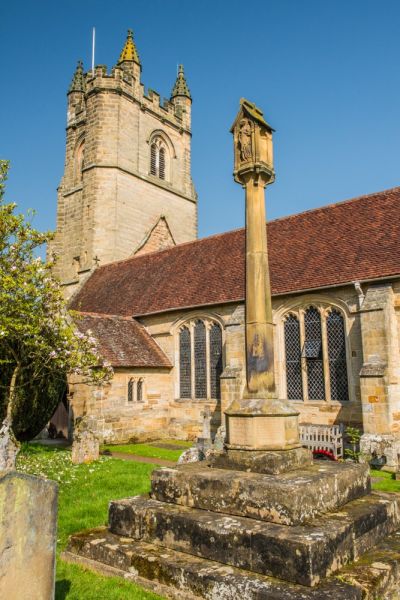
The church is constructed of local sandstone rubble under tiled roofs. The layout consists of a nave with north and south aisles, each with an eastern chapel, a chancel, south porch, and three-stage west tower incorporating a stair turret.
History
The earliest written record of a church at Chiddingstone comes from the Domesday Book of 1086, where scribes have written that in 1072, Bishop Odo, William the Conqueror's half-brother and Earl of Kent, was forced to surrender a church at Chiddingstone to the Archbishop of Canterbury.
The oldest stonework is a 13th-century triple lance window, now blocked, in the east chancel wall. North and south aisles were added in the 14th century and the west tower in the following century. Look at the string course that runs around the top of the tower and you will see a collection of grotesque carved faces.
At the east end of the north aisle is the Bore Place Chapel, built in the latter half of the 15th century. A similar chapel, dedicated to St Edward, stands at the eastern end of the south aisle.
Sir Robert Read of Bore Place enlarged the Bore Place Chapel in 1516 and paid for four chantry priests to say masses for himself and his family. The chantry was suppressed in 1547 under the Act of Suppression.
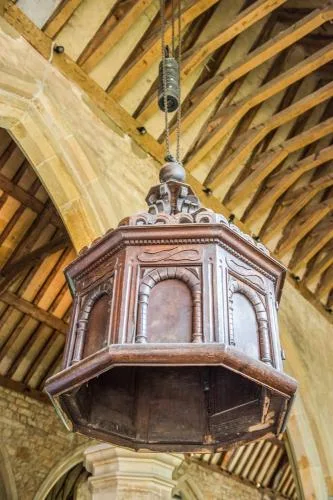
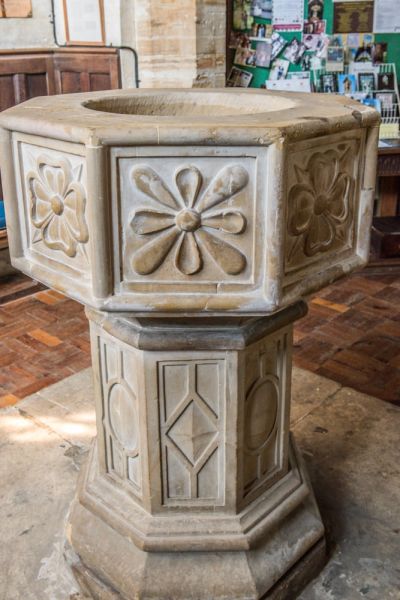
The nave was struck by lightning in 1624 and had to be completely rebuilt, with contributions arriving from all across Kent, Oxford, and London. One new feature was the porch, rebuilt in a mix of classical and Gothic styles. The porch boasts a sundial dated 1626, making it an early example. The rebuilding was executed by a master mason named William Holis, who also carved the font in 1628.
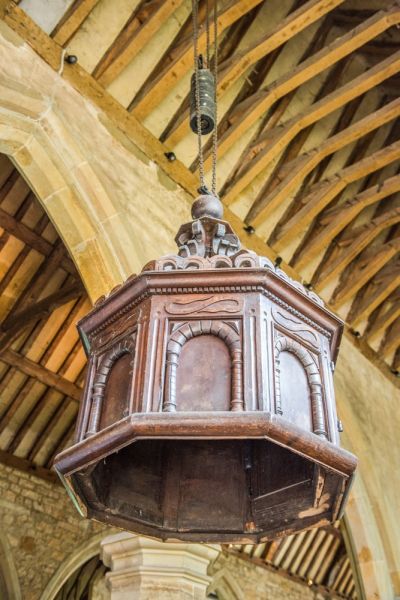
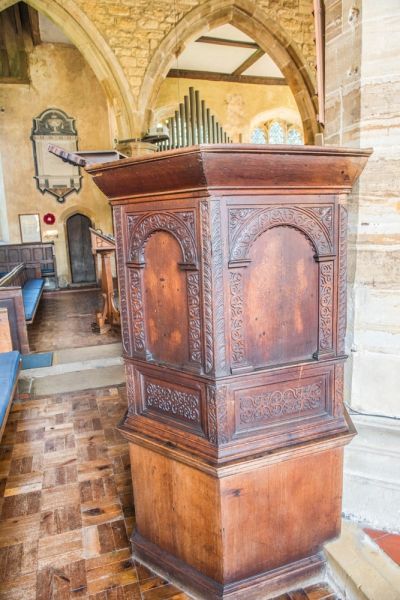
The pulpit dates to the same era and is similar in style to the font cover. The Ten Commandments board was installed in 1720, and church records show that the artist was paid one pound for his work. The same artist was given only five shillings for the royal coat of arms.
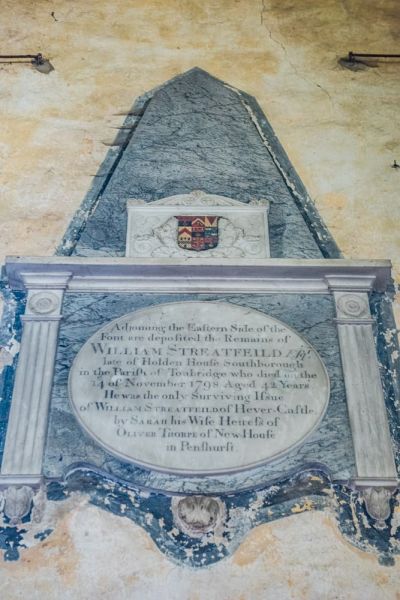
Highlights include a 1650 altar tomb to Frances, daughter of John Reeve of London, and her two husbands, Thomas Streatfeild [yes, that is the correct spelling] and John Seyliard.
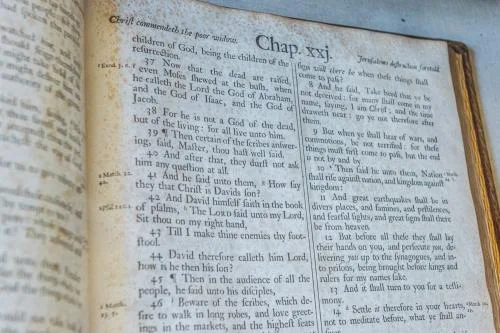
The Vinegar Bible
On display in a glass case is a rare example of a 1717 'Vinegar Bible'. The name comes from the 'Parable of the Vineyard' where 'vineyard' was humorously translated as 'vinegar'. the 1717 edition was published by John Baskett and it was so full of mistakes that it was called 'a Baskett full of errors'. The phrase gave rise to our modern term 'basket case'.
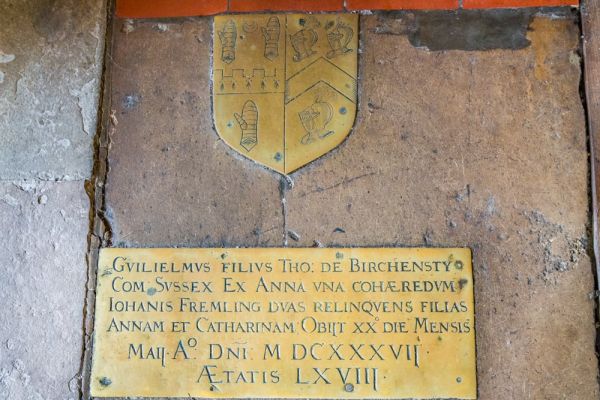
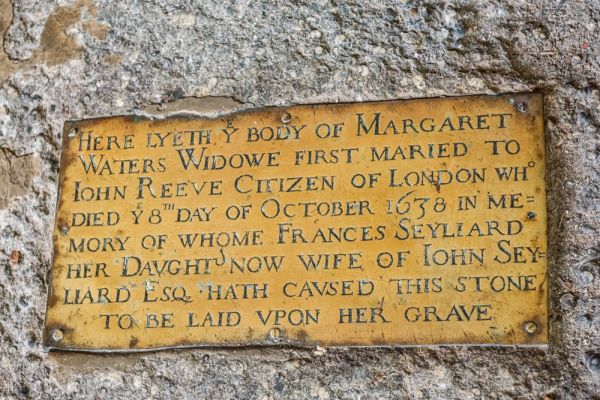
There are three memorial brasses in the church. The oldest is that of Richard Streatfeild and dates to 1584. Next is a brass to William Birsty dated 1637, and the third dates to 1638 and commemorates Margaret Waters.
In the nave and south aisle are iron grave slabs, a testament to the Weald's rich history as a centre of the iron industry. The oldest of these iron grave slabs is that of an ironmaster named Richard Streatfeild, who died in 1601.
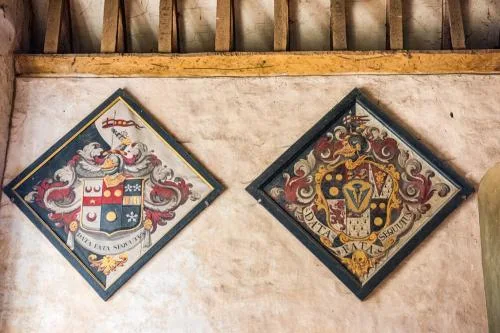
Historical Hatchments
Fixed to the walls of the south aisle are a series of nine funeral hatchments that must together make up one of the finest collections of hatchments in Kent. The oldest hatchment dates to 1627 and the final one to 1852. A guide to the hatchments hangs on a pillar in the south arcade.
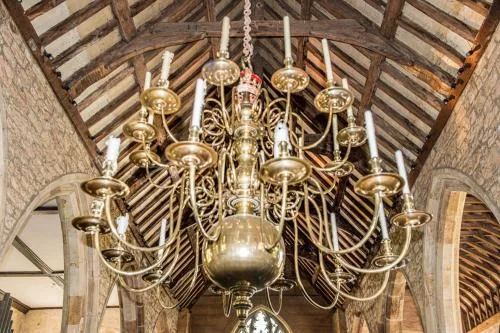
Hanging over the central aisle is a magnificent brass chandelier. This was given to the church in 1726 by Edward Tenison.
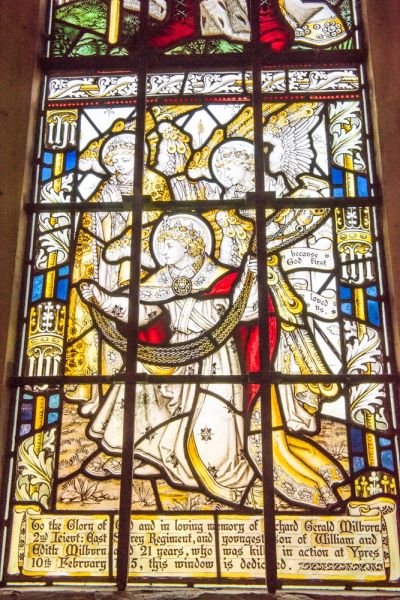
In the east window of the Bore Place Chapel is a fragment of medieval glass. Near the font is a modern stained-glass window installed to commemorate the Millennium.
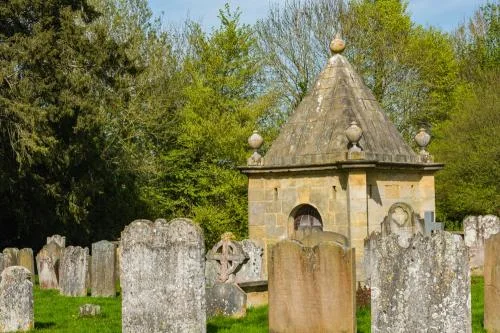
The Streatfeild Vault
In a corner of the churchyard is a peculiar pyramidal family vault erected in 1736 by Henry Streatfeild. Inside the vault are 16 wooden coffins holding generations of the Streatfeild family. The coffins were carved from wood grown on the Streatfeild estate.
Visiting
There is no dedicated church parking, but you can usually find a place to park along the road through the village. The church is usually open to visitors and was open when we visited.
More Photos
About Chiddingstone, St Mary's Church
Address: High Street, Chiddingstone, Kent, England, TN8 7AH
Attraction Type: Historic Church
Location: On High Street, in the centre of the village. Parking along the road.
Website: Chiddingstone, St Mary's Church
Location map
OS: TQ500451
Photo Credit: David Ross and Britain Express
NEARBY HISTORIC ATTRACTIONS
Heritage Rated from 1- 5 (low to exceptional) on historic interest
Chiddingstone Castle - 0.2 miles (Historic House) 
Hever Castle - 1.5 miles (Castle) 
Penshurst Place - 1.8 miles (Historic House)
Penshurst, St John the Baptist Church - 1.8 miles (Historic Church)
Edenbridge, St Peter & St Paul's Church - 3.5 miles (Historic Church) 
Eden Valley Museum - 3.6 miles (Museum)
Chartwell - 4.9 miles (Historic House)
Riverhill Himalayan Gardens - 5 miles (Garden)
Nearest Holiday Cottages to Chiddingstone, St Mary's Church: