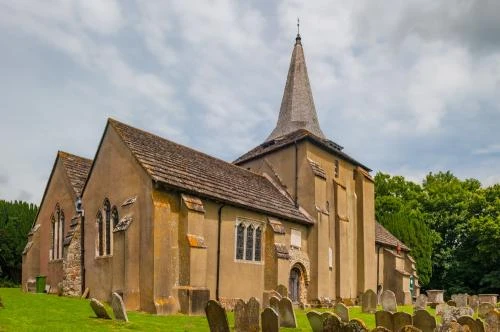
In a leafy setting overlooking the River Adur stands the 11th-century church of St George, West Grinstead. Historical highlights inside the church include medieval brasses, 14th-century stained glass, and ornate memorials to the Burrell family.
History
We know from documentary evidence that a church stood at West Grinstead at least as early as 1100, and the stonework in the nave suggests an even earlier origin. The earliest reference to a rector came in 1215.
The church we see today is built of rendered sandstone under a roof of Horsham stone tiles. The layout consists of a nave, chancel with a south chapel, south aisle, north porch, and south tower.
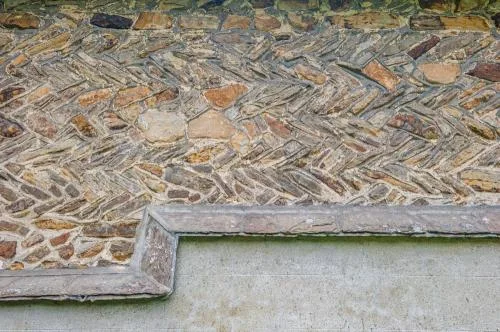
The north-west wall of the nave is built in a herringbone masonry style typical of the period around 1100. The tower was added in the 13th century when the south aisle was also added. The chancel dates to the later 13th century.
A south, or manorial chapel was inserted in the late 14th century. The nave and chancel are supported on a timber roof that may be of 14th-century date.
Historical Highlights
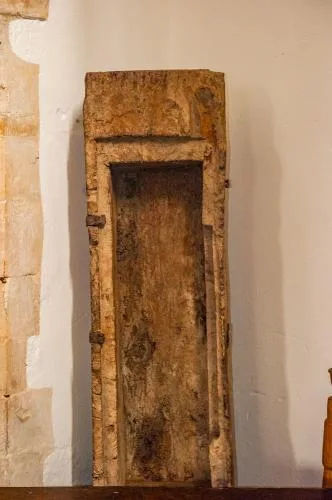
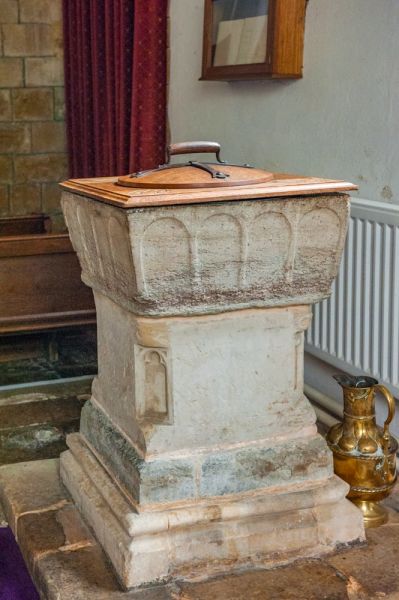
One of the most intriguing highlights is a dug-out chest made from a single oak trunk, thought to be early medieval. The marble font is 12th century, though it stands on a 14th-century stem.
Most of the pews date to the 16th and 17th centuries, with later additions. The pews bear numbers and the names of local landowners who had assigned seating. The names on the pews are likely from the 1820s.
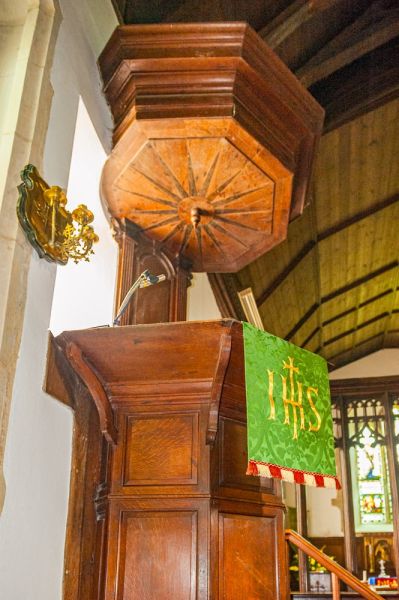
The wooden pulpit dates to the 18th century and is topped by a beautifully-inlaid sounding board. The wooden chancel screen incorporates pieces from a medieval screen uncovered during restoration work. The communion rails date to the Georgian period.
A square-headed aumbry in the north chancel wall dates to the 13th century.
Medieval Brasses
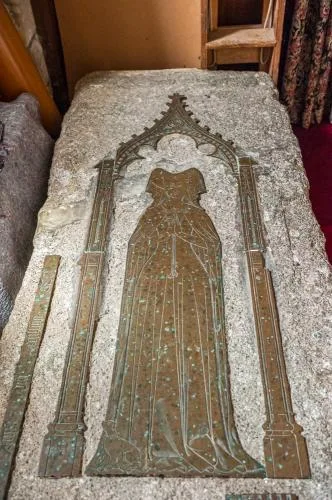
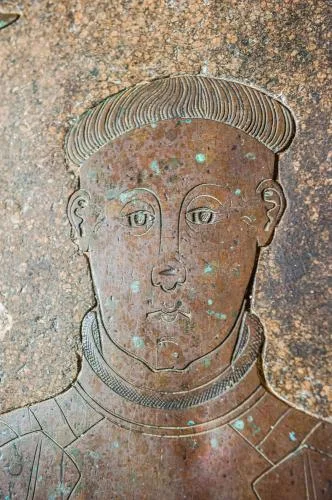
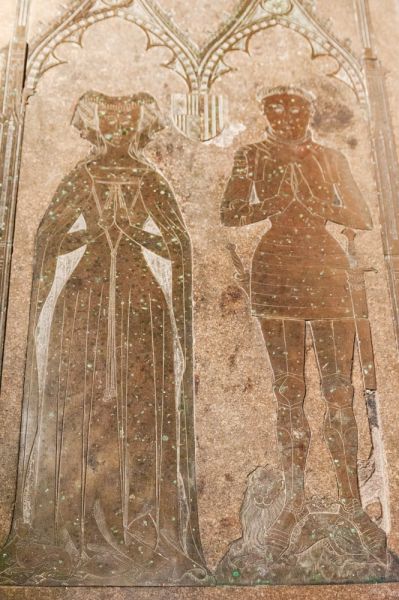
The church is known for its rich collection of monuments. In the south chapel are two funerary brasses. The oldest is to Philippa Halsham (d. 1395), while the second commemorates Philippa's son, Sir Hugh Halsham (d. 1442) and his first wife, Joyce. Sir Hugh fought at the Battle of Agincourt in 1415 as part of the retinue of the Earl of Arundel.
Interestingly, Philippa Halsham's brass was made around 1440, though she died in 1395. It seems likely that her brass was 'retrospectively' commissioned by her son before he died.
There is some confusion of which of Sir Hugh's two wives is commemorated on the brass. The inscription refers to Lady Joyce, his first wife, who died in 1421, although coats of arms on the brass suggest that may be his his second wife, Petronilla, who is being remembered. You will see both names mentioned in other online sources.
It seems likely to us that Sir Hugh had the brass made long before his death, and the figure beside him is that of his first wife. If that is true, the date of Sir Hugh's death would have been left blank and then added in after his death.
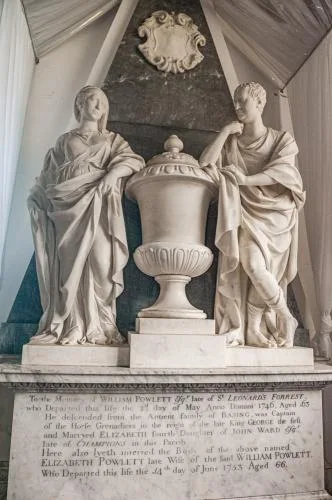
In the south aisle are memorials to the Ward family of Champions Farm. Among the finest is a memorial by John Michael Rysbrack (1694-1770) in memory of William Powlett (d. 1746) and his wife Elizabeth, née Ward. This shows the couple in Roman dress, standing on either side of an oversized urn.
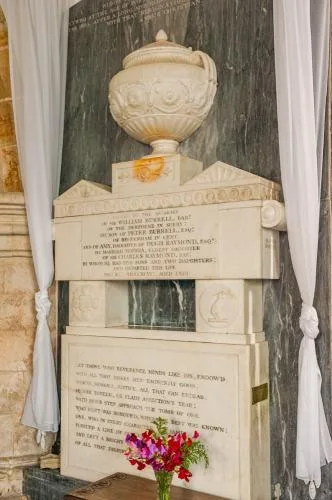
William Burrell Memorial
Even more striking is the memorial to Sir William Burrell (d. 1796) and his wife, Sophia. Burrell was a famous antiquarian in his day and bequeathed a massive collection of documents relating to Sussex history to the British Museum on his death.
Burrell is perhaps best known for commissioning a series of drawings detailing churches across Sussex. The memorial was crafted by John Flaxman (1755-1826).
A tablet to Elizabeth Woodward (d. 1797) on the north chancel wall is also thought to be by Flaxman, or perhaps by one of his students. Woodward was the wife of the West Grinstead rector, John Woodward.
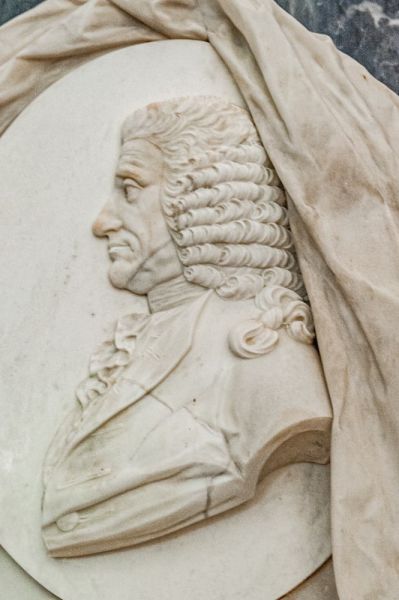
Another striking memorial is that of Sir Merrik Burrell (d. 1787). This takes the form of a large medallion showing Burrell in profile under an outrageous (by modern standards) wig. Burrell served as governor of the Bank of England from 1758-1760.
In the nave aisle is a memorial window to three men of West Grinstead who died in WWI.
Stained Glass
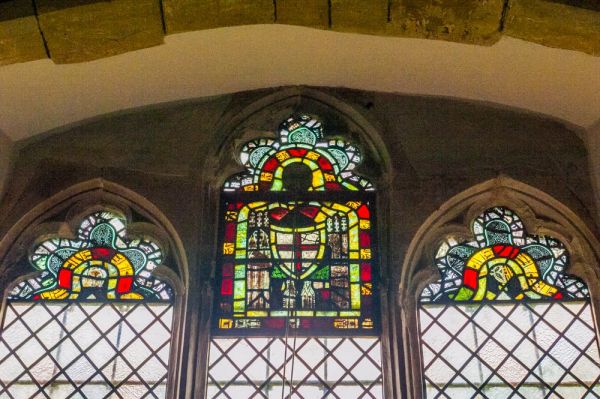
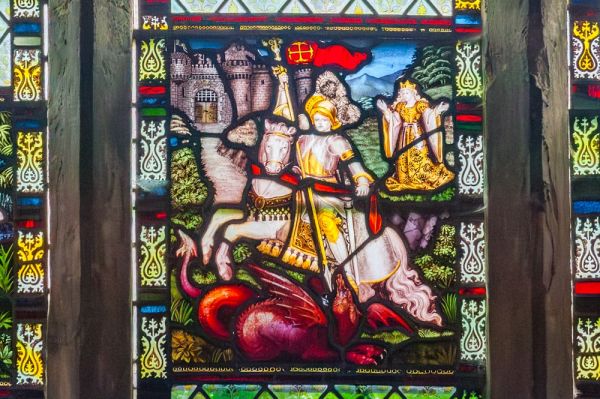
The west window in the south aisle holds a jumble of 14th and 15th-century grisaille glass, and the wonderful east window is by CE Kempe. The window is dedicated to Sir Walter Wyndham Burrell (1814–1886).
The reredos behind the altar is also by the Kempe studio and depicts the Annunciation. The Lady Chapel window is by another famous stained-glass firm, Clayton and Bell.
The peculiar royal coat of arms is, oddly, monochrome. There is also confusion over its date for, though the coat of arms is that of George IV, it includes a bonnet, not a crown, which puts the date before 1816 (i.e. before George IV was crowned). It seems possible that the painter drew his inspiration from an outdated coat of arms.
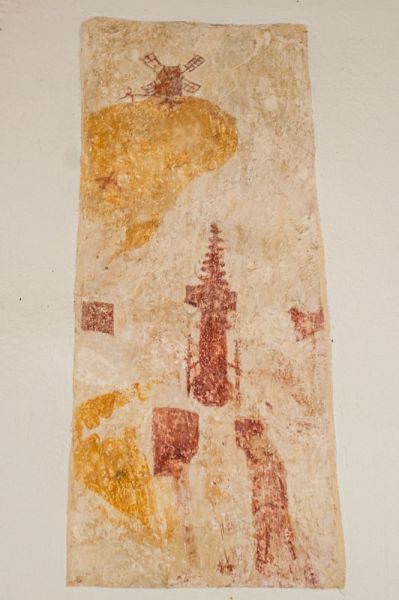
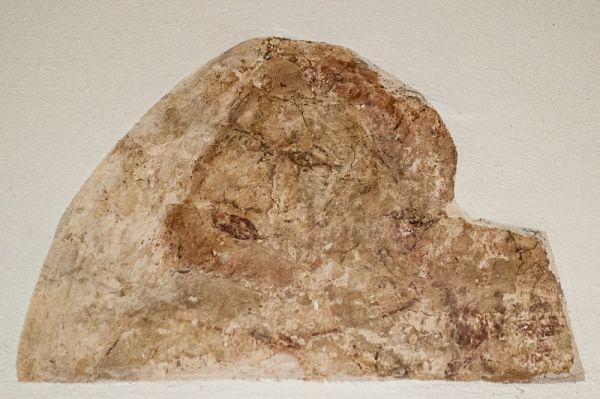
On the north nave wall is a fragmentary 15th-century wall painting depicting St Christopher.
Visiting
Follow Clothalls Lane to a large turnaround and parking area outside the churchyard. The church is typically open to visitors and was open when we visited.
More Photos
About West Grinstead, St Peter's Church
Address: Rectory Lane, West Grinstead, West Sussex, England, RH13 8LR
Attraction Type: Historic Church
Location: Follow Clothalls Lane to a parking area outside the churchyard.
Website: West Grinstead, St Peter's Church
Location map
OS: TQ171207
Photo Credit: David Ross and Britain Express
POPULAR POSTS
HERITAGE
 We've 'tagged' this attraction information to help you find related historic attractions
and learn more about major time periods mentioned.
We've 'tagged' this attraction information to help you find related historic attractions
and learn more about major time periods mentioned.
Historic Time Periods:
Find other attractions tagged with:
11th century (Time Period) - 14th century (Time Period) - 15th century (Time Period) - Georgian (Time Period) - memorial brass () - Norman (Architecture)
NEARBY HISTORIC ATTRACTIONS
Heritage Rated from 1- 5 (low to exceptional) on historic interest
Shipley Windmill - 1.9 miles (Historic Building) 
Warminghurst, Holy Sepulchre Church - 4 miles (Historic Church) 
Henfield Museum - 4 miles (Museum) 
Blue Idol Meeting House - 4.2 miles (Historic Church)
Leonardslee Gardens - 4.6 miles (Garden)
West Chiltington, St Mary's Church - 5.2 miles (Historic Church)
Chanctonbury Ring - 5.7 miles (Prehistoric Site)
Steyning, St Andrew & St Cuthman - 5.8 miles (Historic Church)
Nearest Holiday Cottages to West Grinstead, St Peter's Church: