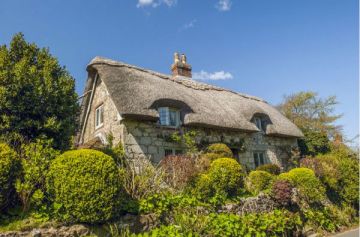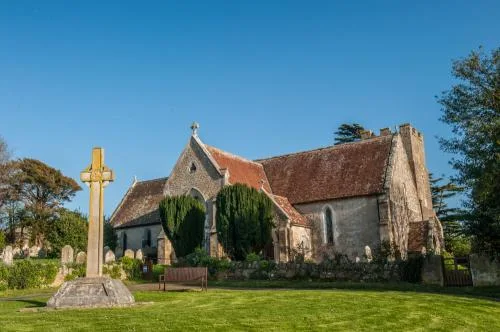
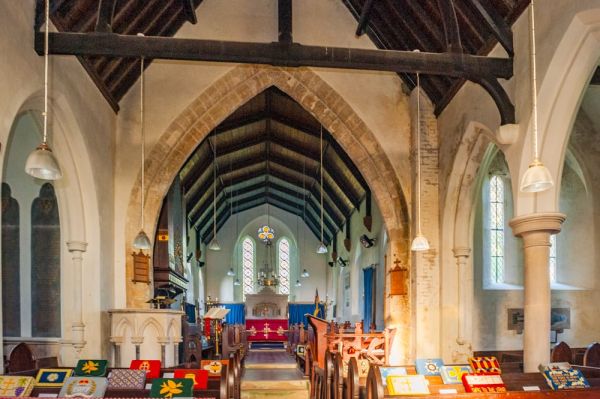
All Saints Church, Calbourne, stands on the edge of the village green in an idyllic setting in keeping with its picturesque village setting. The church was recorded in the Domesday Book of 1086, when the church of Winchester (later Winchester Cathedral) held the manor.
An AD 826 charter issued by King Egbert of Wessex suggests that there may have been a church at Calbourne around that time, but if so, no trace of it remains.
History
The church recorded in the Domesday Book was likely a manorial chapel. In the 12th century this simple aisleless building was transformed by the addition of north and south chapels. The church was enlarged in the 13th century when the chancel was lengthened, and a west tower added.
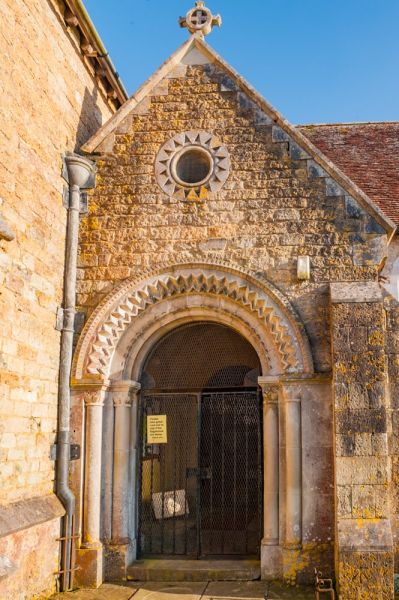
The tower was damaged by lightning in 1683 and only repaired in 1752. The medieval north chapel was replaced in 1842 when a north porch was added. With that exception, the church has remained unaltered save for the south arcade, which was largely replaced in the Victorian period.
Well-known rectors of Calbourne include Nicholas Tindal, best-known for his historical writings, who was installed in 1740, and John Fisher, who went on to become Bishop of Salisbury.
Historical Highlights
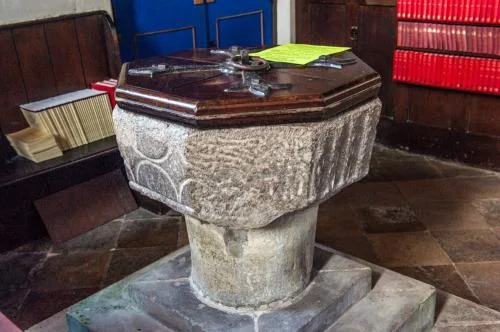
The first interior highlight to meet your eye is a peculiar 13th-century octagonal Purbeck marble font with a richly-carved rim. The font appears to have originally been square, only to be later recarved in octagonal shape by lopping off the corners.
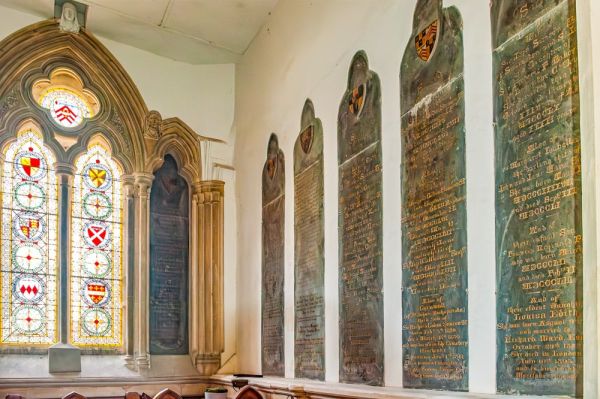
The north chapel, known as the Barrington Chapel, holds a dozen 19th-century tablets honmouring members of the Barrington family.
A Father's Grief
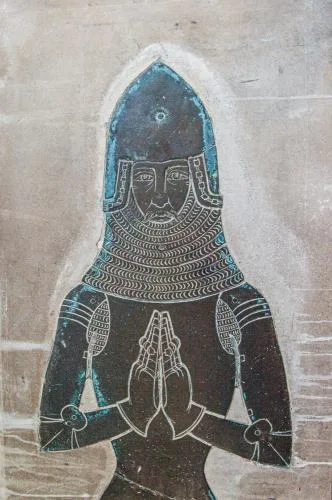
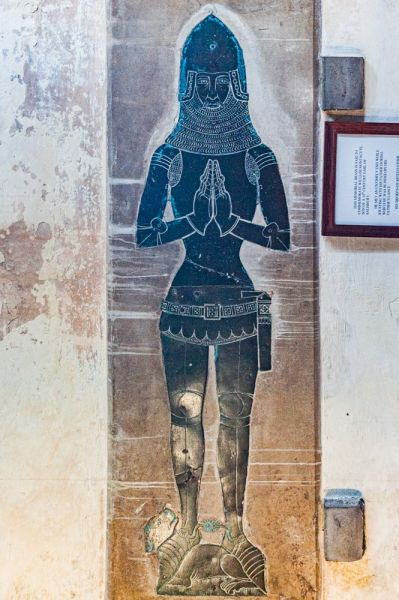
Mounted on the wall is a 14th-century brass thought to represent Sir William Montagu (Montacute), the son of the Earl of Salisbury. According to legend, William was jousting in a tournament at Windsor when, in a tragic accident, his father's lance pierced William's eye and he was killed. The grief-stricken Earl vowed to erect an altar tomb and a memorial brass in every church within his estates, including Calbourne.
An information plaque beside the brass gives its date as 1379, which cannot be accurate, for the Earl's only son died in 1382.
In a poignant twist of fate, William Montagu's grandfather, the 1st Earl of Salisbury, also died of injuries received in a tournament.
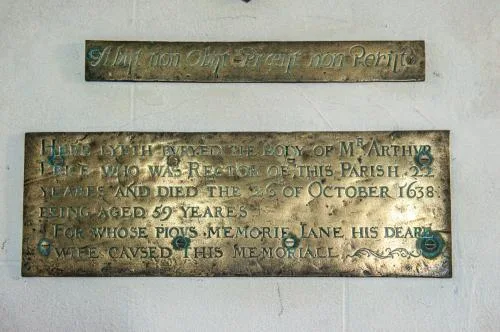
A 17th-century rector
There is less family drama attached to a second brass, this time to a 17th-century rector of Calbourne named Arthur Price. The epitaph, edited for readability, reads like this:
Here lies buried the body of Mr. Arthur Price who was rector of this parish 22 years and died the 26th of October 1638 being aged 59 years.
For whose pious memory Jane his dear wife caused this memorial.
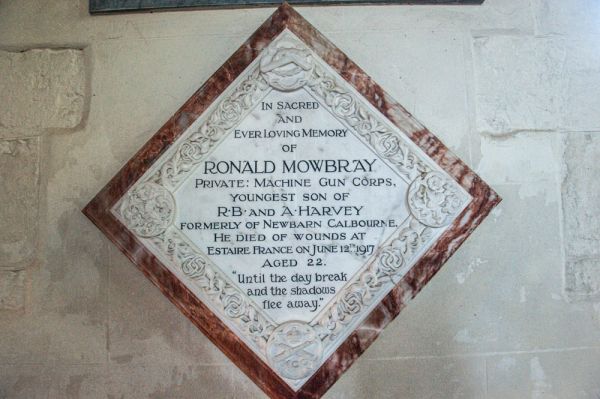
On the wall is a marble tablet in diamond shape commemorating Ronald Mowbray, a private in the Machine Gun Corps who died of wounds received in action on 12 June 1917.
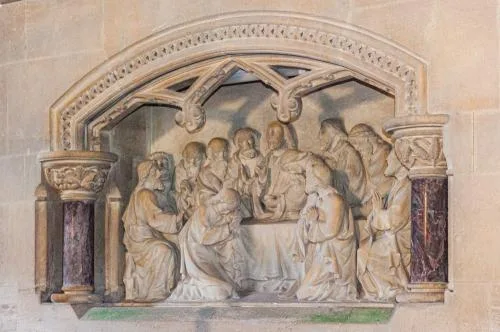
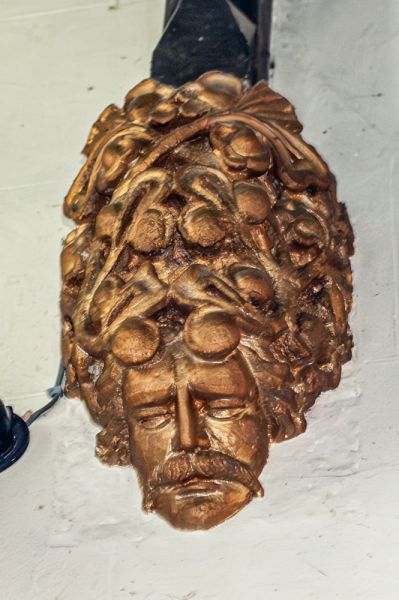
Behind the high altar is a beautifully-carved reredos depicting The Last Supper, while high above, supporting roof rafters, are six corbel heads. Two of these corbels appear to depict the same woman, perhaps a church patron.
On the north chancel wall is a brass commemorating Daniel Evance, a church rector who died in 1671. Evance's brass depicts symbols of mortality and has a peculiar anagram formed by the letters of his first and last names, reading, 'I CAN DEAL EVEN'.
All Saints, Calbourne, is a delightful church in a picturesque village setting, and well worth a visit.
Visiting
The church is normally open to visitors daily and was open when we visited. There is limited parking along the road verge, but please take care not to obstruct traffic.
More Photos
About Calbourne, All Saints Church
Address: The Green, Calbourne, Isle of Wight, England, PO30 4JE
Attraction Type: Historic Church - 3
Location: The chiurch stands on the north side of the village green. There is limited parking along the road verge.
Website: Calbourne, All Saints Church
Location map
OS: SZ425866
Photo Credit: David Ross and Britain Express
HERITAGE
 We've 'tagged' this attraction information to help you find related historic attractions
and learn more about major time periods mentioned.
We've 'tagged' this attraction information to help you find related historic attractions
and learn more about major time periods mentioned.
Find other attractions tagged with:
11th century (Time Period) - 13th century (Time Period) - 14th century (Time Period) - 19th century (Time Period)
NEARBY HISTORIC ATTRACTIONS
Heritage Rated from 1- 5 (low to exceptional) on historic interest
Shalfleet, St Michael the Archangel Church - 1.8 miles (Historic Church) 
Long Stone Neolithic Burial Mound - 1.8 miles (Prehistoric Site)
Castle Hill (Mottistone) Hillfort - 1.8 miles (Prehistoric Site) 
Mottistone Manor Garden - 2.1 miles (Garden)
Mottistone, St Peter & St Paul Church - 2.1 miles (Historic Church)
Brook, St Mary's Church - 2.3 miles (Historic Church)
Brighstone, St Mary's Church - 2.4 miles (Historic Church)
Newtown Old Town Hall - 2.6 miles (Historic Building)
Nearest Holiday Cottages to Calbourne, All Saints Church:
Freshwater, Isle of Wight
Sleeps: 8
Stay from:£1,260 - £8,187
Carisbrooke, Isle of Wight
Sleeps: 8
Stay from:£841 - £3,691