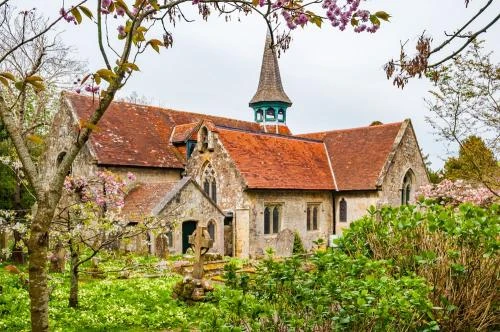
The Old Church of Shanklin is dedicated to St Blasius (alternately spelled as Blays, Blaze, or Blasé) began as a family chapel built by Geoffrey de Lisle, who intended it to serve his household and tenants, as well as those of the neighbouring Norman lord, Ralph de Glamorgan, who held estates in Sandown and Landguard.
This early chapel, built sometime in the reign of King Stephen (1135-1154) was dedicated to St John, though by 1367 the dedication was recorded as St Blays.
History
It is a mark of how strong the threat of French invasion was throughout the medieval period that the church at Shanklin was required to provide an archer for the defence of the island against foreign incursions.
The chapel was entered by what is now the door linking the parish room to the nave, where you can see wear on the stone steps. If you look closely, you can see crusaders' crosses carved into the door jamb.
Until the 19th century, the chapel was closely linked to the churches at Bonchurch and Brading. The lords of the manor and their families were buried here, but all others were buried at Brading. Ministers were interred at Brading until the middle of the Georgian period, and it was not until 1857 that the first resident of Shanklin was buried in the churchyard here in Shanklin. The first recorded baptism came in 1724 and the first wedding in 1754.
During his time in captivity at Carisbrooke Castle, King Charles I got special permission to ride on horseback to Shanklin Chapel, under guard, where he took communion in the chapel porch.
By the early 19th century, the population of Shanklin was increasing, and the incumbent priest decided that his accommodation was inadequate, so he locked the door and refused to surrender it to the church patron (to whom he was closely related) unless his living arrangements were improved.
This seems to have been the first salvo in a conflict that went on for several decades, with the priest demanding to be treated like nearby rectors and refusing access to the church, even for the patron to perform necessary repairs to the building.
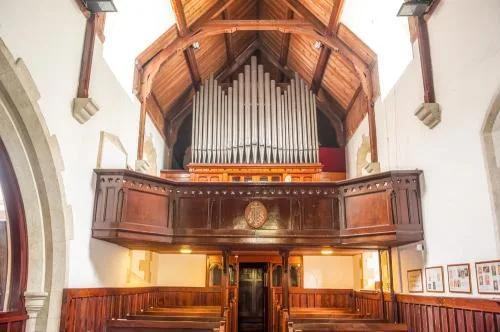
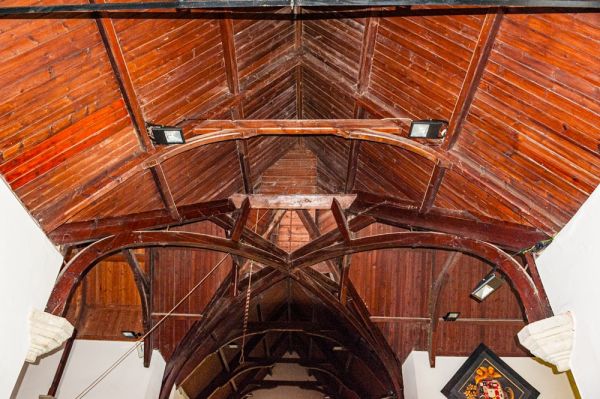
It was the growth of Shanklin as a tourist destination that finally prompted change. In 1852 the chapel was enlarged with transepts to north and south. The church was extended to the best and a lovely bell turret installed at the junction of the roofs.
Highlights
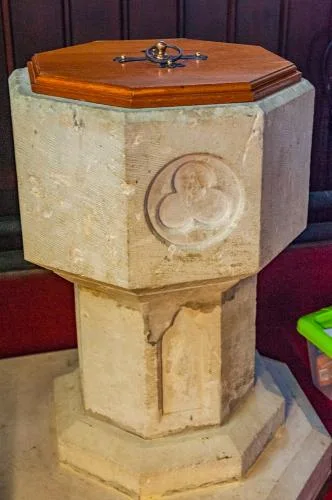
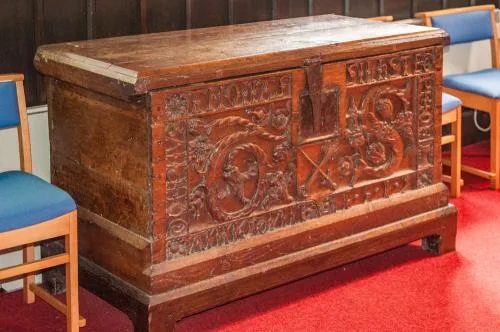
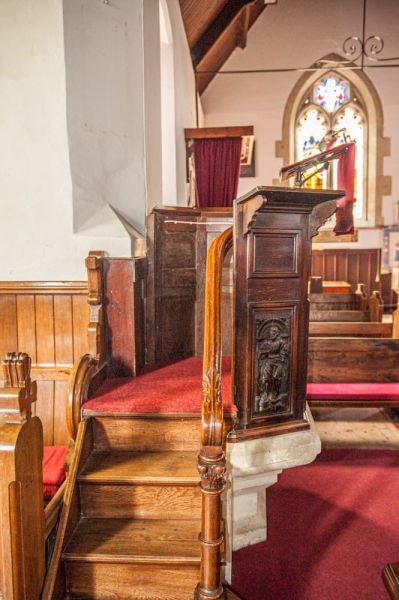
The oldest features of historical interest are a 13th-century font and a beautifully-carved oak chest, dating to 1512. The chest was once owned by Thomas Silkstead, Prior of St Swithun's in Winchester. On the wall is a tablet in memory of Vice-Admiral Henry Hill (1772-1849). The pulpit and lectern incorporate early 16th-century carved panels.
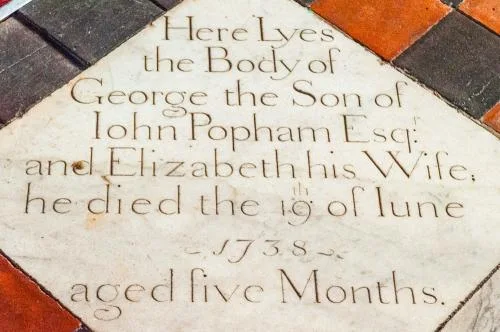
The most memorable memorials are to members of the Popham and Hill families. One touching memorial is a floor tablet to the memory of George Popham, son of John Popham and his second wife, Elizabeth, who died at the age of just five months in 1738. Another tablet records the death of John and Elizabeth's daughter, who died at 10 months. On the wall nearby is yet a third memorial, this time to a daughter of John Popham and his first wife, Grace, who died at 13.
The theme of childhood mortality carries on in the chancel, where a marble tablet records the death of Sarah Popham, who died at 12 years of age in 1808.
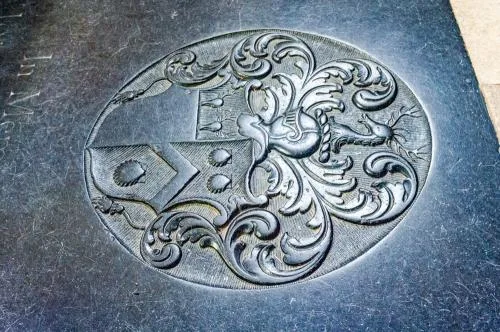
Nearby is a wonderful ledger slab carved with the Popham coat of arms and installed in memory of John Popham.
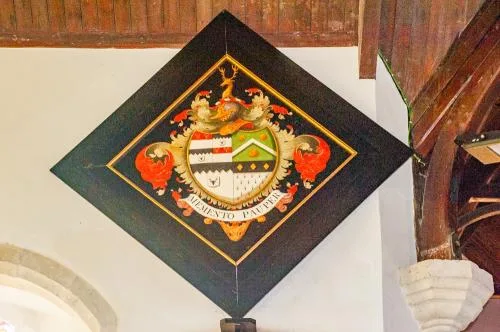
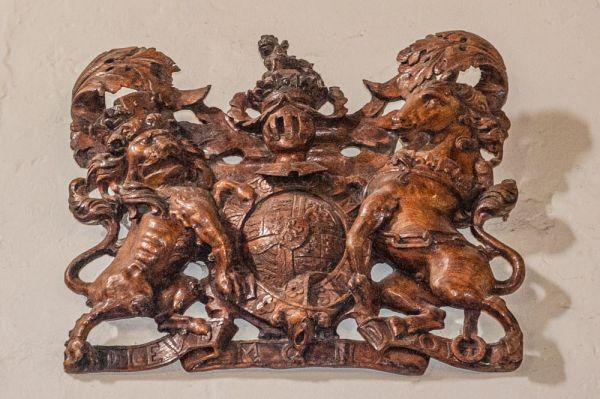
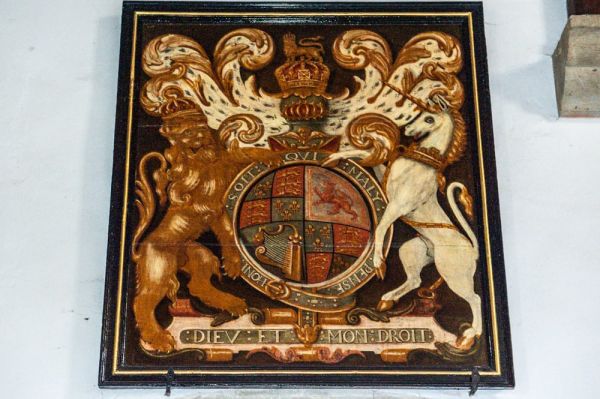
Curiously, there are two royal coats of arms, one painted and another, bearing the arms of William III, carved from wood. There are also three funeral hatchments, one of which was painted for the funeral of King George II. What it is doing here in Shanklin is a mystery.
The other two hatchments are to members of the Popham family. The earliest dates to 1763 and the later to 1816.
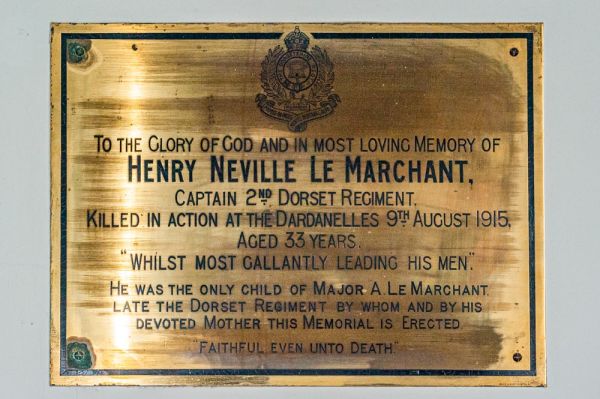
A poignant brass plaque on the wall records the death of Henry Neville, captain in the 2nd Dorset Regiment, who was killed in action during the failed attack on Gallipoli in 1915 'while gallantly leading his men.'
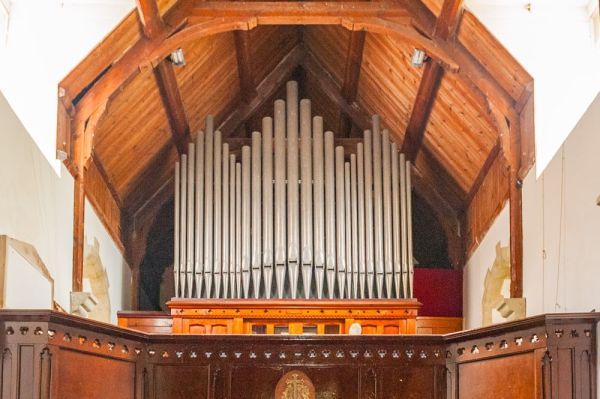
One final highlight is the impressive organ, installed in a west gallery. This dates to 1874.
Who was St Blasius?
Blasius, or Blaise, was a 4th-century bishop of Sebaste, then in Armenia but now part of Turkey. He is the patron saint of wool combers and sore throats.
An obvious next question is why a church on the Isle of Wight is dedicated to this relatively unknown Armenian saint. The answer, according to legend, lies in the crusading exploits of Richard the Lionheart, King of England.
It seems that while the king was on crusade in 1192, he was shipwrecked on an island off what is now Dubrovnik in Croatia. He wanted to build a church in gratitude for surviving the wreck, but the Bishop of Regusa convinced him to give money towards rebuilding the cathedral of Regusa, which was dedicated, in part, to St Blasius.
The bishop accompanied Richard when he finally returned to England, where he eventually was named Bishop of Carlisle.
But what is the connection of St Blasius to Shanklin? It seems that a 12th-century lord of the manor went on crusade at the same time as King Richard. It is pure speculation, but if this lord was in the king's retinue, he would have heard of St Blasius, and brought the saint's story back home when he returned from the crusade.
Visiting
The church stands at the junction of Church Road (A3055) and Manor Road, at the southernmost edge of Shanklin. There is a small parking area directly opposite the churchyard. The church was open when we visited.
More Photos
About Shanklin, St Blasius Church
Address: Church Road, Shanklin, Isle of Wight, England, PO37 6QY
Attraction Type: Historic Church
Location: At the junction of Church Road and Manor Road, at the southernmost edge of Shanklin. Parking opposite the churchyard.
Website: Shanklin, St Blasius Church
Location map
OS: SZ578805
Photo Credit: David Ross and Britain Express
HERITAGE
 We've 'tagged' this attraction information to help you find related historic attractions
and learn more about major time periods mentioned.
We've 'tagged' this attraction information to help you find related historic attractions
and learn more about major time periods mentioned.
Historic Time Periods:
Find other attractions tagged with:
12th century (Time Period) - 13th century (Time Period) - 16th century (Time Period) - 19th century (Time Period) - Richard I (Person) - Tudor (Time Period)
NEARBY HISTORIC ATTRACTIONS
Heritage Rated from 1- 5 (low to exceptional) on historic interest
Bonchurch Old Church - 1.6 miles (Historic Church) 
Appuldurcombe House - 2.3 miles (Historic House)
Ventnor Botanic Garden - 3 miles (Garden) 
Godshill, All Saints Church - 3.3 miles (Historic Church) 
St Lawrence Church - 3.5 miles (Historic Church)
St Lawrence Old Church - 3.6 miles (Historic Church)
Brading Roman Villa - 3.8 miles (Roman Site)
Morton Manor Gardens - 3.9 miles (Garden) 
Nearest Holiday Cottages to Shanklin, St Blasius Church: