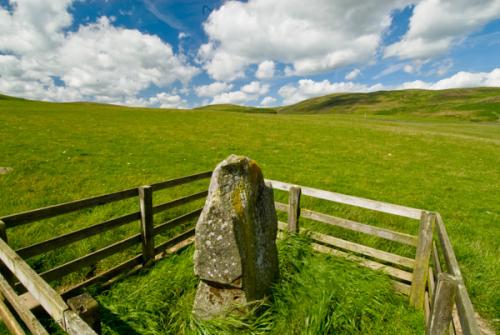
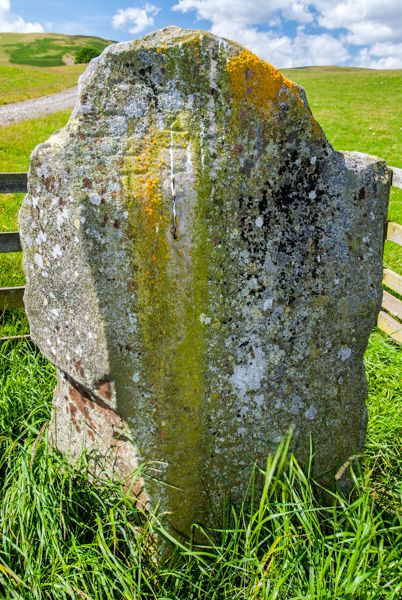
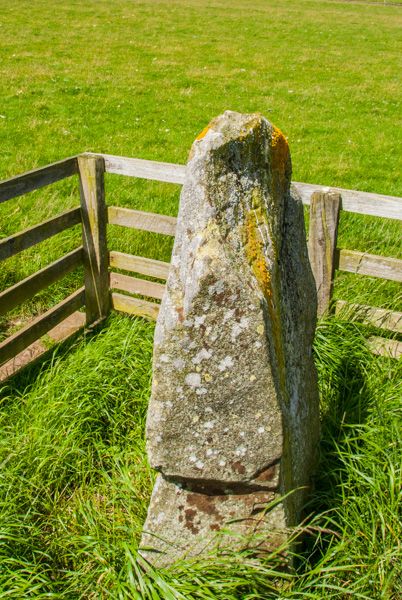
The Yarrow Stone is an early Christian standing stone approximately 4.5 feet in height. The stone was found during ploughing work during the early 19th century and has now been set upright, enclosed by a wooden fence. When found, it was lying flat, with the remains of human bones beneath it.
What is it?
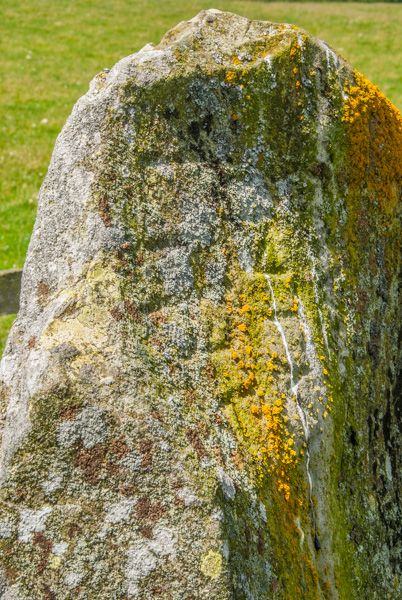
Was it a grave marker? It seems likely, though we don't know for sure. There is a very faint Latin inscription on the east face, but exactly what the inscription says is open to some debate.
It appears to mark the graves of two 6th-century British chiefs, sons of a chief called Liberalis. The grave marker was probably part of a family or tribal burial ground, and stood beside an old trackway.
The very worn Latin inscription has been translated as 'This is an everlasting memorial. In this place lie the most famous princes Nudus and Dumnogenus. In this tomb lie the two sons of Liberalis.'
So, a literal interpretation of the inscription is to assume there was a local chief named Liberalis, and the stone marks the burial place of his sons. There is another, more romantic interpretation, however.
King Arthur's Grave?
The Yarrow Stone hit the news in 2012 when an amateur historian named Damian Bullen claimed that it marked the grave of the legendary King Arthur.
Not content with the scholarly interpretation of the inscription, Mr Bullen broke down the words and concluded that the name Dumnogenus suggested descent from the Dumnonii, an ancient native British tribe whose territory took in much of what is now Devon, Cornwall, Somerset, and Dorset.
His translation then takes on a different meaning; '‘Here lie two famous and very noble princes of Dumnonia, buried without possessions'.
He concludes that the stones mark the burial place of Arthur and his kinsman Mordred. His theory also takes in the nearby mere known as 'Dead Lake', which according to local folklore was the burial place of warriors who died in a local battle. Could the 'Dead Lake' be the place where Arthur's sword Excaliber was cast before his death?
Of course, a certain suspension of belief is needed to accept this - or any other theory - when documentary evidence is scanty, but it is fun to speculate!
A battle marker?
Another theory suggests that the Yarrow Stone marks an earlier battle of Arthur's recorded as 'in the wood of Celidon' by the 9th-century Welsh monk Nennius. Celidon may refer to the Caledonian Forest, what is now called Ettrick Forest, which encompasses the Yarrow site.
One variation on the theory combines Arthur and traditional historical interpretation and suggests that the stone marks the graves of two local princes of Strathclyde who died in Arthur's battle here.
While I can't vouch for this being the grave of King Arthur, I can vouch for the wonderfully scenic setting! The open countryside is glorious, with wide views over the surrounding hills and along the glen.
There are several other prehistoric sites in the area, including the quite sizeable standing stone known as the Glebe Stone, just a short distance down the road.
More Photos

About Yarrow Stone
Address: Yarrow, Borders, Scotland
Attraction Type: Prehistoric Site
Location: On the A708 1 mile west of Yarrow, just off the lane leading to Whitefield farm.
Location map
OS: NT347274
Photo Credit: David Ross and Britain Express
POPULAR POSTS
HERITAGE
 We've 'tagged' this attraction information to help you find related historic attractions
and learn more about major time periods mentioned.
We've 'tagged' this attraction information to help you find related historic attractions
and learn more about major time periods mentioned.
Historic Time Periods:
Find other attractions tagged with:
19th century (Time Period) - 6th century (Time Period) - 9th century (Time Period) - Iona (Place) - Prehistoric (Time Period) - Roman (Time Period) - standing stone (Historical Reference)
NEARBY HISTORIC ATTRACTIONS
Heritage Rated from 1- 5 (low to exceptional) on historic interest
Glebe Stone - 0.3 miles (Prehistoric Site) 
Bowhill - 5 miles (Historic House) 
Traquair House - 5.1 miles (Historic House) 
Robert Smail's Printing Works - 5.8 miles (Museum)
Halliwell's House Museum - 7.6 miles (Museum) 
Cross Kirk, Peebles - 10.2 miles (Historic Church)
Neidpath Castle - 10.6 miles (Castle)
Abbotsford House - 10.8 miles (Historic House)
Nearest Holiday Cottages to Yarrow Stone: