Caer Gai is a 1st-century Roman earthwork fort, occupied until the mid-2nd century. According to tradition the fort was used by King Arthur after the Romans left Britain in the 5th century.
History
Around 70 AD the invading Romans established a marching camp and later, a fort, at Llanfor, 5 miles from Llanuwchllyn. The fort was part of the Roman push to conquer the Ordovices tribe in north Wales.
The gravel soil of the fort made it hard to maintain the earthwork defences, so around 75 AD they built a new fort at Caer Gai, on higher ground overlooking the River Dee.
The fort is laid out on a square plan, about 420 feet on each side, enclosing a total area of about 4.5 acres. The fort was occupied until about 130 AD and was defended by earthwork ramparts rising 3 metres high.
Inside the earthworks were timber buildings, for it seems the Romans never rebuilt the site in stone. Buildings included a guest-house, bath house, and a principia, or administration centre. Outside the fort lay a vicus, or civilian settlement.
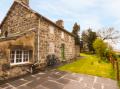
The current farmhouse of Caergai stands in the northern corner of the fort and partly overlies the earthworks. About 200 feet to the west is a well which the Romans probably used to supply the fort with drinking water. The bank and ditch defences can be easily seen on the ground, and the distinctive square Roman masonry blocks can be seen built into later field boundaries.
Finds on the site have been sparse. In 1865 a number of cremation urns, full of human bone ash, were discovered in a field called Cae Dentir north east of the fort. Two decades later a small timber building thought to be a shrine was excavated in the same spot, and pottery sherds were found, along with a carved stone bearing the inscription 'IVLIVS GAVERONIS F FE MIL CHO I NER'.
The stone appears to be a votive panel later re-used as a grave marker. The inscription translates loosely as 'Julius the son of Gavero, ironsmith and soldier of the First Cohort of Nervians'. The 'ironsmith' is probably most closely parallel to what we would call a blacksmith. The Nervian cohort was raised in what is now Belgium. The same unit was later stationed at Netherby in Cumbria.
The King Arthur Connection
The name Caer Gai has suggested a link to the mythical Sir Kay of Arthurian legend. Kay translates as Gai in Welsh, so the connection is at least understandable. But there's more. The name might also refer to the Latin name Caius or Gaius, and refer to a very real Romano-British leader who occupied the fort after the Romans withdrew from Britain in the early 5th century.
One version of the tale is that Cai, or Kay, is King Arthur's foster brother. He must have been quite a character, for the stories say he killed monsters and witches, and could drink as much as 4 men.
And there is yet more; another tale says that the Caer Gai site became the seat of Cai Hir ap Cymyr, a Romano-British chief. The Elizabethan poet Edmund Spenser identified Cai Hir ap Cymyr as Timon, foster father of King Arthur. The young Arthur is said to have been brought up at Caer Gai, or at least educated here at his foster-father's court.
About Caer Gai Roman Fort
Address: Caergai Farm, A494, Llanuwchllyn, Gwynedd, Wales
Attraction Type: Roman Site
Location: On the A494 1 mile north of Llanuwchllyn at Caergai farm. The fort is on private land so please ask at the farm for permission to view the site.
Location map
OS: SH877 314
Photo Credit: Ssolbergj, licensed for reuse under the Creative Commons Licence
HERITAGE
 We've 'tagged' this attraction information to help you find related historic attractions
and learn more about major time periods mentioned.
We've 'tagged' this attraction information to help you find related historic attractions
and learn more about major time periods mentioned.
Historic Time Periods:
Find other attractions tagged with:
2nd century (Time Period) - 5th century (Time Period) - Elizabethan (Architecture) - Roman (Time Period)
NEARBY HISTORIC ATTRACTIONS
Heritage Rated from 1- 5 (low to exceptional) on historic interest
Carndochan Castle - 1.9 miles (Castle) 
Tomen y Bala - 4.3 miles (Castle)
Llanfor Roman Camp - 4.8 miles (Roman Site) 
Brithdir Roman Fort - 10.1 miles (Roman Site)
Tyfos Stone Circle (Ring of Tyfos) - 10.4 miles (Prehistoric Site)
Nannau Estate - 10.6 miles (Garden)
Pont Minllyn - 11 miles (Historic Building)
Rhos Y Beddau Stone Rows - 11.2 miles (Prehistoric Site)
Nearest Holiday Cottages to Caer Gai Roman Fort: