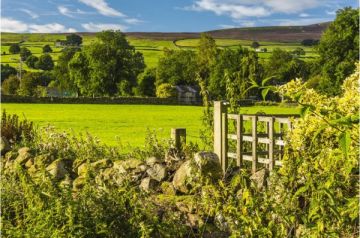
Just east of Bala lies the site of a 1st-century Roman marching camp, situated in farm fields on the floodplain of the River Dee.
History
The fort was probably built around 70 AD and was in use for only a short period before it was replaced by a new fort at Caer Gai, five miles distant, about 75 AD. Why was the fort deserted? Possibly because the loose gravel on the floodplain made it very hard to maintain the defensive ditches.
Continual erosion would have made the defences untenable, so it is no surprise that within a few years the auxiliary fort at Caer Gai was built on higher ground. It seems that the defences were slighted to make them unusable; the rampart was pushed down to backfill the ditches when the legions left for the newer fort.
The fort is roughly square, with sides running 650 feet along an east-west axis, and 600 feet north to south, enclosing an area of about 9 acres. The site is defended by a rampart and 3 ditches on all sides. The ramparts appear to have been made of simple turf walls.
Within the walls are signs of two colonnaded courtyard buildings, set in the centre of the fort. These were probably the principia (the administration building) and praetorium, or general's quarters. To the south stood a granary, and a series of 22 subdivided buildings suggest several barracks. The barracks are larger than usual, at 10m by 60m. The number and size of the barracks suggest that Llanfor was made to hold 4 legionary cohorts.
Archaeology studies suggest there was metalworking activity here, and the remains of a possible bathhouse and yard have been found.
Unusually, there were three gateways. There is a central gate in the east wall, but no matching gate in the west wall, probably because the west side of the fort faced water meadows. On the north and south walls the gateways are offset to one side rather than centrally located, was the Roman custom.
Beside the road to the north of the fort are a series of rectangular shapes thought to be the remains of hearths, possibly all that remains of a timber and earth vicus, or civilian settlement.
The earthwork defences were built on top of an earlier temporary marching camp, of much smaller size. The fort probably supported a legionary garrison.
An aerial survey in 1976 found a marching camp to the north west of the fort. The camp has much longer sides than the fort; at least 1250 feet on the north-east side can be traced, suggesting that the camp enclosed an area of about 29 acres.
Evidence of the fort at ground level is scanty to say the least. This is a site that is best viewed from the air!
About Llanfor Roman Camp
Address: Bala, Gwynedd, Wales
Attraction Type: Roman Site
Location: Off the A494, just north east of Bala. The enclosure lies south of the road, in farm fields. Very little obvious remains are visible. Marked as 'sheep pens' on OS maps.
Location map
OS: SH9375836145
Photo Credit: Ssolbergj, licensed for reuse under the Creative Commons Licence
Opening Details: Open access site, usually accessible at any reasonable time
POPULAR POSTS
HERITAGE
 We've 'tagged' this attraction information to help you find related historic attractions
and learn more about major time periods mentioned.
We've 'tagged' this attraction information to help you find related historic attractions
and learn more about major time periods mentioned.
Historic Time Periods:
Find other attractions tagged with:
NEARBY HISTORIC ATTRACTIONS
Heritage Rated from 1- 5 (low to exceptional) on historic interest
Tomen y Bala - 0.5 miles (Castle) 
Caer Gai Roman Fort - 4.8 miles (Roman Site)
Tyfos Stone Circle (Ring of Tyfos) - 5.9 miles (Prehistoric Site)
Carndochan Castle - 6.5 miles (Castle)
Moel Ty Uchaf Stone Circle - 7.4 miles (Prehistoric Site)
Rhos Y Beddau Stone Rows - 8.3 miles (Prehistoric Site)
Llangar Church - 8.7 miles (Historic Church) 
Rug Chapel - 9.2 miles (Historic Church)
Nearest Holiday Cottages to Llanfor Roman Camp: