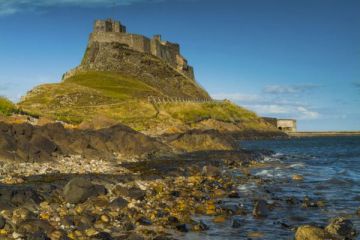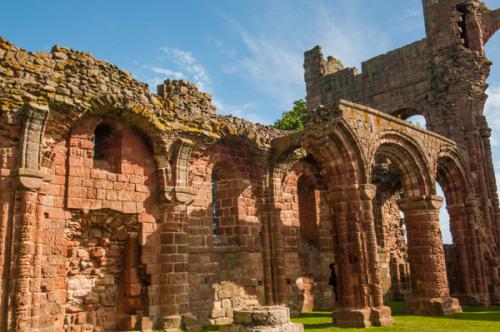
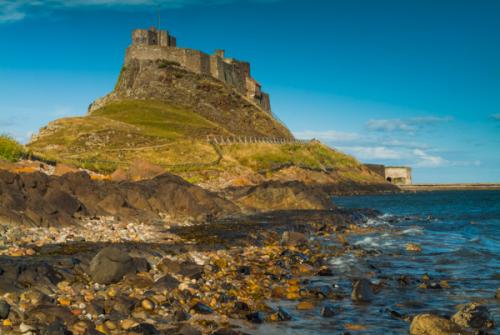
The name Lindisfarne is often used (incorrectly) to refer to Holy Island, a tidal island off the Northumberland coast. Though the island is small, it boasts a lot of historical interest. The chief points of interest are the dramatically sited Lindisfarne Castle, rising like a beacon on a rise above the seashore, and the ruins of Lindisfarne Priory, a medieval monastery.
History
The north-east coast of what is now England was only sparsely populated prior to the 6th century. In AD 547 King Ida of Bernicia began to systematically settle the coast, and his descendants established the Kingdom of Northumbria.
The next major event we know of came later in the 6th century, when Theodoric, King of the Angles, was forced to take refuge on Holy Island for three days where he was besieged by Urien, Prince of Rheged.
Around AD 634 St Aidan, an Irish monk educated at Iona, founded the monastery of Lindisfarne at the request of King Oswald of Northumbria. Shortly after AD 651, Bishop Finan of Northumbria built a timber church to act as his bishop's seat.
From these humble beginnings, Holy Island became the most important centre for the spread of Christianity in northern England. More monks came from Iona, including Cuthbert, who later rose to become abbot of Lindisfarne.
Holy Island ceased to be such an important site after the Synod of Whitby in 663 gave Roman Catholic observance the upper hand over traditional Celtic worship.
The Lindisfarne Gospels
The most famous relic of the Saxon period at Lindisfarne is the remarkable illuminated manuscript known as the Lindisfarne Gospels, probably made in the early 8th century, possibly by Eadfrith, Bishop from 698-721. The Gospels are now in the British Library in London.
The priory was abandoned after a series of Viking attacks, beginning in 793. In 875 the monks exhumed Cuthbert's body and carried it on a long journey that finally ended at Durham. After the threat of Viking invasion lessened the site of Cuthbert's original shrine became a popular place of pilgrimage.
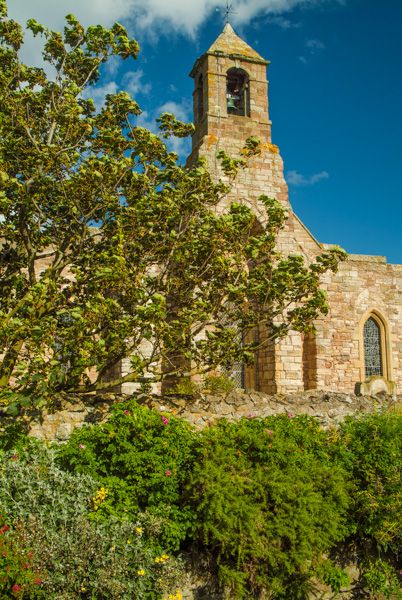
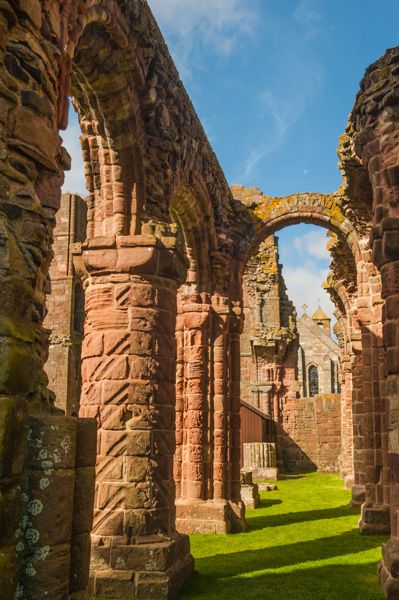
In 1093 the Celtic monastery was re-founded as a Benedictine house and continued until it was suppressed by Henry VIII in 1536. The picturesque priory ruins are one of the major visitor attractions on Holy Island. The priory does not stand on the original priory site. Instead, the parish church of St Mary was built on the original monastic site.
That makes St Mary's the oldest building on the island, or at least, the oldest one that still has a roof! Parts of the Saxon church are incorporated into the building, including the chancel arch and wall.
Lindisfarne Castle
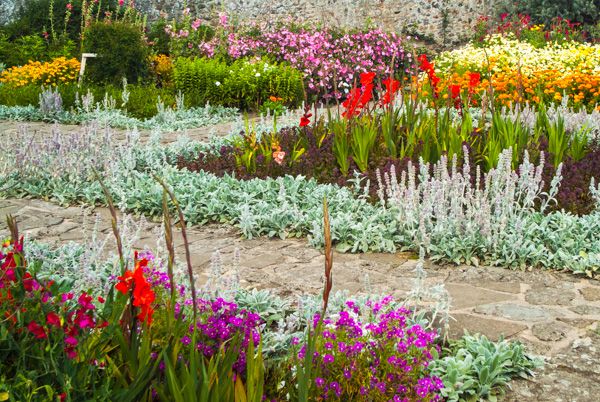
The name 'castle' is perhaps a misnomer. Henry VIII established a fort here on a plug of volcanic rock. The Tudor fort was later remodelled by Sir Edwin Lutyens in Arts and Crafts style for Edward Hudson, the editor of Country Life magazine. Gertrude Jekyll, the most celebrated gardener in the early 20th century, created a small walled garden below the castle.
There is a paid parking area for visitors near the priory and church, and a shuttle bus connecting the priory to the castle, though in truth it makes a very pleasant walk along the shore. The area around the priory has a very popular pub and several gift shops.
Holy Island is also a very popular site for bird watchers and is contained within the Northumberland Coast Area of Outstanding Natural Beauty (AONB).
More Photos
About Holy Island
Address: Lindisfarne, Northumberland, England
Attraction Type: Countryside - Island
Location: Accessed by a tidal causeway off the coastal highway near Beal. Please check tide times carefully to avoid getting stranded!
Location map
OS: NU131433
Photo Credit: David Ross and Britain Express
HERITAGE
 We've 'tagged' this attraction information to help you find related historic attractions
and learn more about major time periods mentioned.
We've 'tagged' this attraction information to help you find related historic attractions
and learn more about major time periods mentioned.
Historic Time Periods:
Find other attractions tagged with:
20th century (Time Period) - 6th century (Time Period) - 8th century (Time Period) - Arts and Crafts (Architecture) - castle (Architecture) - Celtic (Architecture) - Henry V (Person) - Henry VI (Person) - Henry VII (Person) - Henry VIII (Person) - Iona (Place) - Lindisfarne (Place) - London () - Medieval (Time Period) - Roman (Time Period) - Saxon (Time Period) - Tudor (Time Period) - Viking (Historical Reference) - Whitby (Place)
NEARBY HISTORIC ATTRACTIONS
Heritage Rated from 1- 5 (low to exceptional) on historic interest
Lindisfarne Priory - 1 miles (Abbey) 
Lindisfarne Castle - 1 miles (Castle) 
Bamburgh Castle - 5.9 miles (Castle)
Bamburgh, St Aidan's Church - 6 miles (Historic Church)
RNLI Grace Darling Museum - 6 miles (Museum) 
St Cuthbert's Cave - 6.7 miles (Countryside)
Farne Islands - 7.1 miles (Countryside)
Ancroft, St Anne's Church - 8.1 miles (Historic Church)
Nearest Holiday Cottages to Holy Island:

Holy Island, Northumberland
Sleeps: 6
Stay from:£570 - £2,923
Holy Island, Northumberland
Sleeps: 6
Stay from:£612 - £3,547