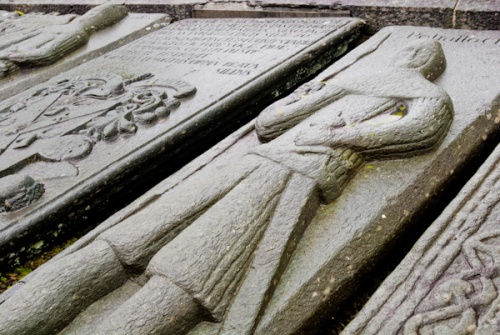
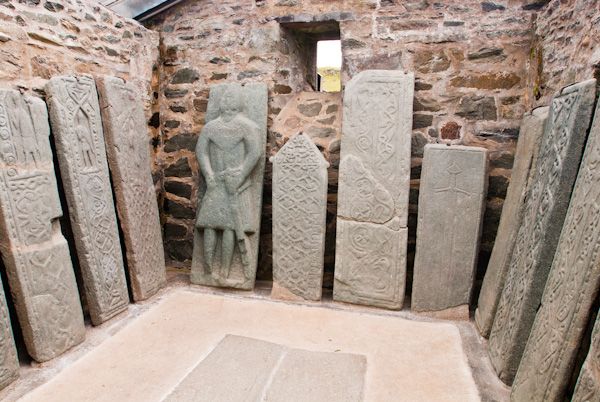
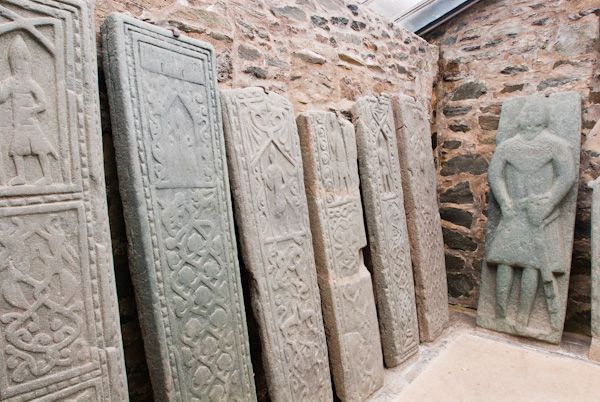
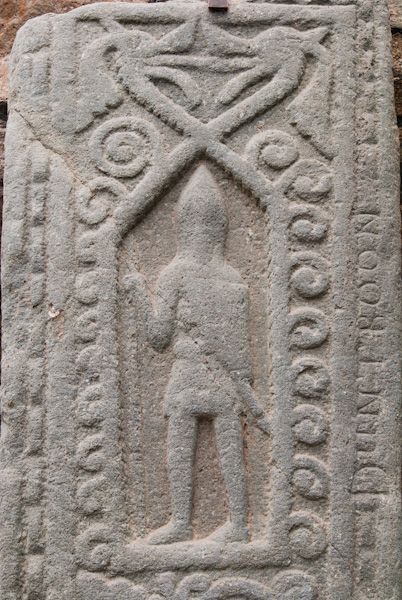
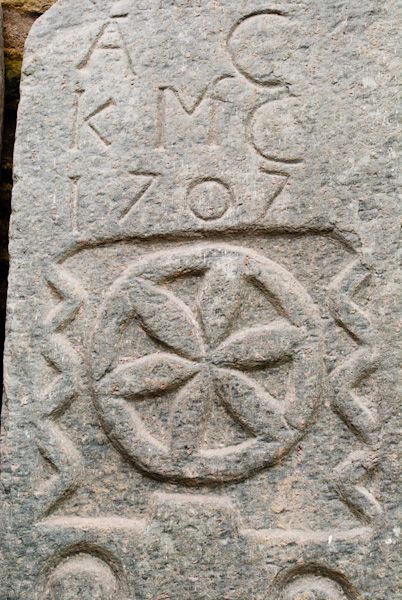
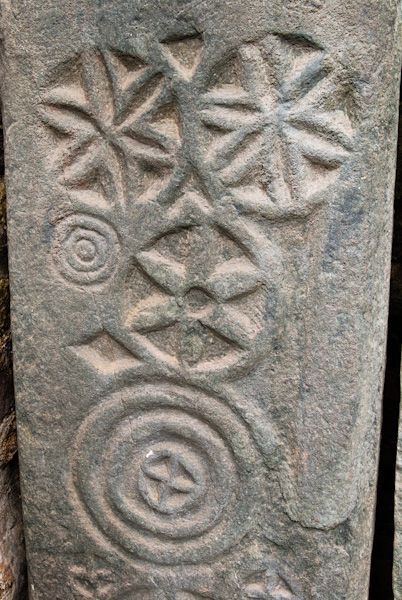
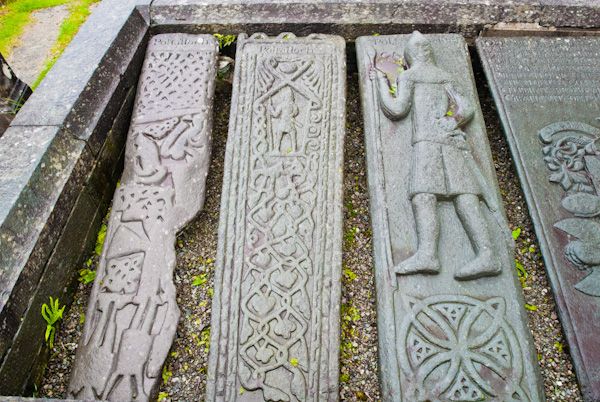
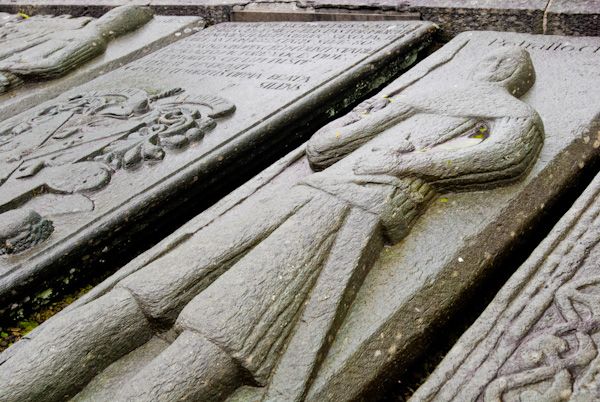
Gathered together at Kilmartin church are 80 sculpted stone grave slabs gathered from around the Kilmartin region. The earliest of the slabs dates to the 13th century, and the latest to 1712.
Most of the stones (those thought to be most at risk from weathering) are protected under cover of a former mausoleum building at the rear of the churchyard. A few others still lie 'in situ' within the churchyard.
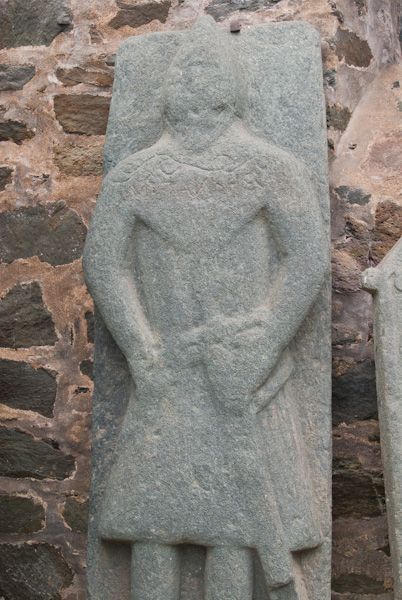
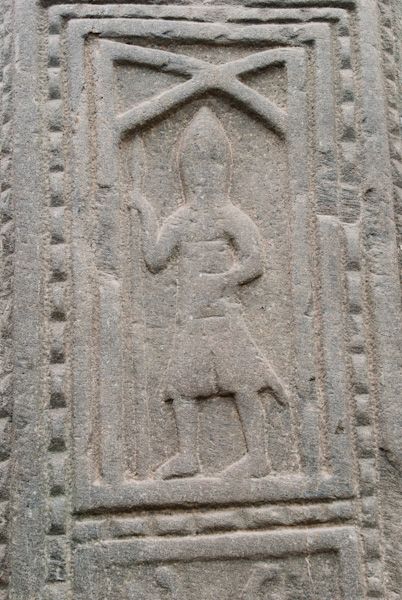
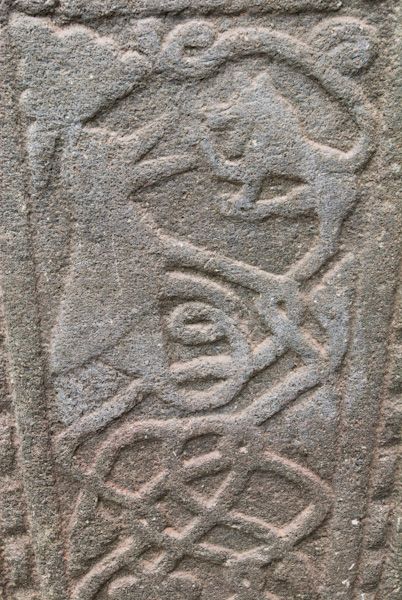
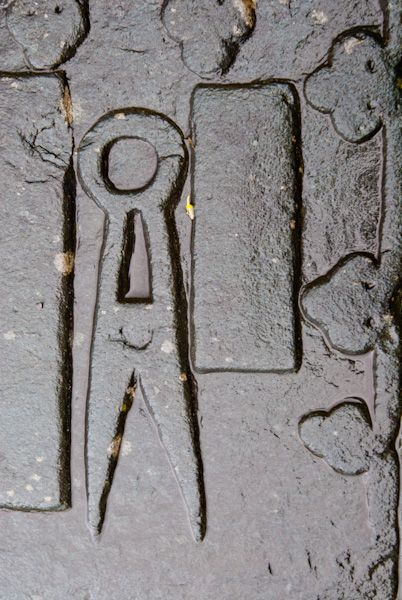
Many of the slabs carry similar carvings, including claymores and swords, often linked to interlaced foliage designs. Other symbols include animals and crosses, plus objects from daily life such as a comb and a set of shears. The latter symbol suggests that the deceased may have been a woman; the shears being a common symbol for domestic activity.
Templars at Kilmartin?
A popular yet unproven theory suggests that the Kilmartin carvings are linked in some way to the Knights Templar. This theory appears to be based on the style of swords carved on many of the slabs. The swords are much more likely to simply represent the social status of the deceased.
Many of the stones were the work of a group of sculptors working in the Loch Awe area through the 14th and 15th centuries. The carvers may have had a workshop at Kilmartin itself or in the surrounding area.
Included with the Kilmartin stones are several beautifully carved slabs from the Poltalloch Estate. The quality of the carvings is of the highest order, and the designs are similar to others in the West Highlands, such as Kilberry, Keills, and Kilmory Knap.
The Kilmartin Crosses
The two most important monuments at Kilmartin are not the grave slabs, however, but the so-called 'Kilmartin crosses', a pair of beautifully carved crosses, one dating from the 9th or 10th century, and the other of late medieval date.
The Kilmartin Crosses have been moved inside the church for protection. The church is usually open from April - Sept. 9.30 am - 7.00 pm (except during services), but please double-check current opening times before planning a visit.
Just south down the glen are a profusion of prehistoric remains, including a linear cemetery, numerous standing stones, and several sites with cup and ring carved rocks.
More Photos

About Kilmartin Sculptured Stones
Address: Kilmartin Glen, A816, Kilmartin, Argyll and Bute, Scotland
Attraction Type: Historic Church - Carved Stone
Location: Stone collection is in the Kilmartin churchyard, on the A816. Crosses are within the church; open Spring-Summer.
Website: Kilmartin Sculptured Stones
Historic Scotland
Location map
OS: NR835990
Photo Credit: David Ross and Britain Express
Opening Details: Open access site, usually accessible at any reasonable time
HERITAGE
 We've 'tagged' this attraction information to help you find related historic attractions
and learn more about major time periods mentioned.
We've 'tagged' this attraction information to help you find related historic attractions
and learn more about major time periods mentioned.
Historic Time Periods:
Find other attractions tagged with:
10th century (Time Period) - 13th century (Time Period) - carved cross (Architecture) - grave slab (Architecture) - Medieval (Time Period) - Prehistoric (Time Period) - standing stone (Historical Reference)
NEARBY HISTORIC ATTRACTIONS
Heritage Rated from 1- 5 (low to exceptional) on historic interest
Kilmartin Crosses - 0 miles (Historic Church) 
Glebe Cairn - 0.3 miles (Prehistoric Site)
Kilmartin Museum - 0.3 miles (Museum)
Nether Largie Cairns - 0.6 miles (Prehistoric Site)
Nether Largie Standing Stones - 1 miles (Prehistoric Site)
Temple Wood Stone Circles - 1 miles (Prehistoric Site)
Carnasserie Castle - 1.1 miles (Castle)
Baluachraig Cup and Ring Marks - 1.4 miles (Prehistoric Site)
Nearest Holiday Cottages to Kilmartin Sculptured Stones:
Nearby accommodation is calculated 'as the crow flies' from Kilmartin Sculptured Stones. 'Nearest' may involve a long drive up and down glens or, if you are near the coast, may include a ferry ride! Please check the property map to make sure the location is right for you.
Lochgilphead, Strathclyde
Sleeps: 5
Stay from:£479 - £2,931

Lochgilphead, Strathclyde
Sleeps: 4
Stay from:£475 - £828