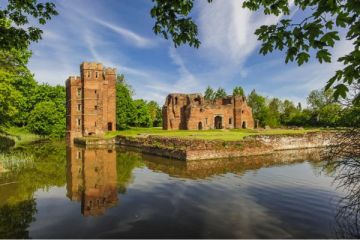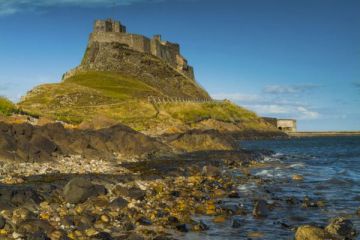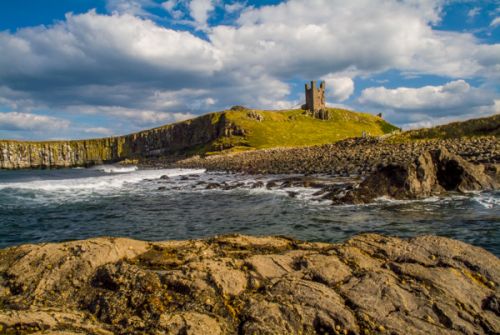
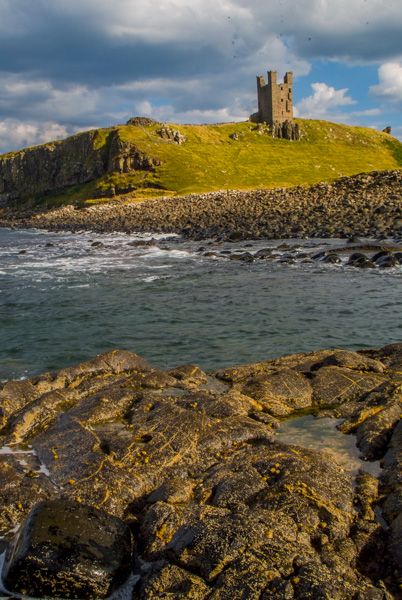
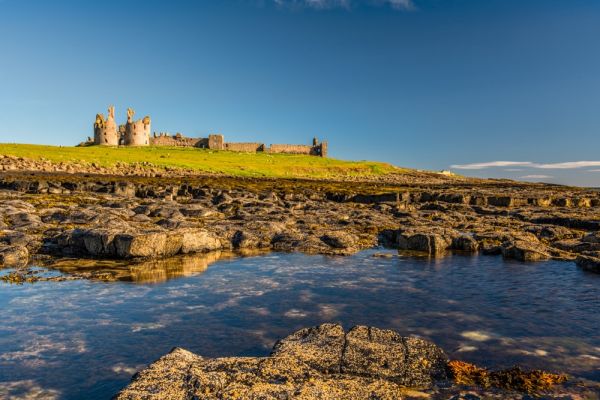
Dunstanburgh Castle is, without doubt, one of the most striking and evocative medieval castles in England. The castle sits atop high cliffs on a promontory overlooking the North Sea.
The striking remains are all the more evocative when you consider that they can only be reached by a mile-long footpath along the coast from Embleton to the north or a slightly longer path from Craster to the south. The castle is the largest in terms of area in all of Northumberland.
History
Dunstanburgh Castle was constructed by Thomas, Earl of Lancaster, in 1313, on a site that had been in use since prehistoric times. Lancaster was pressed by his royal cousin, Edward II, to join the king's expedition to Scotland. Lancaster refused, and retreated to his Northumbrian power base, where he began building his new castle, though he did not have the necessary royal permission to crenellate.

If Lancaster had joined Edward's invasion force it might have changed the course of history, as Edward was beaten by Robert Bruce at Bannockburn and the scales of Scottish independence tipped in Bruce's favour.
Lancaster's refusal was typical of his troubled relations with the crown. Edward and his cousin were briefly reconciled and the king granted a license to crenellate in 1316, but by that time Dunstanburgh was almost finished.
The Castle Unfinished
Lancaster led a revolt against Edward in 1322, a revolt that ended in defeat at the Battle of Boroughbridge. Lancaster was captured and executed at Pontefract Castle. The still unfinished castle stayed with the duchy of Lancaster, and in the late 14th century was expanded by the most famous Duke, was later expanded by John of Gaunt.
The castle finally fell out of use after 1399, when the Duchy was merged with the crown.
The castle was besieged twice by the Earl of Warwick during the Wars of the Roses and so badly damaged that it gradually fell into ruin.
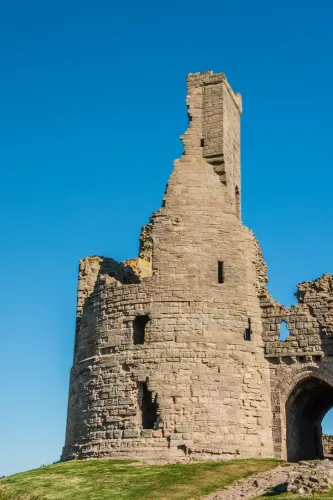
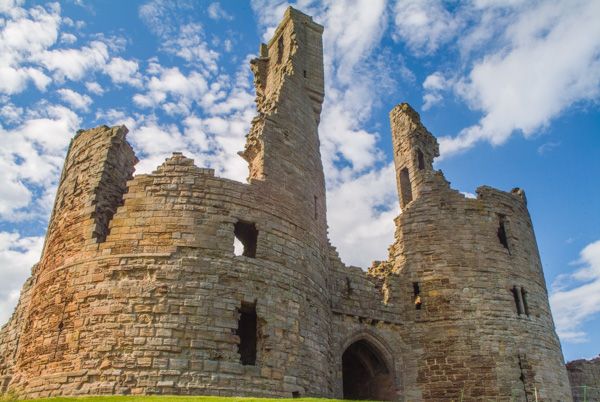
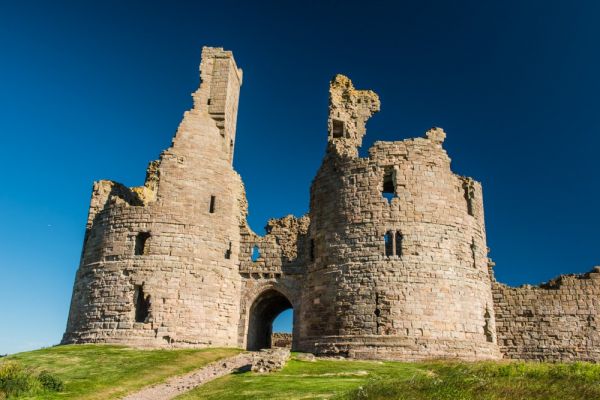
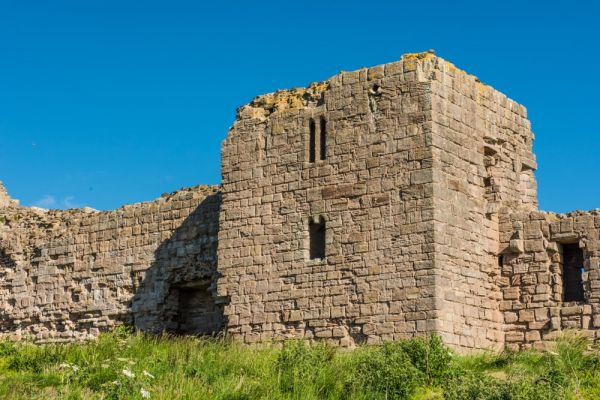
The most impressive part of the ruins is the massive gatehouse, flanked by two D-shaped towers. The towers fulfil a dual purpose as both gateway defences and residential quarters. The hall, the main living area for the castle lord and retainers, was on the top floor.
These towers once rose four stories high (about 80 feet), and give access to an inner ward surrounded by a stone wall, and punctuated by two rectangular towers known as the Constable and Egyncleugh towers. A further rectangular tower, known as the Lilburn tower, stands to the north.
John of Gaunt's Castle
When John of Gaunt set about his rebuilding at Dunstanburgh in the 1360s he blocked the gatehouse passage and inserted a new gate in the nearby curtain wall, defended by a projecting barbican. This effectively marooned the earlier gatehouse towers, turning the keep/gatehouse into a keep tower. He built a walled courtyard behind his new tower, with a constable's lodging in the courtyard.

John of Gaunt's blocking walls were torn down in the Victorian period, leaving the castle with two entrances close together.
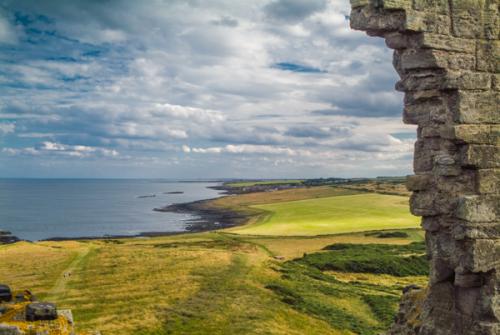
Views of the castle across the sweep of the coastline to the north and south are stunning, a fact that painter JMW Turner certainly appreciated, as the famed landscape artist painted Dunstanburgh on several occasions.
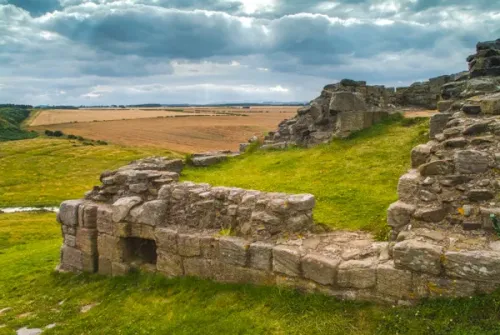
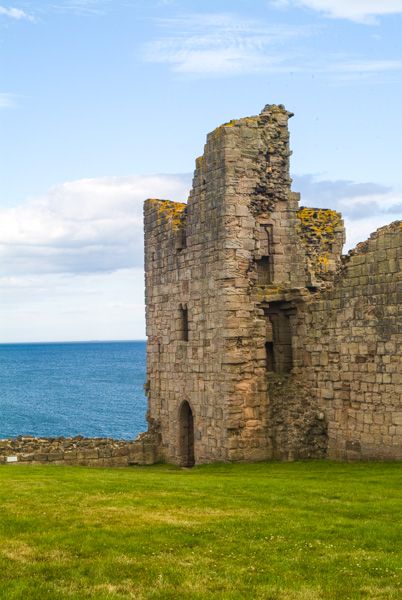
Dunstanburgh is one of the most dramatically situated castles in northern England, with almost sheer cliffs on the seaward side and crumbling, ruinous towers creating ragged silhouettes on the skyline. It's a stunning location, with the sound of the waves and seabirds calling creating atmospheric background noise.
More Photos
About Dunstanburgh Castle
Address: Dunstanburgh Road, Craster, Northumberland, England, NE66 3TT
Attraction Type: Castle
Location: Reached via a coastal footpath from Craster to the south or Embleton to the north
Website: Dunstanburgh Castle
Email: dunstanburghcastle@nationaltrust.org.uk
National Trust
Location map
OS: NU258220
Photo Credit: David Ross and Britain Express
HERITAGE
 We've 'tagged' this attraction information to help you find related historic attractions
and learn more about major time periods mentioned.
We've 'tagged' this attraction information to help you find related historic attractions
and learn more about major time periods mentioned.
Historic Time Periods:
Find other attractions tagged with:
14th century (Time Period) - castle (Architecture) - Edward II (Person) - JMW Turner (Person) - Medieval (Time Period) - Prehistoric (Time Period) - Victorian (Time Period) - Wars of the Roses (Historical Reference)
NEARBY HISTORIC ATTRACTIONS
Heritage Rated from 1- 5 (low to exceptional) on historic interest
Howick Hall Gardens - 2.1 miles (Garden) 
Howick, St Michael's Church - 2.2 miles (Historic Church)
Alnwick Garden - 2.9 miles (Garden) 
Preston Tower - 5.5 miles (Historic Building)
Alnwick Castle - 6.4 miles (Castle) 
Bailiffgate Museum, Alnwick - 6.4 miles (Museum)
Alnwick, St Michael's Church - 6.5 miles (Historic Church) 
Alnwick Abbey Gatehouse - 6.6 miles (Abbey)
Nearest Holiday Cottages to Dunstanburgh Castle: