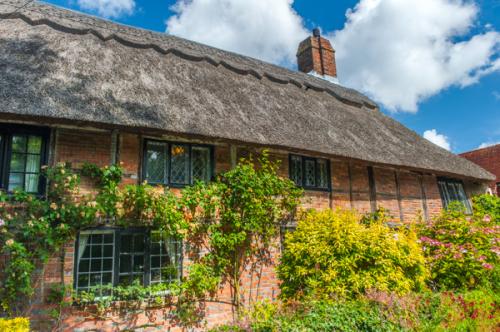
Wilmington is a pretty village just west of Polegate, located immediately south of the A27 between Eastbourne and Lewes. The village is famous primarily for the ancient hill figure known as the Long Man of Wilmington, carved into the slope of a chalk hill just south of the village.
The village is laid out on either side of a single street, running on a north/south axis.
History
We know that the area around Wilmington was settled in the prehistoric period, for there are Bronze Age barrows on the downs above the village. It seems likely that the earliest inhabitants of Wilmington lived on top of the surrounding hills but moved down into the valley in the late Saxon period.
The Domesday Book tells us that Earl Godwinson, the father of King Harold, owned most of the land here before the Norman Conquest. The Domesday Book recorded the village name as 'Wineltone'.
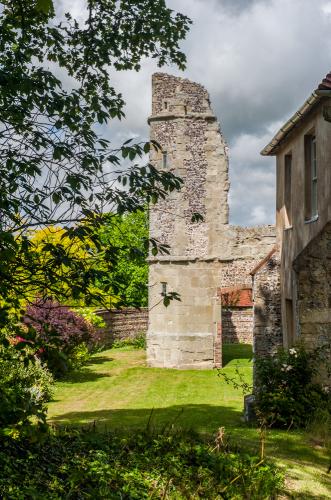
Wilmington Priory
The Benedictine Abbey of Grestain in Normandy established a priory at Wilmington sometime before 1243, possibly as early as the late 12th century. Unusually, the priory did not have its own church or chapter house, and monks prayed in the parish church, dedicated to St Mary and St Peter.
The most important moment in the priory's history came in 1265, when Eleanor, wife of Simon de Montfort, Earl of Leicester, stayed here on the eve of the Battle of Evesham.
In 1413 Henry V granted Wilmington Priory to the dean and chapter of Chichester as part of a general move away from monasteries with foreign links, known as 'alien houses'.
The priory fell into disrepair after the Dissolution of the Monasteries, but it survives as a much-modified residence now operated by the Landmark Trust as holiday accommodation.
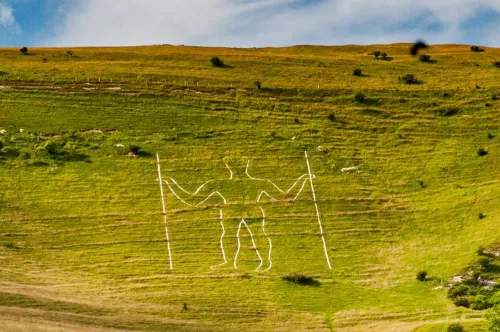
Long Man of Wilmington
Carved into the north facing slope of the downs immediately south of the village is the mysterious figure of a man holding a slender upright pole in each hand. The Long Man of Wilmington is 230 feet high and theories as to its age vary from prehistoric times to the 17th century. The earliest historical record of the carving appears in 1710. One suggestion is that it was carved by monks from Wilmington Priory.
The Long Man, like the priory, was granted by the landowner, the Duke of Devonshire, to the Sussex Archaeological Trust in 1925.
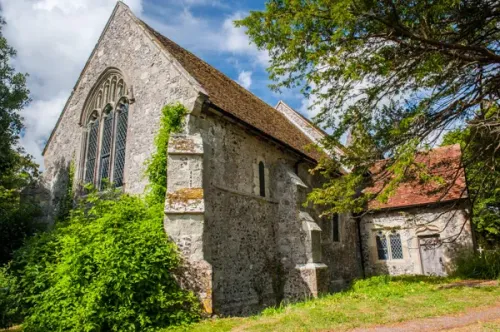
St Mary & St Peter's Church
Though the village was listed in the Domesday Book, as mentioned above, there is no record of a church until the early 12th century. Despite this, it seems very likely that a timber Saxon church stood on this site since the 7th century.
The most intriguing historical treasure inside the church is the 'Wilmington Madonna', a carved stone figure thought to date to the 12th century, though some historians think that it may be pagan in origin.
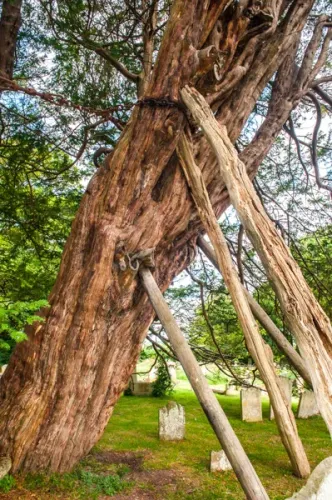
The Wilmington Yew
In the churchyard is an ancient yew tree thought to be somewhere between 1,600 and 2,000 years old. Its presence suggests that the site was a sacred place long before the first church was erected here. The yew measures roughly 23 feet around at its base, and has to be supported by wooden braces and chains to keep it upright.
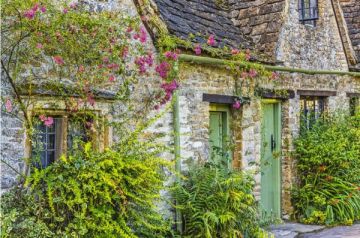
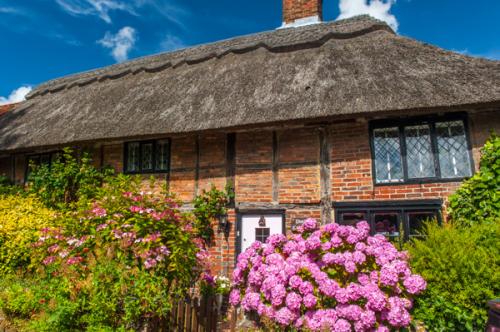
Do take the time to stroll about the village; there are over two dozen listed buildings in Wilmington, including several attractive thatched cottages, that help give Wilmington an air of timeless beauty.
Visiting
Wilmington is easy to access off the A27, with the turnoff three miles west of Polegate. There is limited parking along The Street, the main road that leads south through the heart of the village. There is a large car par at the southern fringe of Wilmington, signposted for visitors to the Long Man and the Priory.
About Wilmington
Address: A27, Wilmington, East Sussex, England
Attraction Type: Village
Location: On the A27, 3 miles west of Polegate. Parking at the southern edge of the village, signed for the Long Man and Priory.
Location map
OS: TQ545044
POPULAR POSTS
HERITAGE
 We've 'tagged' this attraction information to help you find related historic attractions
and learn more about major time periods mentioned.
We've 'tagged' this attraction information to help you find related historic attractions
and learn more about major time periods mentioned.
Find other attractions tagged with:
12th century (Time Period) - Henry V (Person)
NEARBY HISTORIC ATTRACTIONS
Heritage Rated from 1- 5 (low to exceptional) on historic interest
Wilmington, St Mary & St Peter - 0.1 miles (Historic Church) 
Long Man of Wilmington - 0.6 miles (Prehistoric Site)
Alfriston, St Andrew's Church - 1.7 miles (Historic Church) 
Alfriston Clergy House - 1.8 miles (Historic Building)
Long Burgh Barrow - 2.3 miles (Prehistoric Site)
Polegate Windmill - 2.3 miles (Historic Building)
Michelham Priory - 3.2 miles (Abbey)
Westdean, All Saints Church - 3.2 miles (Historic Church)
Nearest Holiday Cottages to Wilmington: