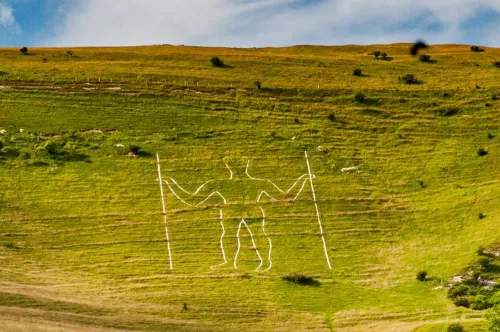
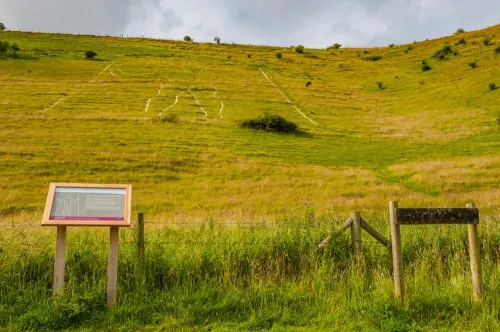
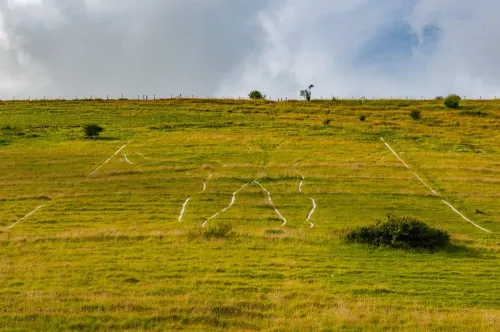
The Long Man of Wilmington is one of Britain's most famous hill figures, carved into the north-facing slope of Windover Hill, immediately south of Wilmington village. The figure depicts a man bearing a long, slender rod in each hand. These rods, or poles, extend above the figure's head on both sides.
Early writers describe these rods as being in the form of a scythe and a rake, but if so, their outline has been altered.
The figure is set against the backdrop of a grassy hillside riven with horizontal 'terracettes', miniature terraces, or ripples, in the contour of the hill. These terracettes are formed by the ongoing effects of animal activity combined with weathering.
History
The first recorded mention of the Long Man of Wilmington comes from 1710, when the surveyor John Rowley drew an illustration of the site. Rowley's drawing suggests that the original figure was little more than a shadow on the grass rather than the solid outline we see today.
The illustration also depicts the Long Man with a helmet where the face should be. This has led some historians to suggest that the Long Man was meant to be the figure of a prehistoric warrior or god of war.
The figure of the Long Man was only visible when the light was just right, or after a snowfall, but in the 19th century a series of yellow bricks were laid out along the faint shape that showed through the grass, making the figure visible at a distance.
Some records suggest that these bricks reshaped the Long Man and changed to position of its feet.
Local legend also suggests that the figure was robbed of his manhood due to the prudish attitudes of the Victorian period. It makes a nice story, but there is no historical or archaeological evidence to support the legend.
The Long Man was painted green to match the surrounding grass during WWII, when the British military was concerned that the figure might be used by enemy aircraft as a navigation landmark.
In 1969 the figure was restored and the earlier bricks that marked the figure's outline were replaced with concrete blocks. These blocks are repainted on a regular basis so that the hill figure is easily visible from a distance. In good light you can see the Long Man from several miles away.
How Old is the Long Man?
In truth, no one knows. It has been presumed to be prehistoric, but some historians think the figure was carved by monks from nearby Wilmington Priory sometime during the 11th or 12th centuries. Other historians point to 4th-century Roman coins bearing a similar figure, or to Saxon art that bears a strong resemblance to a helmeted version of the Long Man.
The Duke of Devonshire gave the Long Man of Wilmington to the Sussex Archaeological Trust in 1925. The Trust, now renamed the Sussex Archaeological Society, still looks after the site today.
Visiting
The Long Man is almost directly on the course of the South Downs Way long-distance footpath, but for visitors arriving by car, access is simple. There is a free car park at the southern edge of Wilmington village, reached directly off the A27 just east of Polegate.
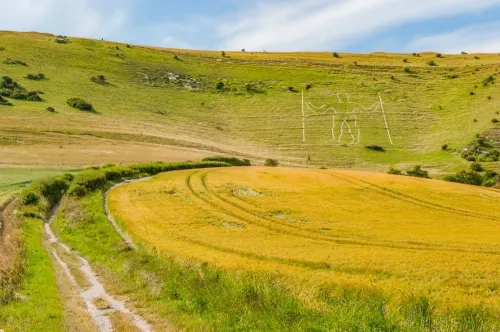
From the car park, a well-signed footpath leads about 500 metres to the base of the hill figure, where you will find an information panel. The figure is in sight most the way.
I found that the best views were from a distance, as the closer you get to the hill figure, the greater the apparent angle of the hill and, thus, the less of the figure you can see. It is still worth the walk just to see the Long Man up close!
It is interesting to compare the Long Man of Wilmington to its most obvious parallel, the Cerne Abbas Giant in Dorset.
About Long Man of Wilmington
Address: South Downs Way, Wilmington, South Downs, East Sussex, England, BN26 5SW
Attraction Type: Prehistoric Site
Location: Access via the South Downs Way or by footpath from a car park at the southern fringe of Wilmington village, off the A27.
Website: Long Man of Wilmington
Location map
OS: TQ542034
Photo Credit: David Ross and Britain Express
POPULAR POSTS
HERITAGE
 We've 'tagged' this attraction information to help you find related historic attractions
and learn more about major time periods mentioned.
We've 'tagged' this attraction information to help you find related historic attractions
and learn more about major time periods mentioned.
Historic Time Periods:
Find other attractions tagged with:
18th century (Time Period) - Medieval (Time Period) - Prehistoric (Time Period) - Roman (Time Period) - Saxon (Time Period)
NEARBY HISTORIC ATTRACTIONS
Heritage Rated from 1- 5 (low to exceptional) on historic interest
Wilmington, St Mary & St Peter - 0.5 miles (Historic Church) 
Alfriston, St Andrew's Church - 1.3 miles (Historic Church) 
Alfriston Clergy House - 1.4 miles (Historic Building)
Long Burgh Barrow - 2 miles (Prehistoric Site)
Polegate Windmill - 2.4 miles (Historic Building)
Westdean, All Saints Church - 2.6 miles (Historic Church)
Friston, St Mary's Church - 3.3 miles (Historic Church)
Charleston - 3.6 miles (Historic Building) 
Nearest Holiday Cottages to Long Man of Wilmington:

Stone Cross, East Sussex
Sleeps: 4
Stay from:£440 - £2,121