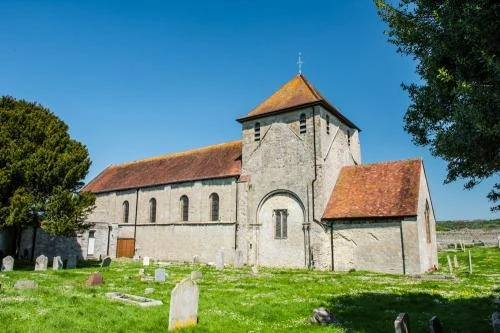
Portchester's remarkable parish church stands within the walls of historic Portchester Castle, on the western bank of Portsmouth Harbour.
History
The origins of Portchester's parish church are confusing, to say the least. Depending on which source you consult, it was founded either in 1128 or 1133, at the instigation of Henry I or of William Pont de l’Arche, who served the king as Sheriff of Hampshire and as a member of the Royal Exchequer.
The church's own excellent guidebook suggests that William Pont de l’Arche established the church in 1128 and Henry I founded an Augustinian priory, attached to the church, in 1133.
On the other hand, English Heritage, who look after Portchester Castle, suggest that William Pont de l’Arche established the priory around 1128 and this foundation was merely confirmed in Henry I's charter of 1133.
If the origins of the church and priory are subject to debate, their location is not; they stood within the castle's outer bailey, an area encircled by ancient Roman walls.
Portchester Priory eventually moved to a larger site at Southwick around 1150, but the priory church remained to serve as Portchester's parish church, though there is no longer any trace of the other priory buildings.
What to See
The church is partially enclosed by a low stone wall and occupies the south-east corner of the castle's outer bailey. It is an outstanding example of Romanesque style and has been altered very little since it was built.
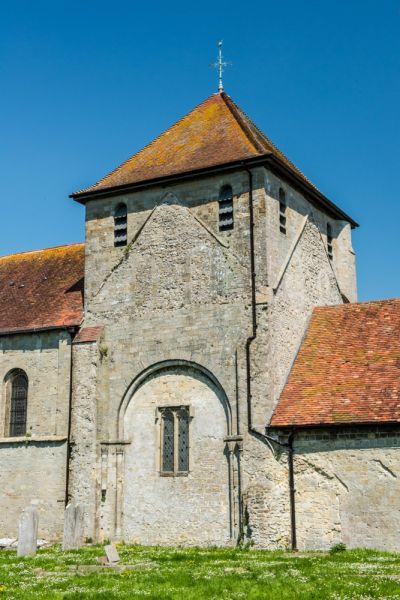
The church is cruciform in plan, with a central tower. The priory cloister was laid out to the south of the church, but there is no trace of the cloister or other monastic buildings above ground. You can still see the doorway that led from the church to the cloister in the south wall, though it is now blocked.
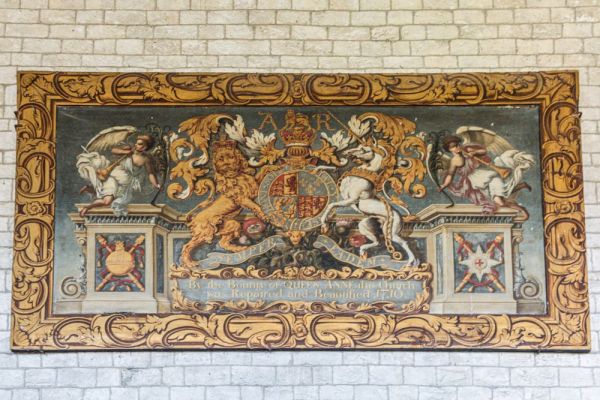
The church was used to hold prisoners of war during the 17th century and it was heavily damaged in 1653 when Dutch prisoners set it on fire. The damage was not repaired until 1710, with a grant of money from Queen Anne's Bounty, an act of Parliament that provided money for church repair and to augment the income of poor clergymen.
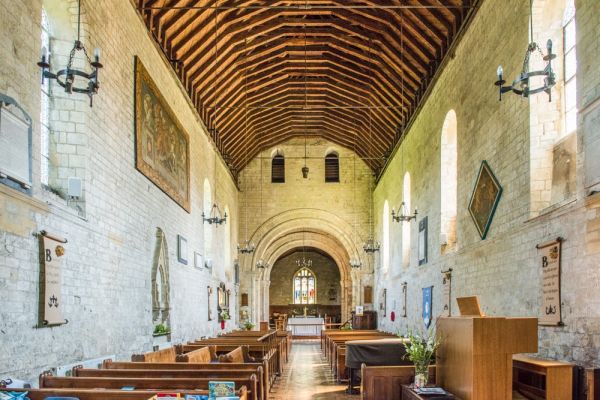
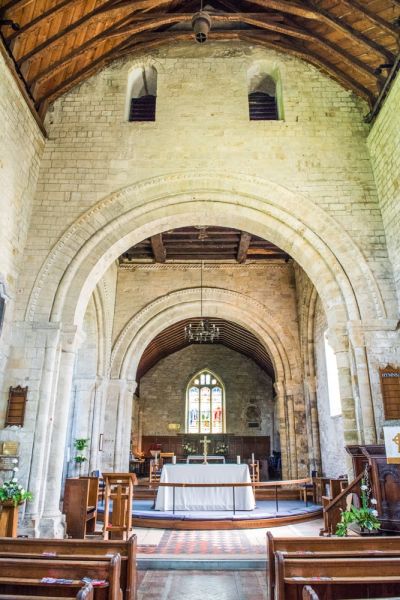
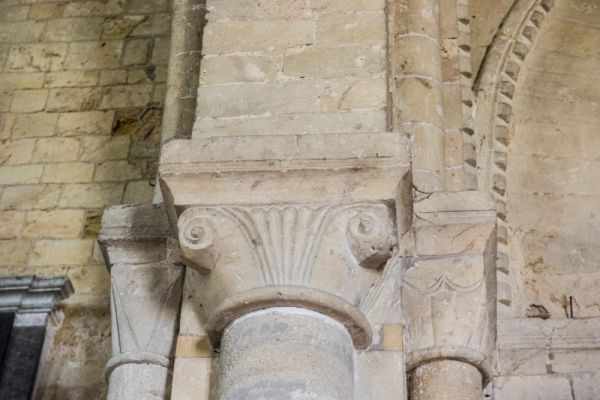
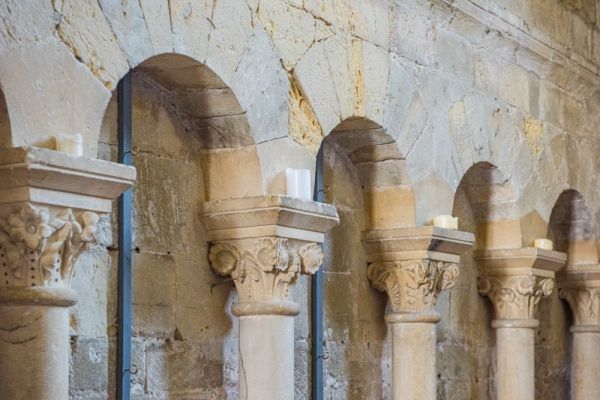
The church interior shows its origins as a monastic church, with beautifully carved arcades and blocked arches in several places, both interior and exterior.
Highlights
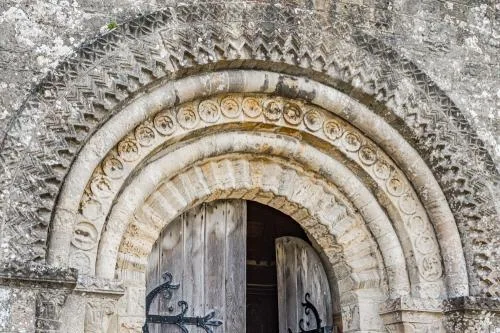
You enter the church through the west door, a beautiful example of Norman sculpture with four layers of carved moulding. The interior is exceptionally simple, with Romanesque windows illuminated a long, narrow space.
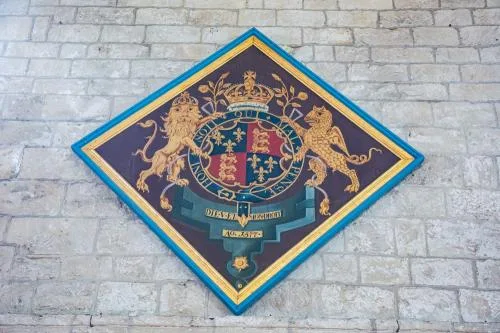
Unusually, there are two royal coats of arms. One, on the south nave wall, dates to 1577, during the reign of Elizabeth I, and the second, on the north wall, is from 1710, during the reign of Queen Anne. The Elizabethan painted arms may be the oldest in England.
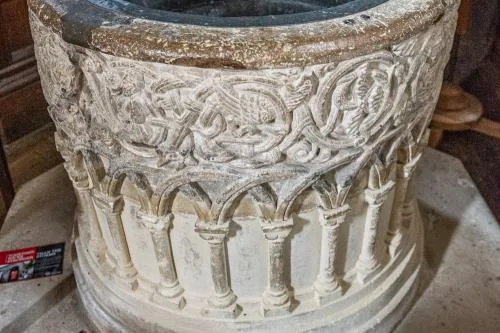
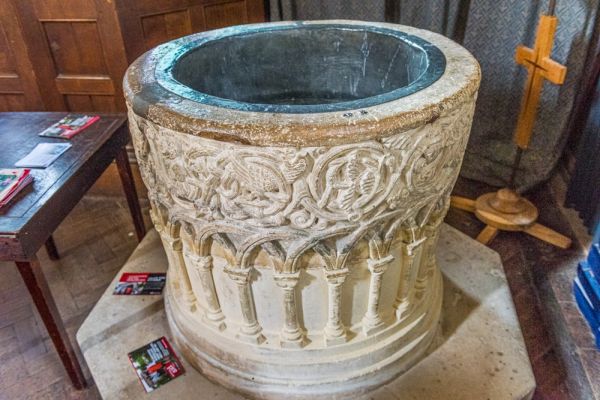
The richly-carved circular font bowl is a striking example of 12th-century craftsmanship, with magnificent interlacing foliage above round-headed arches.
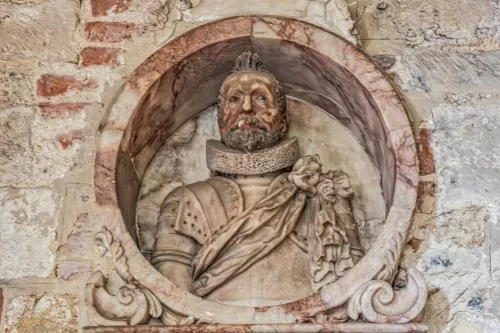
The most interesting memorial is that of Sir Thomas Cornwallis (d. 1618), who served as groom porter to Queen Elizabeth. The memorial is of alabaster, showing a half-effigy of Cornwallis dressed in armour, with a coat of arms above his head. The carving detail of his armour and glorious neck ruff is exquisitely crafted.
Other memorials include that of Thomas Luttman, who died in 1757, and Reverend Thomas Longlands (d. 1856), vicar of Portchester for more than 50 years.
HMS Tremendous Table
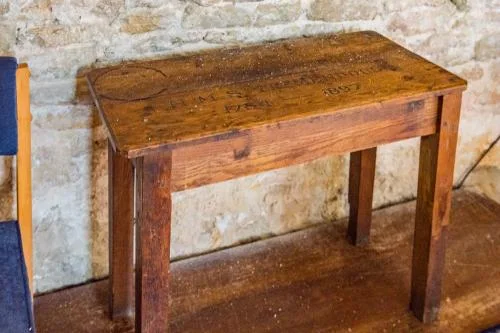
One historical feature, easily missed, is a small wooden table against the wall. This table was made from timbers salvaged from the HMS Tremendous. The Tremendous was a 74-gun ship of the line in the Royal Navy, launched in 1784 and took part in the Battle of the Glorious First of June, the Battle of Port Louis, and the Neapolitan War, amongst other actions. The ship remained afloat in one form or another until 1897, a remarkable span of 113 years.
The Tremendous was rebuilt in the Chatham dockyards in 1810 and was the first ship built with a diagonal truss system, designed by Robert Seppings, the Master Shipwright at Chatham. The Tremendous was renamed HMS Grampus in 1845, and under that name it served as a powder hulk from 1856.
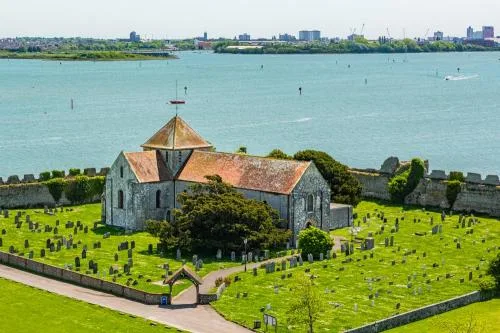
St Mary's is a fascinating building, with little architectural features everywhere that speak to its origins as a priory church.
Do take time to explore the church if you are already planning a trip to see Portchester Castle.
Visiting
The church stands within the Roman walls that surround Portchester Castle. There is a castle car park at the end of Castle Lane. From there, you walk through the castle gate and you will see the church in the far-right corner of the castle grounds. The church is regularly open to visitors and was open when we visited.
More Photos
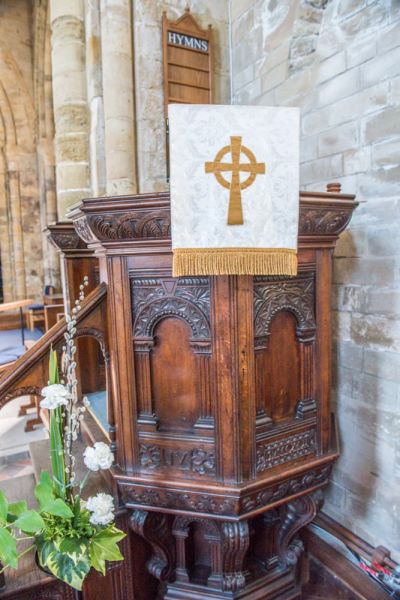
About Portchester, St Mary's Church
Address: Portchester Castle, Castle Street, Portchester, Hampshire, England, PO16 9QH
Attraction Type: Historic Church
Location: Inside the grounds of Portchester Castle. There is a castle car park at the bottom of Castle Street.
Website: Portchester, St Mary's Church
Location map
OS: SU625045
Photo Credit: David Ross and Britain Express
HERITAGE
 We've 'tagged' this attraction information to help you find related historic attractions
and learn more about major time periods mentioned.
We've 'tagged' this attraction information to help you find related historic attractions
and learn more about major time periods mentioned.
Historic Time Periods:
Find other attractions tagged with:
12th century (Time Period) - 16th century (Time Period) - Elizabeth I (Person) - Elizabethan (Architecture) - Norman (Architecture) - Queen Anne (Person) - Tudor (Time Period)
NEARBY HISTORIC ATTRACTIONS
Heritage Rated from 1- 5 (low to exceptional) on historic interest
Portchester Castle - 0.1 miles (Castle) 
Fort Brockhurst - 2.4 miles (Historic Building) 
The Mary Rose - 2.4 miles (Museum) 
Southwick Priory - 2.5 miles (Abbey)
Southwick, St James Without-the-Priory Gate Church - 2.6 miles (Historic Church)
King James Gate - 2.9 miles (Historic Building) 
Landport Gate - 3 miles (Historic Building)
Portsmouth Museum - 3.2 miles (Museum)
Nearest Holiday Cottages to Portchester, St Mary's Church:

Titchfield Common, Hampshire
Sleeps: 4
Stay from:£660 - £2,329