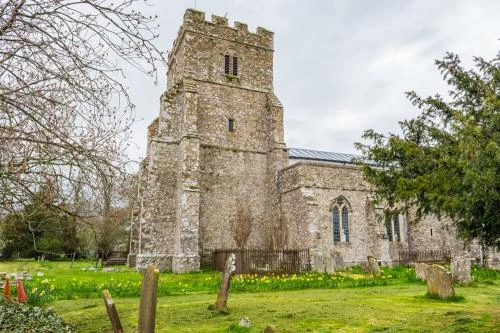
St George's Church, Ivychurch, is a large 14th-century building, known as 'The Cathedral of Romney Marsh' for its impressive size (the same is sometimes said of All Saints Church in nearby Lydd). There was an earlier 13th-century church on the same site, but this was rebuilt from the ground up in the 14th century, creating a church much larger than the rural population could ever have needed.
History
We don't know when the first church was erected at Ivychurch, but there was a church here during the 13th century, as well as a monastery. Fragments of 13th-century stonework are incorporated into the east wall of the sanctuary. Over the porch is a parvise, a small chamber used as a lodging for priests.
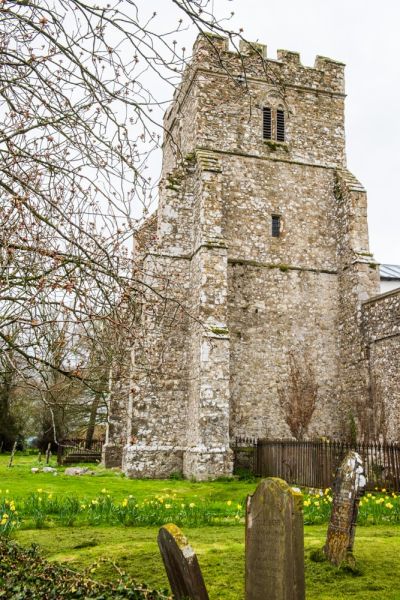
St George's Church is among the largest in Kent, at 135 feet long, with a tower reaching 100 feet high. The church is laid out on an unusual plan, with the nave and aisles running parallel from the west tower to the east wall, with no chancel arch or other structural division along the way.
A Smuggler's Haven
Local tradition says that Oliver Cromwell's troops used the north aisle to stable their horses during the Civil War. Tradition also suggests that smugglers used the vaults beneath the church to store their contraband good during the 18th century, when Romney Marsh was heavily used for illicit smuggling.
Romney Marsh was a haven for smugglers, who often used churches to store their goods. Rectors looked the other way and sextons were often involved in smuggling. Smugglers would lead their pack horses up to the church to load and unload.
The church was used by the Home Guard during WWII and a watch was kept in the tower every night for signs of invasion.
Historical Highlights
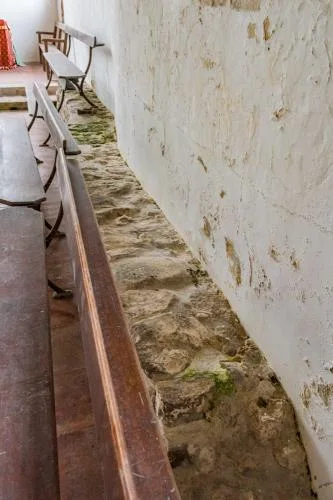
One ancient relic is a long stone bench, or seat, built against the south wall at the entrance to St Katherine's Chapel. This seat probably survives from the 13th-century building. The seat allowed aged or infirm members of the congregation to sit during services at a time before benches became common.
Able-bodied worshippers stood, knelt, or sat on the floor, which would have been covered with rushes. The stone seat gave rise to the old expression, 'Let the weakest go to the wall.'
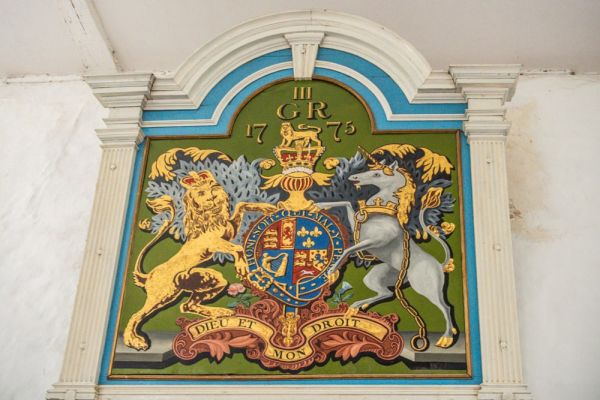
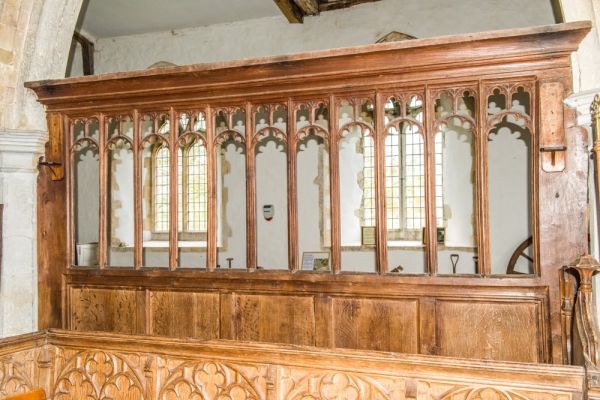
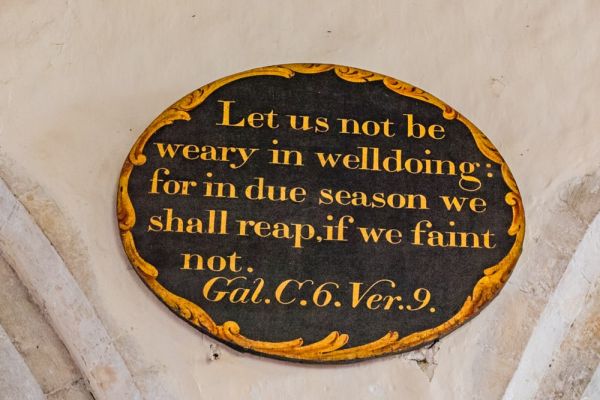
There are pieces of original 14th-century glass in the window of St Katherine's chapel, and the base of a 15th-century screen still separates the chancel and nave. Surviving features from the 18th century include the pulpit, oval text boards, reredos panels, and a royal coat of arms to King George III, dated 1775.
The partition separating the north aisle from the rest of the church is also Georgian and was made from the 18th-century box pews.
A Clergyman's Hudd
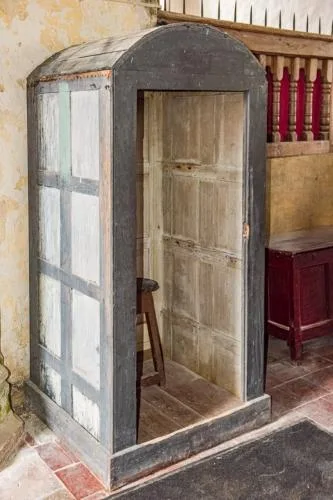
The most unusual historical feature inside the church is a an 18th-century 'hudd', which resembles a wooden sentry box. The hudd is a portable shelter used during burial services, mainly to keep the clergyman's prayer book and powdered wig dry during inclement weather. It was carried to the graveside and used during the service, then stowed away until needed again.
Hudds were popular during the Georgian period, when wigs were commonly worn. Other examples of hudds can be seen at Wingfield (Suffolk) and Deeping St James in Lincolnshire.
The Ivychurch hudd is enclosed on three sides and has a rounded top so that rain will run off.
The Ivychurch Textile
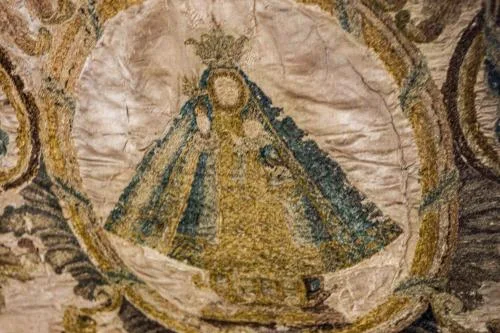
The most interesting historical treasure inside the church is a 16th-century Chenille embroidery, known as the Ivychurch Textile. The embroidery, in the form of a banner, probably originated in the south of France in the middle of the 18th century. It depicts a crowned Virgin and Child.
The Virgin Mary holds a bird in one hand, possibly meant to be the Dove of the Holy Spirit. alternatively, it could represent a phoenix, the symbol of the Resurrection. The Christ Child holds a bird, thought to represent a goldfinch, the symbol of The Passion.
Wall Painting
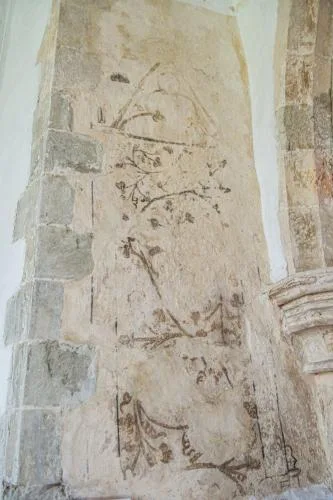
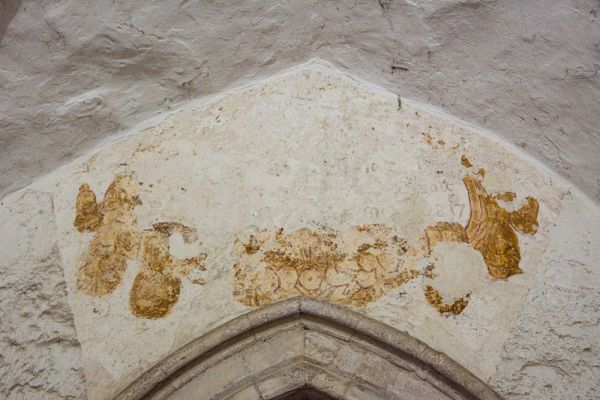
In 2009, a wall painting was discovered beside a blocked window. The painting consists of an architectural frame containing ornate scrollwork detail. The frame seems similar in style to paintings of the 14th century, but the scrollwork, depicting acanthus leaves and three-lobed flowers, seems more consistent with paintings of the 13th century.
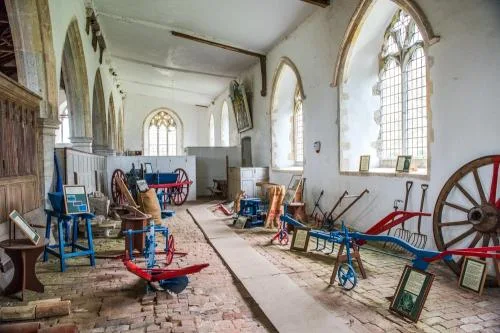
When we visited, the north aisle was given over to a display of historical farming equipment, donated by Eli Frith of Chapel Farm.
Visiting
Ivychurch is roughly 4 miles north-west of New Romney. The church is in the centre of the village, next to the Bell Inn, and there is parking in a lay-by outside the churchyard. The church was open when we visited.
More Photos
About Ivychurch, St George's Church
Address: Ashford Road, Ivychurch, Romney Marsh, Kent, England, TN29 0AL
Attraction Type: Historic Church
Location: In the centre of the village, beside the Bell Inn. Pasrking in a lay-by outside the church.
Website: Ivychurch, St George's Church
Location map
OS: TR028276
Photo Credit: David Ross and Britain Express
NEARBY HISTORIC ATTRACTIONS
Heritage Rated from 1- 5 (low to exceptional) on historic interest
Old Romney, St Clement's Church - 1.5 miles (Historic Church) 
St Mary in the Marsh Church - 2.2 miles (Historic Church)
Midley Church - 2.8 miles (Historic Church) 
New Romney, St Nicholas Church - 2.8 miles (Historic Church)
Romney, Hythe & Dymchurch Railway - 3.3 miles (Family Attraction)
Fairfield, St Thomas Becket Church - 3.9 miles (Historic Church) 
Lydd, All Saints Church - 4.2 miles (Historic Church)
Appledore, St Peter & St Paul Church - 4.6 miles (Historic Church)
Nearest Holiday Cottages to Ivychurch, St George's Church: