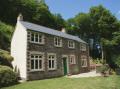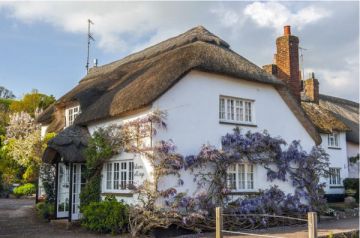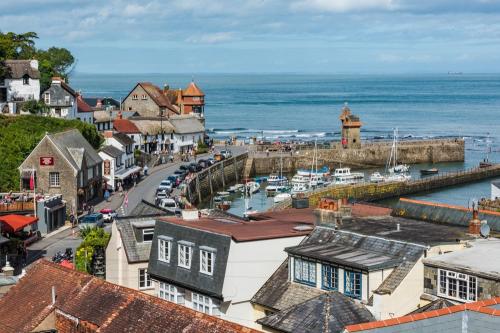
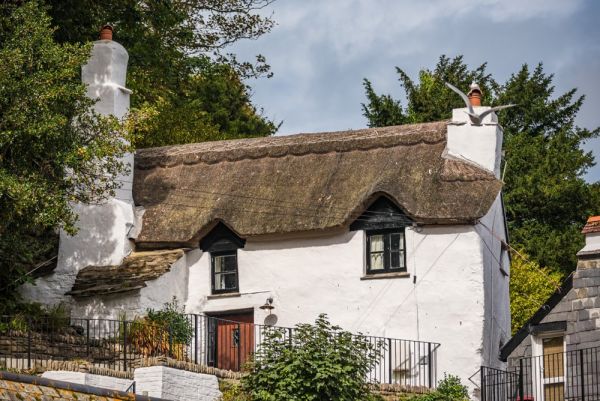
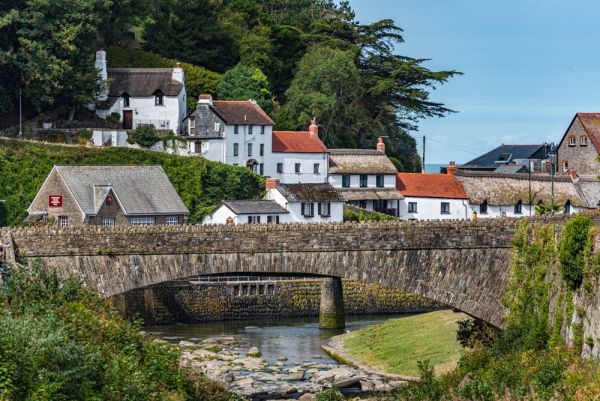
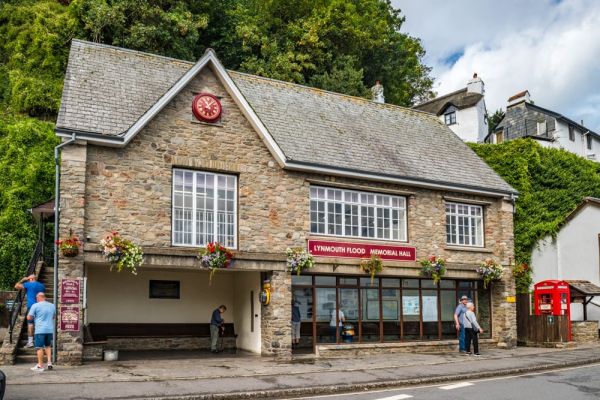
The twin villages of Lynton and Lynmouth together make up one of the most popular seaside resorts in Devon. Though the two villages are often linked together, they have very different characters. Lynton, on top of the cliffs, is a Victorian resort, while Lynmouth, at the base of the cliffs, is a historic fishing village of stone-built cottages beside the River Lyn.
Cliff Railway
Linking the seaside harbour of Lynmouth to the clifftop settlement of Lynton is a steam-driven funicular, or tramway. The tramway was begun in 1887 by Sir George Newnes and opened on Easter Monday, 1890. There are 2 cars, each holding up to 40 passengers, linked by a continuous cable.
Water from the West Lyn River feeds a tank under the upper car, while water is released from the lower car until the top car outweighs it and begins its descent. Our family has taken the trip, and it is great fun!

Valley of the Rocks
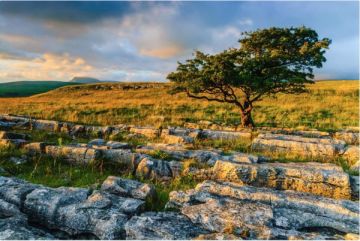
Just west along the coast from Lynmouth is the Valley of the Rocks, a sheltered dry valley running parallel to the coast, famed for its herd of wild goats. The scenery is stunning, and the cliffs are some of the highest in Britain.
Our family has taken the walk, when our daughter was no more than 5 years old, and we all enjoyed it. An extremely popular circular walk leaves from the cliff railway station and follows the coastal path through the Valley of the Rocks before looping inland and back to Lynton.
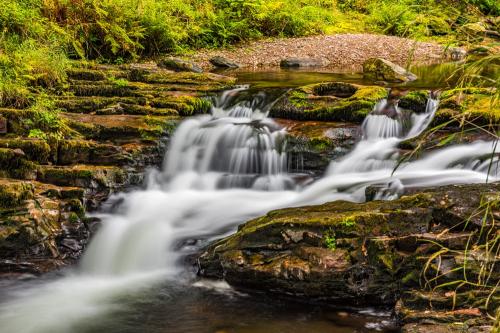
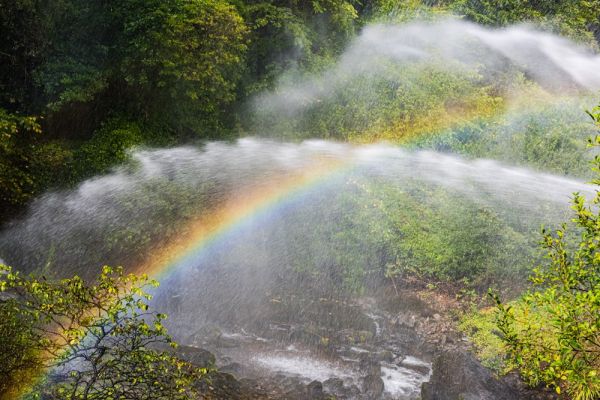
Just inland is Watersmeet, where the rivers Hoaroak and East Lyn join. The rivers run down a narrow, rocky gorge, over a series of spectacular waterfalls. The National Trust owns the countryside and runs a visitor centre and cafe at Watersmeet.
The area gained popularity during the Napoleonic Wars when British tourists were forced to forgo their holidays on the continent. Victorian visitors dubbed the area 'Little Switzerland' by Victorian visitors, and it is easy to see why, for the region is sheer heaven if you enjoy stunning landscapes and walking opportunities.
The Tarka Trail and South West Coast Path run through Lynmouth, and the Two Moors Way terminates here, as does the Coleridge Way. No wonder, then, that painter Thomas Gainsborough declared that the twin villages were 'the most delightful place for a landscape painter this country can boast'.
Lynmouth is located at the western edge of Exmoor National Park.
More Photos
About Lynmouth
Address: Lynmouth, Devon, England
Attraction Type: Village
Location map
OS: SS732479
Photo Credit: David Ross and Britain Express
HERITAGE
 We've 'tagged' this attraction information to help you find related historic attractions
and learn more about major time periods mentioned.
We've 'tagged' this attraction information to help you find related historic attractions
and learn more about major time periods mentioned.
Historic Time Periods:
Find other attractions tagged with:
NEARBY HISTORIC ATTRACTIONS
Heritage Rated from 1- 5 (low to exceptional) on historic interest
Brendon, St Brendan's Church - 1.5 miles (Historic Church) 
Valley of Rocks - 1.8 miles (Countryside) 
Parracombe, St Petrock's Church - 4.1 miles (Historic Church) 
Oare, St Mary's Church - 4.4 miles (Historic Church)
Robber's Bridge - 5.5 miles (Historic Building) 
Culbone, St Beuno's Church - 7 miles (Historic Church)
Arlington Court - 8.7 miles (Historic House)
Arlington, St James Church - 8.7 miles (Historic Church)
Nearest Holiday Cottages to Lynmouth: