In 1192, Richard the Lionheart was returning from the Crusades when he was captured by Duke Leopold V of Austria, who later transferred him to The Holy Roman Emperor, Henry VI. The emperor demanded a huge ransom of 150,000 marks.
Elias, the abbot of Notre-Dame des Dunes at Coxyde (now Koksijde) on the Belgian coast, played a major role as an intermediary in the ransom process that led to Richard's release. In gratitude, King Richard granted the abbey the church of Eastchurch, on the Isle of Sheppey. This is the first historical record of a church at Eastchurch.
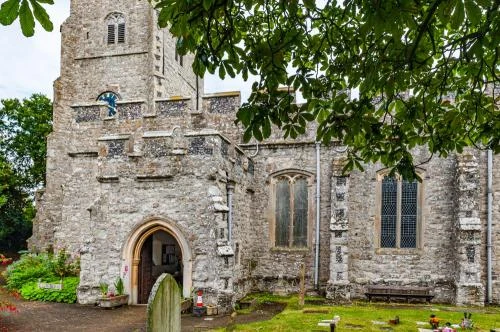
We know that a new church was built in the middle of the 13th century, possibly at what is now Parsonage Farm. Unfortunately, this church stood on a bed of London Clay. Over time, the clay shifted, making the church unstable. When King Henry VI was informed of this in 1431, he ordered the building of a new church on a different site, using stone from the mainland.
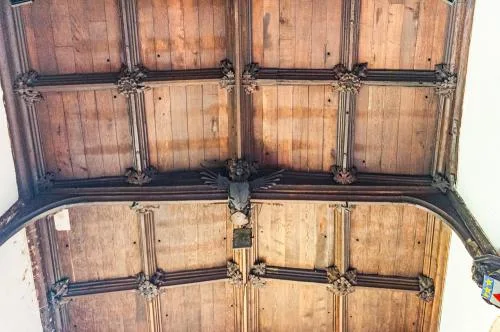
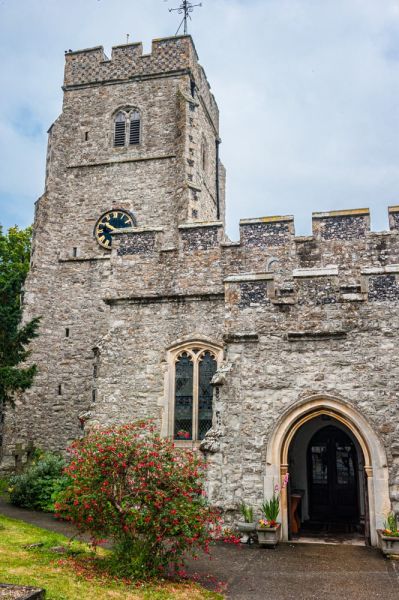
This new church was designed by William Nudds, a monk from Boxley Abbey, near Maidstone. The new church was built in Perpendicular Gothic style and used external buttresses to ensure stability. The result is a triumph of 14th-century architecture and has been very little altered since it was built.
The Abbey of Boxley applied for control of Eastchurch in 1472 but it was not until 1515 that this was completed.
A Vicar with Connections
In 1684, James Jeffries was appointed vicar off Eastchurch. Jeffries had earlier served as the chaplain to the Duke of York (later to become King James II). He was also the brother of George Jeffries, a judge who gained notoriety for the brutal severity with which he treated the Duke of Monmouth's followers in the aftermath of the Monmouth Rebellion of 1685.
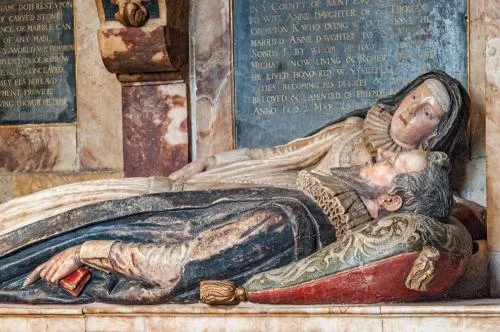
The Livesey Monument
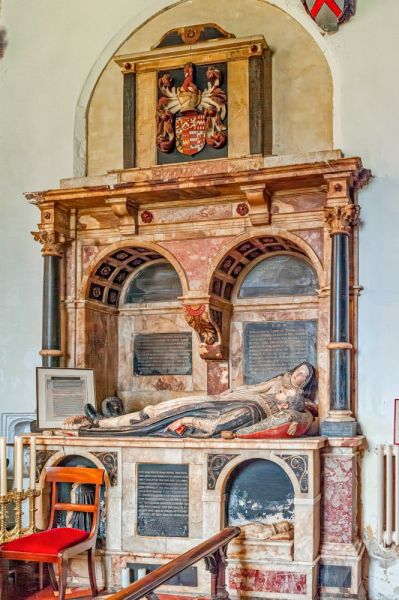
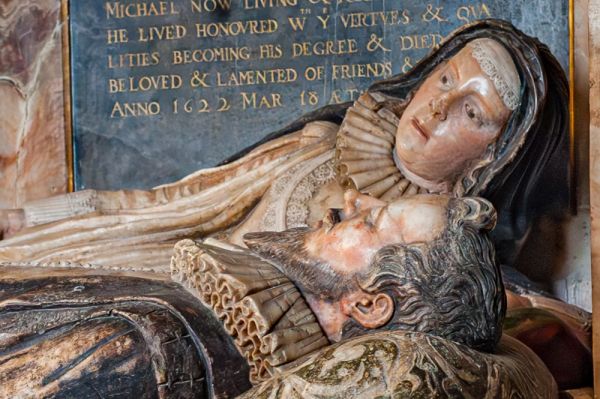
Against the south wall of the chancel is a stunning 17th-century monument to Sir Gabriel Livesey (d. 1622) and his second wife, Anne. This ornate monument shows the couple lying beneath a double niche and a family coat of arms. Interestingly, Anne's effigy is higher than her husband's and she is turned almost to the vertical, while he lies flat on his back. The epitaph reads, in part:
'Here sleeps in ye hope of Resurrection ye Body of Gabriel Livesey of Hollingbourne in ye County of Kent Esq. He first took to wife Anne daughter of Sir Thomas Crumpton Kt. who dying without issue he married Anne daughter of Sir Michael Sonds Kt. by whom he had 2 sonnes, Michael now living and Robert deceased. He lived honoured with ye virtues and qualities becoming his degree and died both beloved and lamented by friends and neighbours. Anno 1622. March 18. Aetat 55.'
On the base of the monument is a kneeling figure of a boy, depicting Michael Livesey, eldest son of Gabriel and Anne. Michael Livesey was made a baronet in 1627 and inherited Parsonage Farm in Eastchurch when his father died.
Michael Livesey raised troops in Kent to fight for Parliament in the Civil War and fought with distinction. In 1649 he served as one of the judges at the trial of King Charles I and he signed the king's death warrant. When Charles II was restored to the throne, Livesey wisely fled to Holland, where he died in 1665. Tradition says that he was assassinated by agents of the Crown, but this seems unlikely.
The Alms Box
One historical highlight inside the church is the ancient alms box, which may be original to the 15th-century church. The alms box was carved from a single piece of oak and is secured with three locks, each of which can only be opened with a separate key. One key was held by the rector and the other two by churchwardens. Think of it as the medieval equivalent of multi-factor authentication today.
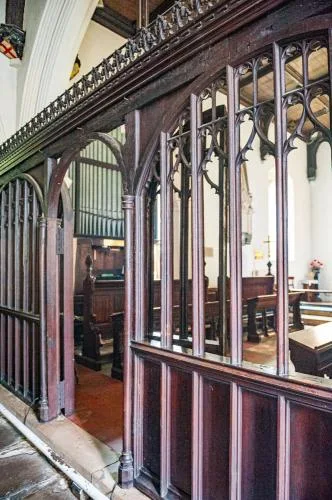
The Rood Screen
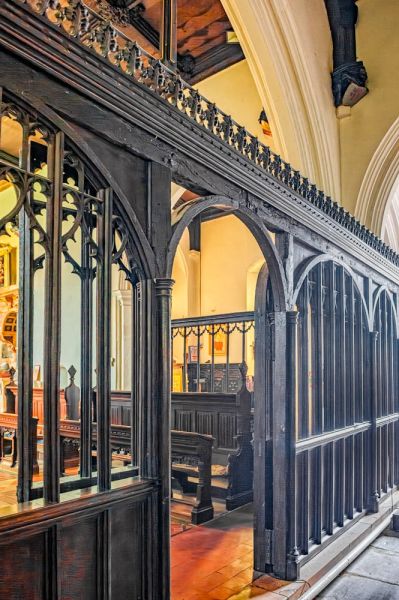
The rood screen stretches across the full width of the church, encompassing the nave and both aisles in an unbroken span. It is thought to belong to the 15th-century church and is the only original and uninterrupted rood screen in Kent. It is beautifully carved, with elegant tracery throughout.
On the north chancel wall is a marble memorial to Vice Admiral Sir Richard King, who was captain of the HMS Achilles at the Battle of Trafalgar.
Charles Rolls
Eastchurch has strong links to the early history of aviation. Look for a memorial window to Charles Stewart Rolls of Rolls-Royce fame, and Cecil Stanley Grace, aviators who died in separate flying accidents in 1910.
Rolls died in July of that year when the tail of his aircraft broke off during an aeronautics display in Bournemouth. This is the first recorded fatality of a British person in an aircraft accident. Grace was lost on a flight across the English Channel in December 1910.
A window in memory of both men was installed in 1912 by their friends. Neither man is buried here; Grace's body was never recovered, while Rolls is buried in St Cadoc's Church in Llangattock-Vibon-Avel, Monmouthshire.
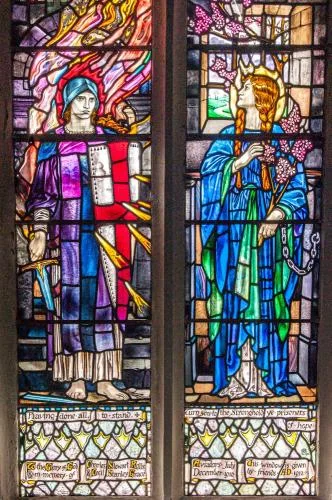
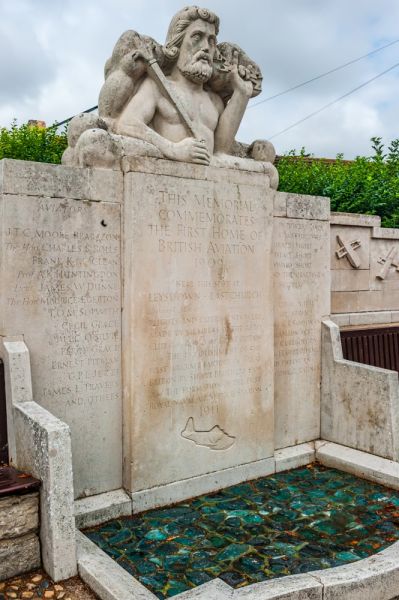
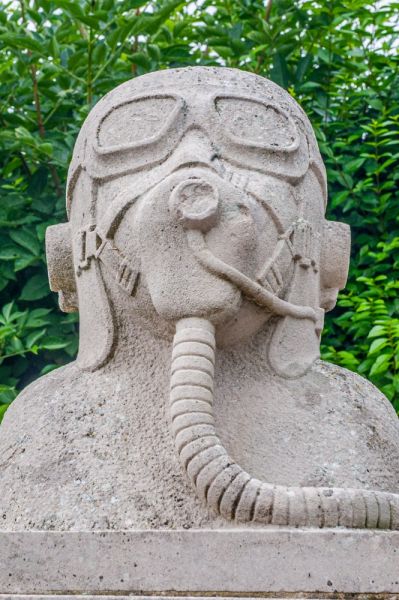
Across the road from All Saints Church is the 'Memorial to the Home of Aviation', commemorating the role of Eastchurch and Leysdown in the beginnings of the Royal Aero Club (1910) and the RAF base outside Eastchurch in 1911.
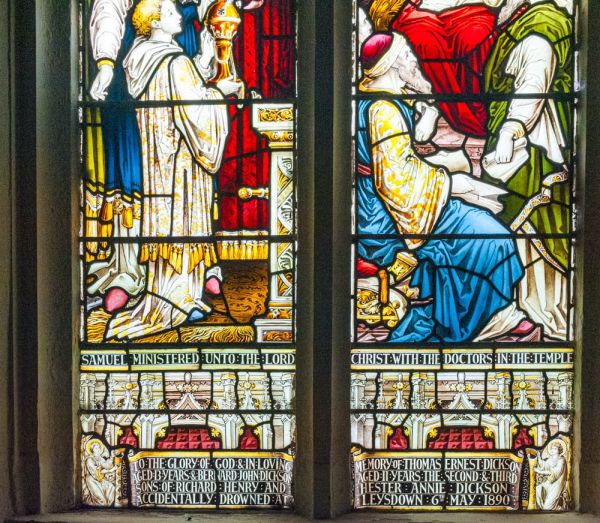
Nearby is a poignant window given in memory of two boys, Thomas and Bernard Dickson, aged 13 and 11 respectively, who drowned in 1890.
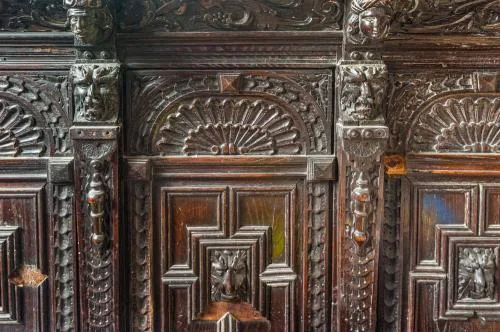
The wooden pulpit dates to the 17th century and boasts finely carved panels. There are two brass candlestick holders, each dating to the reign of George II. There is 17th-century panelling in the tower and the south-east chapel. The panelling was brought here from the Cathedral of St Martin at Ypres.
The nave roof dates to the 15th century.
Visiting
There is parking along High Street, outside the church wall. The church is normally open daily and was open when we visited.
More Photos
About Eastchurch, All Saints Church
Address: High Street, Eastchurch, Isle of Sheppey, Kent, England, ME12 4BN
Attraction Type: Historic Church
Location: On High Street, in the centre of the village. There is parking along the road.
Website: Eastchurch, All Saints Church
Location map
OS: TQ988714
Photo Credit: David Ross and Britain Express
NEARBY HISTORIC ATTRACTIONS
Heritage Rated from 1- 5 (low to exceptional) on historic interest
Minster Abbey, Isle of Sheppey - 2.1 miles (Historic Church) 
Harty, St Thomas Church - 3.9 miles (Historic Church)
Queenborough, Holy Trinity Church - 4.9 miles (Historic Church) 
Luddenham, St Mary's Church - 5.2 miles (Historic Church)
Faversham Stone Chapel - 6.3 miles (Historic Building)
Faversham, St Mary of Charity Church - 6.5 miles (Historic Church)
Chart Gunpowder Mills - 6.6 miles (Museum)
Maison Dieu - 6.6 miles (Historic Building)
Nearest Holiday Cottages to Eastchurch, All Saints Church:
Sittingbourne, Kent
Sleeps: 13
Stay from:£1,291 - £6,084