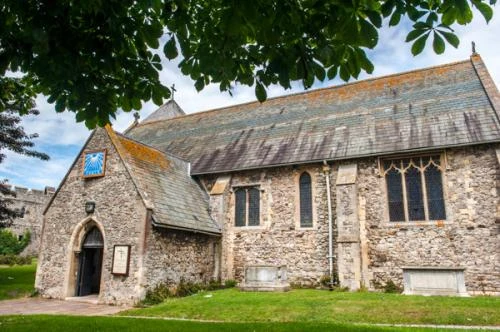
The Abbey Church of the Blessed Virgin Mary and Saint Sexburgha, better known simply as Minster Abbey, is a 12th-century church with a fascinating history going back to the 7th century. It is also a church in two very different parts, with each having its own distinct character, but to understand why this is so, you have to look back into the church's long history.
History
The name 'Minster' provides a clue to the history of this attractive seaside village just east of Sheerness. The name comes from the Old English word for a monastery, or a monastery church.
Sometime between AD 664 and 670, Seaxburh (alternatively spelled Sexburga, Sexburg, or Sexburgha) of Ely, the widowed Queen of Kent, built a Benedictine nunnery on the Isle of Sheppey, in the north-east corner of modern Kent. The site was granted by Seaxburh's son, King Ecgberht of Kent. This was among the earliest nunneries in Kent and was said to be home to 77 nuns.
Queen Seaxburh's daughter Ermenilda joined the nunnery at Minster as a nun, while Seaxburh herself later became the abbess of a double monastery at Ely, where she died. An account held in the library of Lambeth Palace in London suggests that Seaxburh used slave labour to build the nunnery at Minster, but this cannot be confirmed from other sources.
Minster Abbey was the mother church of Sheppey, with chapels founded at Eastchurch, Queenborough, Warden, and Leysdown. The abbess had the right to name the parish priest, but this right later passed to the abbot of St Augustine's Abbey in Canterbury, who also presented the nunnery's chaplain. The chaplain and priest had lodgings in the imposing gatehouse (now the Minster Abbey Museum).
The Danes invaded Sheppey in AD 835 and burned Seaxburh's nunnery to the ground, but after William the Conqueror's successful invasion in 1066, he had the ruined nunnery partially restored, and it was populated by nuns from Newington.
Archbishop de Corbeuil's Double Church
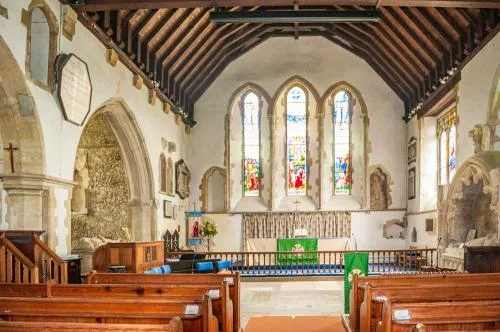
The nunnery was never wealthy, and it struggled along until Archbishop de Corbeuil rebuilt it, beginning in 1123. Archbishop de Corbeuil created two adjoining churches, the southern one used by the local parishioners and the northern one by the nuns. It is possible that the division between the two churches was nothing more than a curtain strung between the nave arches.
Stone for the new churches was imported from Caen, using the same quarry that supplied Canterbury Cathedral.
This 'church in two parts' division explains the sprawling layout of Minster Abbey and the distinct character of the north and south aisles today. The division also saved the Minster church from the depredations of Henry VIII's commissioners during the Dissolution of the Monasteries, for the parish church and the monastic church shared a common wall between them.
As a result, the church was spared, though the rest of the abbey, apart from the gatehouse, was pulled down following the nunnery's suppression in 1539.
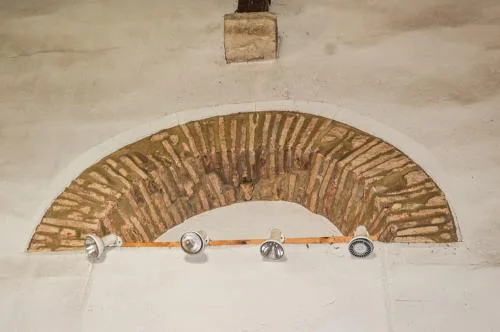
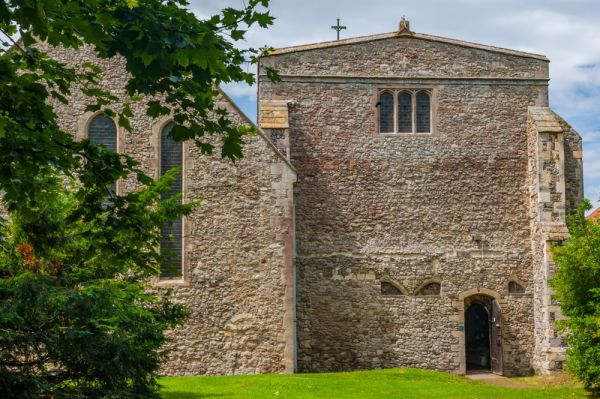
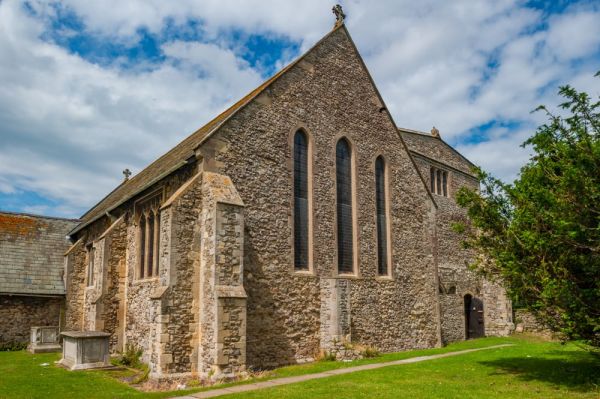
The church we see today consists of a double nave and chancel, south porch, and a west tower terminating the northern nave. The northern half of the church is the oldest part of the building and incorporates Saxon stonework, but most of the church fabric dates to the 13th century.
The tower is a later addition, built on the 15th century. It was never finished and is topped by a modern timber belfry.
The eastern end of the north chancel dates to 1581, while the south parch is a Victorian addition. The southern half of the church has a Victorian character thanks to a restoration in 1879 under the direction of Ewen Christian (1814–1895), best known for his work on Carlisle Cathedraland Southwell Minster.
Historical Highlights
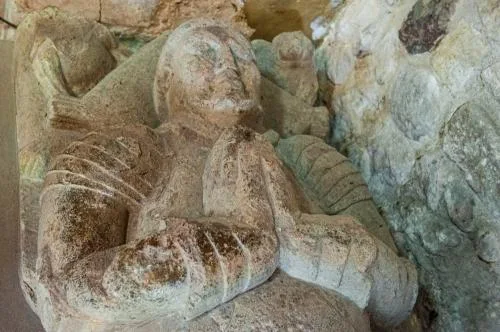
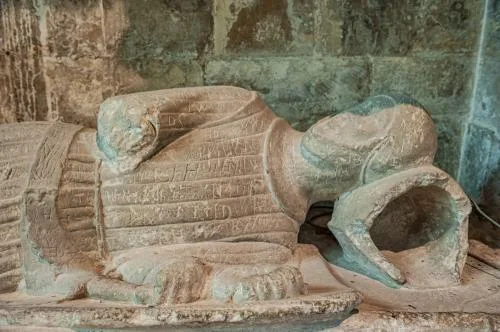
The church features a number of medieval and Tudor monuments. Perhaps the most interesting is that of Sir Robert de Shurland, who fought for King Edward I in his campaigns against the Scots. Shurland was the Lord of Shurland and Minster and Baron of Sheppey. His date of death is uncertain, but it may have been 1324 or 1327.
The Myth of Grey Dolphin
Sir Robert's armoured effigy lies in a richly-carved niche against the south wall, his head resting on his helmet and his feet supported by a squire. Behind his legs, on a smaller scale than the main effigy, is the stone head of a horse in mail, seeming to rise from waves.
Legend, later repeated in The Ingoldsby Legends, says that Sir Robert killed a monk and, determined to seek forgiveness from the king, rode to the place where the king's ship lay at anchor, off the Isle of Sheppey. He swam out to the ship on his horse and begged the king to forgive him. The king agreed to do so, and Sir Robert and his horse swam back to shore.
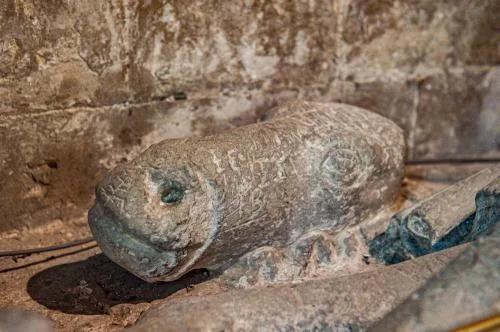
On his return, Sir Robert met a witch, who foretold that his horse, named Grey Dolphin, would be the cause of his death. Sir Robert immediately drew his sword and cut off Grey Dolphin's head.
A year later, Sir Robert was walking along the beach at the same spot, when he came upon the horse's bones. He kicked the horse's skull, and a sherd of jagged bone impaled his foot. This being long before knowledge of germs and treating infection, the wound festered and Sir Robert died from blood poisoning.
Is the presence of the horse's head on Sir Robert's tomb vindication of the legend?
Er ... no. It is far more likely that the horse's head is a symbol of Sir Robert de Shurland's status as a knight. Horses were often part of a knight's funeral procession and sometimes brought inside the church. Other effigies from the same period feature horses, and none of them are linked to a witch's prediction.
Sir Thomas Cheyne
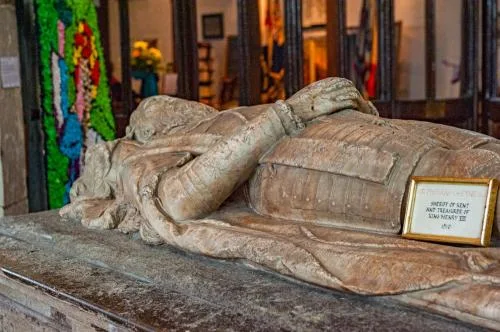
Between the aisles is the Tudor memorial to Sir Thomas Cheyne (1485-1558), who served as Sheriff of Kent, Lord Warden of the Cinque Ports, and Treasurer of the Household under King Henry VIII. A relative of Queen Anne Boleyn, he gained a reputation for political expediency, switching allegiances depending on which way the political wind was blowing.
In the north aisle is another effigy in armour dating from the late medieval period. Exactly who the effigy is meant to represent is unclear, but one possibility is Sir Hugh de Badlesemere. A less likely possibility is that effigy is that of George, 1st Duke of Clarence, who was famously drowned in a butt of wine at the Tower of London.
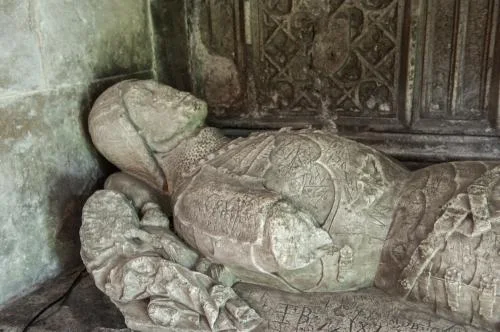
Against the north wall is yet another Tudor effigy. This is thought to depict a Spanish general who was captured in 1588 and held for ransom at nearby Queenborough Castle. The ransom was never paid and the general died in captivity three years later.
The effigy is shown holding a small oval, or egg-shaped object between his hands, with a peculiar carving inside it. This carving has been interpreted as a likeness of the dead man's soul, though some historians think it depicts an animal.
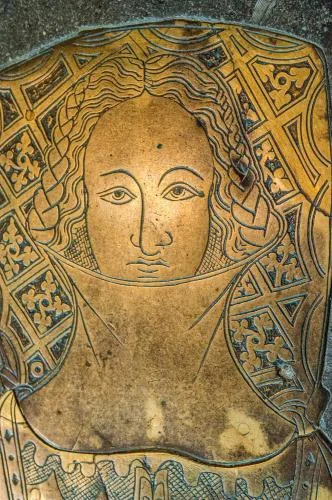
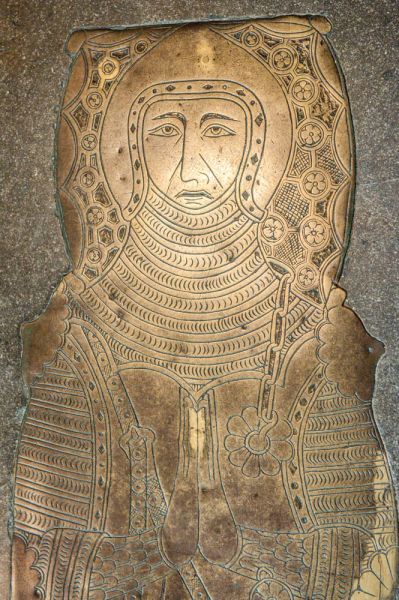
Set into the floor between the choir stalls are memorial brasses to members of the De Northwode family. The brasses date to 1330 and show male armour and female clothing in remarkable detail.
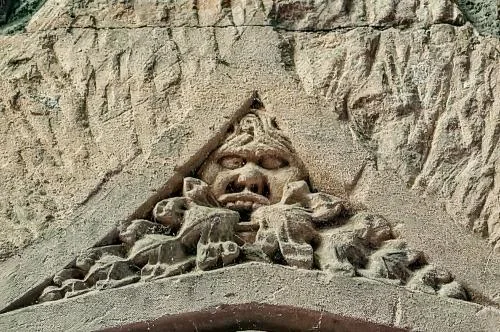
The Green Man
Over a door in the northeastern corner is a pagan Green Man symbol peering out from amidst foliage. The Green Man is often interpreted as a symbol of fertility and regrowth.
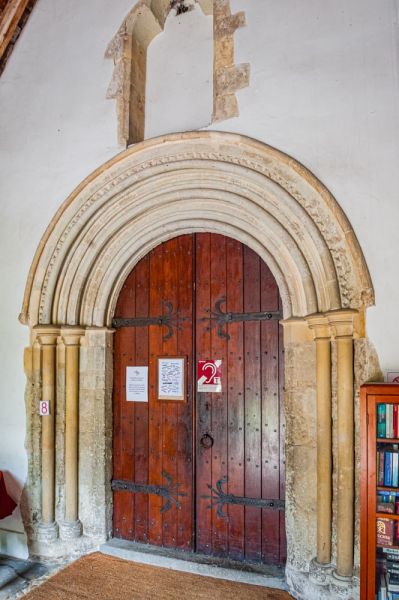
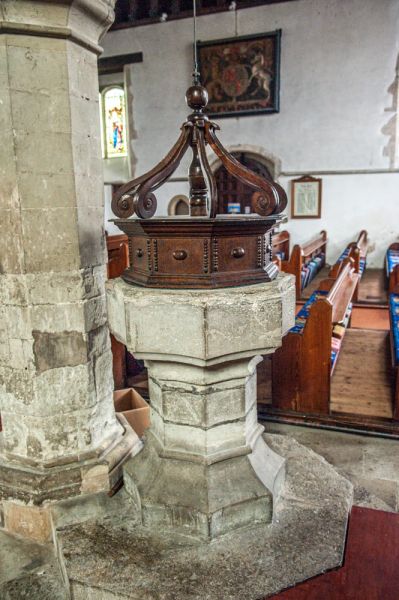
The font is Norman and there are Norman mason's marks on the arch of the south doorway, along with carvings interpreted as crusader crosses. The mason's marks are similar in style to mars found at Canterbury Cathedral, suggesting that the same stonemasons worked at both sites.
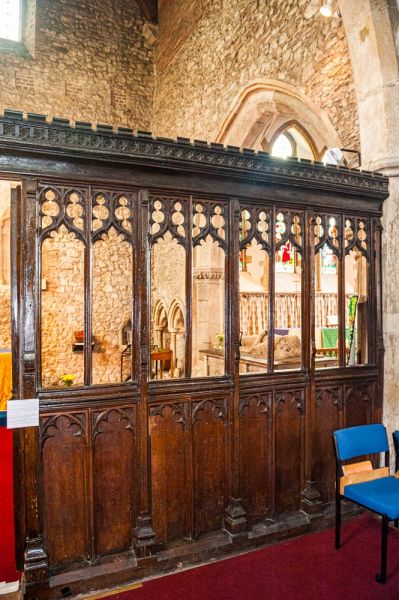
Other interior highlights include a 14th-century wooden screen and a 12th-century carving depicting the Virgin and Child.
Visiting
Minster Abbey stands at the end of a cul-de-sac off Union Road, beside the medieval abbey gatehouse (now a museum). There is a small car park outside the churchyard. The church was open when we visited and we understand that it is open to visitors on a daily basis.
Do not mistake Minster Abbey on the Isle of Sheppey (this church) for Minster Abbey, Isle of Thanet, also in Kent.
More Photos
About Minster Abbey, Isle of Sheppey
Address: Union Road, Minster-on-Sea, Isle of Sheppey, Kent, England, ME12 3QD
Attraction Type: Historic Church
Location: On a cuil-de-sac off Union Road. Parking outside the Minster Gatehouse Museum.
Website: Minster Abbey, Isle of Sheppey
Location map
OS: TQ956729
Photo Credit: David Ross and Britain Express
NEARBY HISTORIC ATTRACTIONS
Heritage Rated from 1- 5 (low to exceptional) on historic interest
Eastchurch, All Saints Church - 2.1 miles (Historic Church) 
Queenborough, Holy Trinity Church - 3 miles (Historic Church) 
Harty, St Thomas Church - 5.9 miles (Historic Church)
Luddenham, St Mary's Church - 6.5 miles (Historic Church)
Faversham Stone Chapel - 7.6 miles (Historic Building)
Faversham, St Mary of Charity Church - 8.1 miles (Historic Church)
Chart Gunpowder Mills - 8.1 miles (Museum)
Maison Dieu - 8.1 miles (Historic Building)
Nearest Holiday Cottages to Minster Abbey, Isle of Sheppey:
Sittingbourne, Kent
Sleeps: 13
Stay from:£1,291 - £6,084