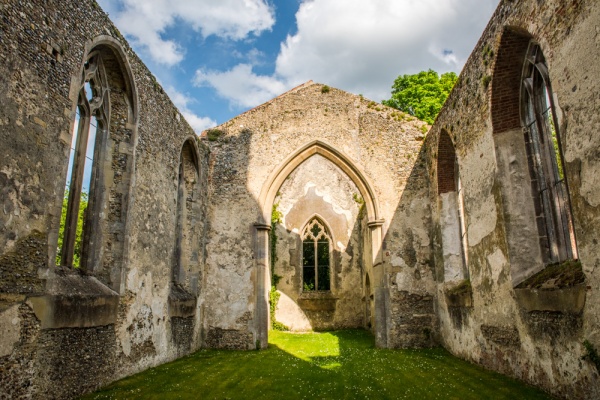
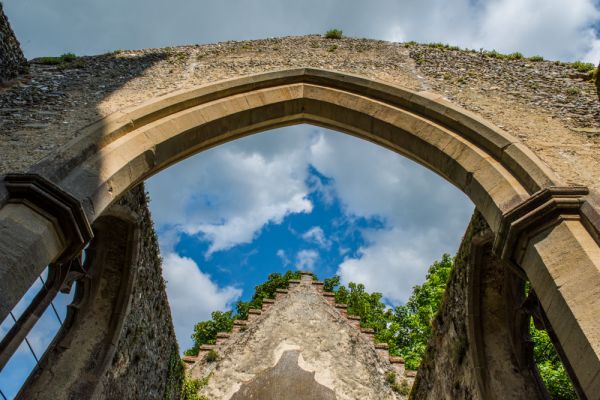
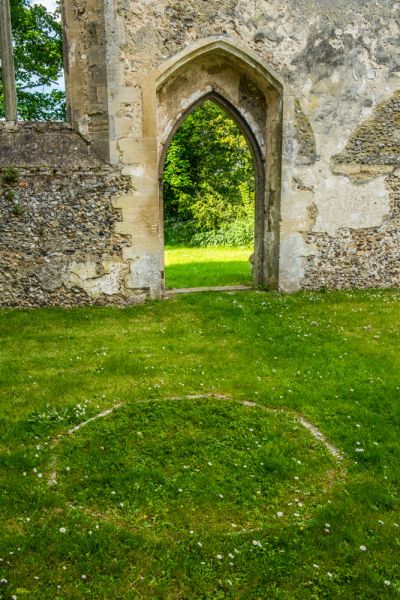
The once fine church of St John the Baptist at Stanton now consists of nothing more than the lofty tower, while the nave and chancel stand roofless and open to the elements.
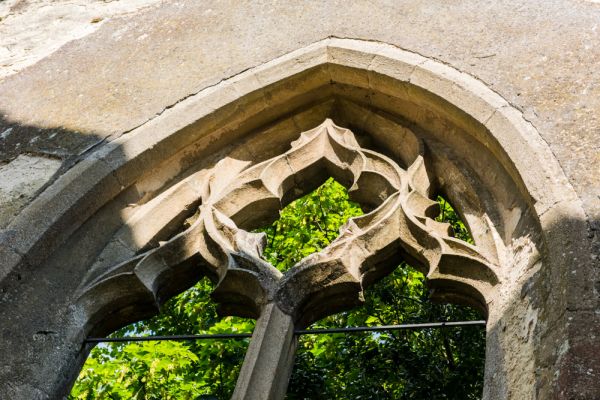
The best feature of the church are the 14th-century windows, which show off delicate Decorated tracery. The tower is a strong, sturdy structure, rising in three stages to an embattled top. The church is no longer in regular use and is in the care of the Churches Conservation Trust. The ruins of the nave and chancel are always open for visitors to explore.
Visiting
There are two churches in the village of Stanton, just as there were in the Domesday Book of 1068. Don't make the same mistake that I did and assume that the church tower you see while nearing Stanton is St John's; it is in fact, All Saints church, which is also well worth visiting. St John's is not immediately obvious, and it really helps if you have an Ordnance Survey map to discover the church's location.
The official postcode is IP31 2ED, but that's misleading; it leads satnavs to a house near the centre of the village. St John's is actually located on the opposite side of the A143 from the village, and the closest postcode is probably IP31 2EA. There is no easy way to access the church, which is located between Bardwell Road and Barningham Road (the B111).
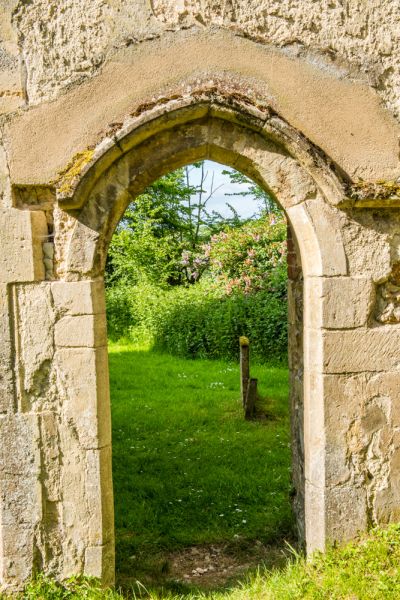
There is no parking area. The best way we found (by complete accident) is to pull into a layby on the Barningham Road, just off the A143. From there a footpath leads through woods and emerges in the overgrown graveyard.
History
St John's probably stands on the site of a late Saxon or early Norman building, as does All Saints in Stanton itself. All Saints served the villagers while St John's served the scattered farms to the north of the village. The church was recorded as 'in very bad repair' as early as 1812. Services were held until 1962 when the roof was finally removed.
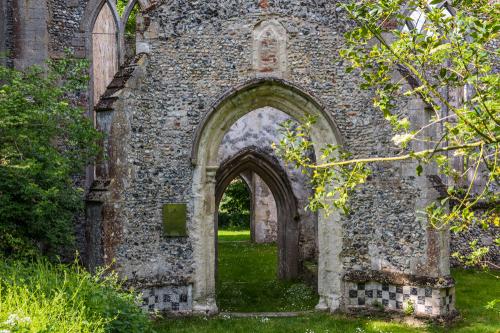
Highlights include the 14th-century tower, made of flint with limestone quoins for the doors and windows. The parapet is a lovely example of East Anglian flushwork, built with stone, brick, and flint. On the north side of the roofless nave are two 14th-century window openings.
The porch is 15th century, made with a chequerboard pattern of knapped flint. The large east window is 14th century. The chancel has a crow-stepped gable dating to 1616. Crowstepped gables were common in 17th-century houses but are not common in churches.
St John's is a very atmospheric church and creates quite a contrast with the 'active' church of All Saints in the village itself.
More Photos

About Stanton, St John's Church
Address: A143, Stanton, Suffolk, England, IP31 2XD
Attraction Type: Historic Church
Location: 9 miles north east of Bury St Edmunds off the A143
Website: Stanton, St John's Church
Churches Conservation Trust
Location map
OS: TL962737
Photo Credit: David Ross and Britain Express
POPULAR POSTS
HERITAGE
 We've 'tagged' this attraction information to help you find related historic attractions
and learn more about major time periods mentioned.
We've 'tagged' this attraction information to help you find related historic attractions
and learn more about major time periods mentioned.
Historic Time Periods:
Find other attractions tagged with:
14th century (Time Period) - 15th century (Time Period) - 17th century (Time Period) - Decorated (Architecture) - Domesday Book (Historical Reference) - Norman (Architecture) - Saxon (Time Period)
NEARBY HISTORIC ATTRACTIONS
Heritage Rated from 1- 5 (low to exceptional) on historic interest
Stanton, All Saints Church - 0.3 miles (Historic Church) 
Bardwell, St Peter & St Paul Church - 1.3 miles (Historic Church)
Sapiston, St Andrew's Church - 2.7 miles (Historic Church) 
Pakenham Water Mill - 3 miles (Historic Building)
Pakenham Windmill - 3.3 miles (Historic Building)
Rickinghall Superior, St Mary's Church - 4.9 miles (Historic Church)
Euston Hall - 5 miles (Historic House)
Westhorpe, St Margaret's Church - 5.8 miles (Historic Church)
Nearest Holiday Cottages to Stanton, St John's Church:
Walsham-le-Willows, Suffolk
Sleeps: 6
Stay from:£929 - £2,585