In 1215, Malcolm, the 7th Earl of Fife, founded an abbey at Culross for monks from KInloss Abbey in Moray. Culross was probably chosen because it was the birthplace of St Mungo and the site of a 6th century church built by St Serf. The new abbey was built on the ruins of St Serf's church, and early carved stones are on display inside the parish church.
History
The first building to be complete was the church, but it was not until the 14th century that the rest of the monastic buildings were finished.
The abbey declined in the late medieval period, and by the late 15th century there were no lay brothers left. This made the church nave redundant, so it was pulled down and a tower built in its place around 1500.

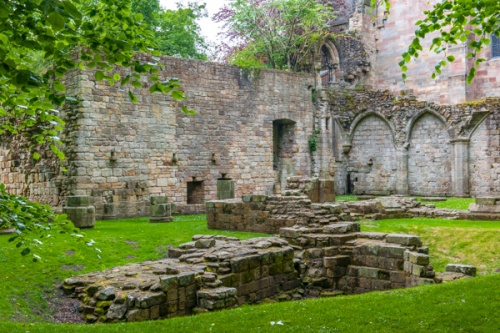
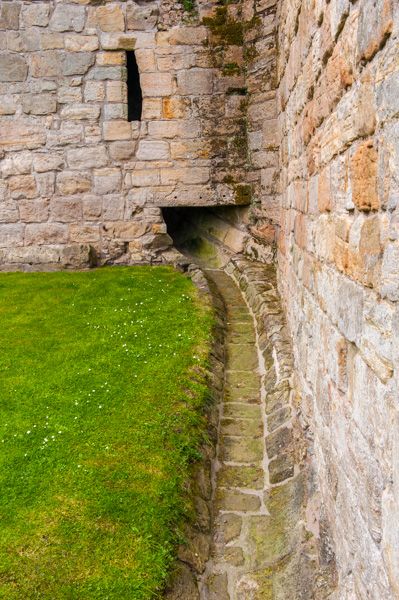
Worship continued in the choir until the Reformation, after which the east choir was used as the parish church. The monastic buildings on the south, east, and west ranges remain, though they are largely in ruins.
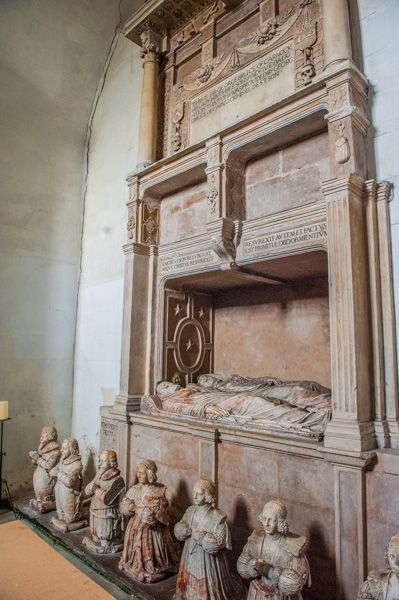
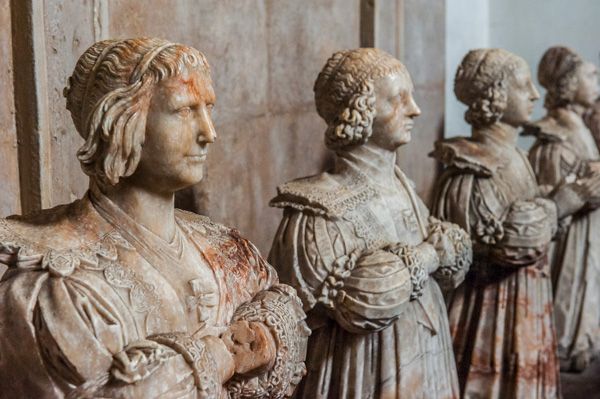
In 1642 the north transept was remodelled as a burial place for Sir George Bruce, Laird of Carnock. The large alabaster memorial to Sir George, his wife, and their 8 children take up most of the end wall of the transept.
The church was heavily restored in 1823 and again in 1905, and many of the original medieval features were retained.

The Abbey Church
While the ruinous monastic buildings are under the care of Historic Scotland, the church is an active place of worship. It is well worth seeing for its array of historic memorials and medieval carvings. In the graveyard are numerous gravestones showing trade symbols for occupations like sailor, butcher, and baker.
You can also see the gravestone of Colour Sergeant Stewart McPherson, a native of Culross who received a Victoria Cross for his service at the Siege of Lucknow in 1857.

The oldest part of the church is the south wall of the nave, dating to the early 13th century; most of the remainder was built about 1300.
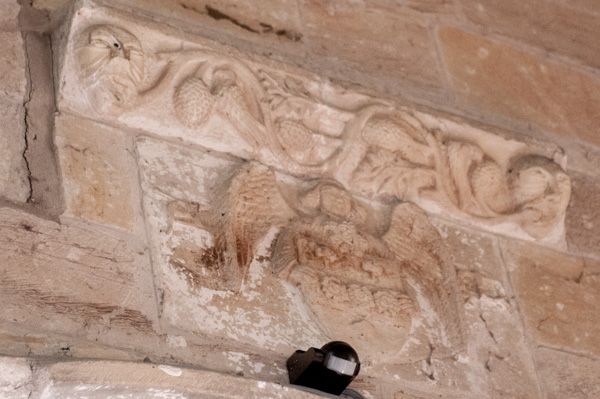
Aside from the Bruce memorial in the north transept, look for the 16th-century slab commemorating Bruce's father, also in the Bruce Aisle. Over the west door is a worn carving of a Green Man, and in the choir are several 8th-9th century Celtic stones, probably fragments of cross-shafts, decorated with knotwork carving patterns.

The Abbey Ruins
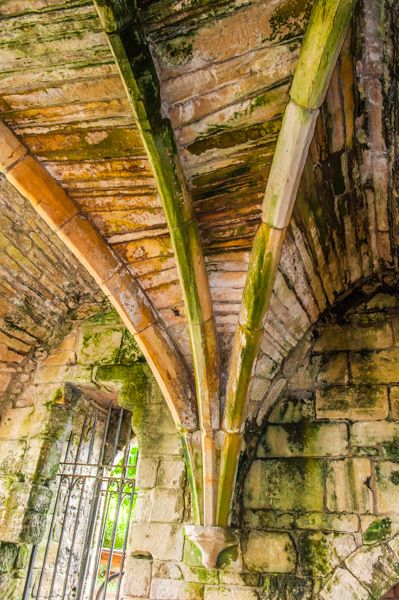
The most impressive part of the ruins is the lay brother's refectory. The ground floor, which probably housed the kitchen, has a very fine vaulted ceiling. You can climb to the upper floor, with a ribbed ceiling vault and two doors, including a blocked doorway arch in the east wall.
A persistent legend says that there is a hidden tunnel beneath the abbey. In the tunnel is a man seated in a golden chair, waiting to give treasure to anyone who can find him.


The abbey is located on Kirk Street, a short walk uphill from the Mercat Cross in the centre of Culross.
More Photos

About Culross Abbey
Address: Kirk Street, Culross, Dunfermline, Fife, Scotland, KY12 8JD
Attraction Type: Abbey
Location: In Culross, on the Firth of Forth, off A985
Website: Culross Abbey
Historic Scotland
Location map
OS: NS989862
Photo Credit: David Ross and Britain Express
POPULAR POSTS
HERITAGE
 We've 'tagged' this attraction information to help you find related historic attractions
and learn more about major time periods mentioned.
We've 'tagged' this attraction information to help you find related historic attractions
and learn more about major time periods mentioned.
Historic Time Periods:
Find other attractions tagged with:
13th century (Time Period) - 14th century (Time Period) - 15th century (Time Period) - 16th century (Time Period) - 6th century (Time Period) - 8th century (Time Period) - 9th century (Time Period) - Celtic (Architecture) - chapter house (Architecture) - Cistercian (Historical Reference) - Decorated (Architecture) - GE Street (Person) - Medieval (Time Period) - Reformation (Historical Reference) - St Mungo (Person)
NEARBY HISTORIC ATTRACTIONS
Heritage Rated from 1- 5 (low to exceptional) on historic interest
Kinneil House - 3.5 miles (Historic Building) 
Kinneil Museum - 3.5 miles (Museum)
Blackness Castle - 5.5 miles (Castle) 
Church of St Michael, Linlithgow - 5.6 miles (Historic Church)
Linlithgow Palace - 5.6 miles (Castle)
Linlithgow Museum - 5.7 miles (Museum)
Pittencrieff House Museum - 6 miles (Museum) 
House of the Binns - 6.3 miles (Historic House)
Nearest Holiday Cottages to Culross Abbey:
Stirling, Central Scotland
Sleeps: 4
Stay from:£621 - £1,754