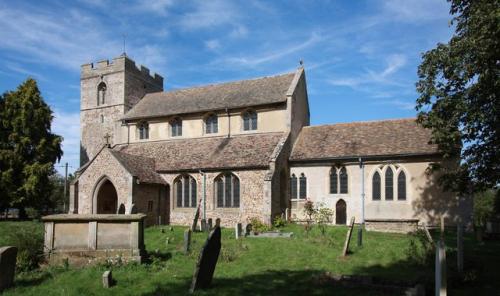
All Saints and St Andrew's Church in Kingston is a lovely 13th-century parish church, extensively rebuilt in Perpendicular style following a fire in 1488. Parts of the 13th-century building were reused and incorporated in the 15th-century design.
The building is of mixed clunch and fieldstone rubble with limestone dressing, under a tiled roof, and consists of an aisled nave with clerestory, chancel, south porch, and west tower. The chancel and tower remain from the 13th-century church, but the remainder of the church dates to 1488.
Medieval Wall Paintings
The main feature of historical interest at Kingston is the wonderful series of wall paintings. The most intriguing of these is over the chancel arch, where a Rood Group scene is set against a deep red background. A unique feature of this painting is the representation of an angel on either side of the cross, each holding up a cup, or chalice, to catch drops of blood from Christ's side.
In the chancel are some very early foliage designs, dating to the 13th century or even the 12th century. Also in the chancel is a scene of foot soldiers carrying lances, also thought to be 13th century. Elsewhere are paintings of the Virgin Mary, figures of saints, including St Christopher and a much-worn figure of a mounted St George, and panels of Biblical texts.
In the north aisle are 15th-century paintings depicting a wheel (symbolizing the Seven Acts of Mercy) and a horned demon (symbolizing the Seven Deadly Sins).
Aside from the wall paintings, there is a 14th-century font of a rather peculiar design It has a very plain octagonal bowl, and is supported on a series of 8 engaged columns joined by trefoiled arches. There is also a nicely carved Jacobean pulpit.
Not quite so visible is the ring of three bells, one of which dates to the 14th century, making it one of the oldest known bells in any English parish church. There are also fragments of the original medieval glass in the east window, and parts of a medieval screen have survived. In the chancel is a repainted wall memorial to Dr Fogge Newton, a Provost of King's College in Cambridge (d. 1612).
About Kingston, All Saints and St Andrew
Address: Church Lane, Kingston, Cambridgeshire, England, CB23 2NG
Attraction Type: Historic Church
Location: Just off the B1046 7 miles west of Cambridge
Website: Kingston, All Saints and St Andrew
Location map
OS: TL345554
Photo Credit: John Salmon, licensed for reuse under the Creative Commons Licence
POPULAR POSTS
HERITAGE
 We've 'tagged' this attraction information to help you find related historic attractions
and learn more about major time periods mentioned.
Historic Time Periods:
Find other attractions tagged with:
12th century (Time Period) - 13th century (Time Period) - 14th century (Time Period) - 15th century (Time Period) - 4th century (Time Period) - Jacobean () - Medieval (Time Period) - Perpendicular (Architecture) - wall painting (Historical Reference) - wall paintings (Historical Reference)
NEARBY HISTORIC ATTRACTIONS
Heritage Rated from 1- 5 (low to exceptional) on historic interest
Wimpole Hall - 2.8 miles (Historic House) 
Barton, St Peter's Church - 3.9 miles (Historic Church)
American War Cemetery - 4.4 miles (Historic Building) 
Trumpington, St Mary & St Michael - 6 miles (Historic Church) 
Queens' College - 6.4 miles (Historic Building)
St Catharines College - 6.5 miles (Historic Building)
Clare College - 6.5 miles (Historic Building)
Trinity Hall - 6.6 miles (Historic Building)
Nearest Holiday Cottages to Kingston, All Saints and St Andrew:

Fulbourn, Cambridgeshire
Sleeps: 2
Stay from:£344 - £1,388