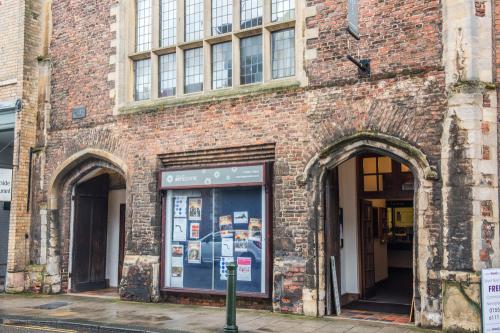
The 15th-century Guildhall of St George is the largest surviving medieval guildhall in the country. The Guildhall was created for the Guild of St George over the years 1410-1420. It is built of brick dressed with ashlar, and the interior is an excellent example of late medieval architectural decoration.
The Grade I listed Guildhall is owned by the National Trust and leased by the Borough Council for use as a public venue for music, the arts, and lectures.
History
The origins of the Guild of St George go back to 1376, but it was not until 1406 that the Guild began to build a hall, using a parcel of land reclaimed from the River Ouse. The Guildhall was is use by 1428. Perhaps the reclaimed riverside land wasn't stable, for the Guild later had to insert five buttresses, spanning the stream, to manage the unstable foundations.
Edward VI dissolved all guilds in 1547, and the Guildhall then passed to the Lynn Corporation -- the civic government. The Corporation used the Guildhall as a public hall, but it saw a number of uses over the centuries, including time as a courthouse, merchant exchange, language school, armoury, and a button factory for unemployed workers.
The first written record of a theatrical performance in the Guildhall comes from 1445 when a nativity play was performed as pre-dinner entertainment for a Guild feast. An annual St George's Day procession took place until 1546.
The Shakespeare Connection
Later in the 16th century, the Guildhall was used by companies of players -- a general term for acting troupes.
Local tradition, supported by recent historical research, suggests that William Shakespeare played at the Guildhall in 1593 as part of the Earl of Pembroke's Men during a time when London theatres were closed due to an outbreak of the plague. One of Shakespeare's leading comic actors was Robert Armin, a native of King's Lynn.
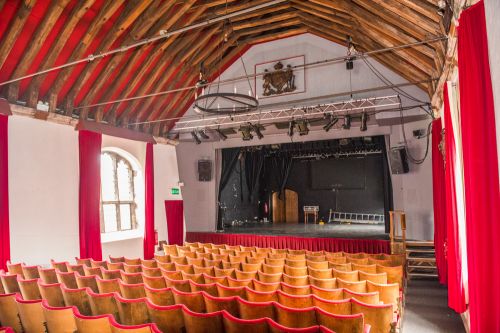
The tradition of holding theatrical performances at the Guildhall was well established by the time Thomas Sharpe built a playhouse inside the medieval building on the instruction of the Mayor of King's Lynn in 1766. Many of the leading actors of the age performed at the Guildhall Theatre, though newspapers complained of rowdy audiences.
The Guildhall's success as a theatrical venue proved its own undoing; so popular were the performances that a purpose-built theatre -- the Theatre Royal -- was erected in St James Steet in 1813. The guildhall became a warehouse, and over time became decrepit. It was in danger of being pulled down in 1945 when Alexander Penrose stepped in and purchased the building.
Over the next decades, the medieval building was restored and transformed, and several adjoining warehouses were added to create gallery spaces.
Visiting
Access to the Guildhall interior is by free guided tour. Tours are organised by volunteers from the Shakespeare Guildhall Trust, a charity working to develop the theatre as a sustainable heritage venue.
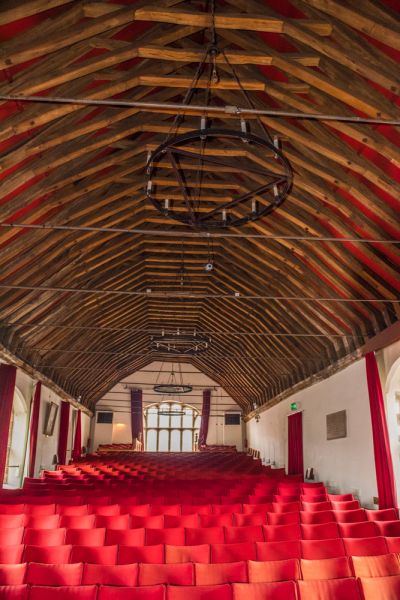
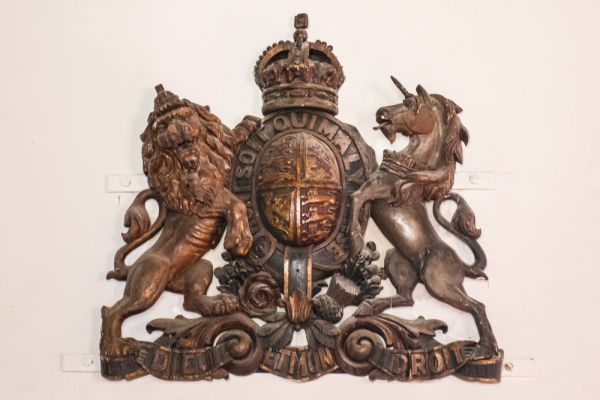
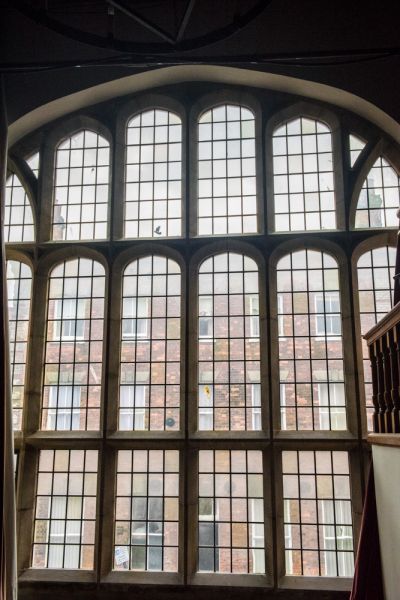
The first thing you will notice is the exceptional timber roof, a work of art in its own right. The modern theatre seating and stage do detract somewhat from the sense of the Guildhall's history, but then again it is wonderful to see the building being used. Look for the richly decorated royal coat of arms over the stage and the beautiful mullioned windows.
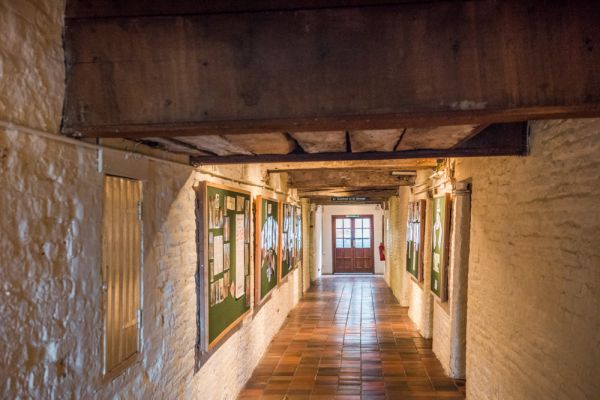
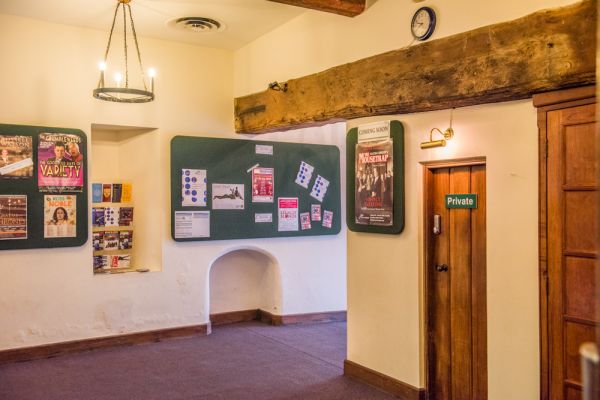
Outside the theatre itself, the age of the Guildhall building is evident, with huge timber beams poking out from behind modern decoration.
More Photos


About St George's Guildhall
Address: 29 King Street, King's Lynn, Norfolk, England, PE30 1HA
Attraction Type: Historic Building
Location: On the west side of King Street near the Tuesday Market Place. Open all year, but generally closed on days there are performances in the theatre.
Website: St George's Guildhall
Email: stgeorgesguildhall@nationaltrust.org.uk
National Trust
Location map
OS: TF616202
Photo Credit: David Ross and Britain Express
POPULAR POSTS
HERITAGE
 We've 'tagged' this attraction information to help you find related historic attractions
and learn more about major time periods mentioned.
We've 'tagged' this attraction information to help you find related historic attractions
and learn more about major time periods mentioned.
Historic Time Periods:
Find other attractions tagged with:
15th century (Time Period) - 16th century (Time Period) - Decorated (Architecture) - Earl of Pembroke (Historical Reference) - Edward VI (Person) - London () - Medieval (Time Period) - Shakespeare (Person) - William Shakespeare (Person)
NEARBY HISTORIC ATTRACTIONS
Heritage Rated from 1- 5 (low to exceptional) on historic interest
King's Lynn Custom House - 0.1 miles (Historic Building) 
King's Lynn, St Nicholas Chapel - 0.2 miles (Historic Church) 
Trues Yard Fisherfolk Museum - 0.2 miles (Museum)
Town Hall & Trinity Guildhall, King's Lynn - 0.2 miles (Historic Building)
King's Lynn Minster - 0.3 miles (Historic Church)
Lynn Museum - 0.3 miles (Museum)
Greyfriar's Tower - 0.4 miles (Abbey)
Red Mount Chapel, King's Lynn - 0.6 miles (Historic Church)
Nearest Holiday Cottages to St George's Guildhall: