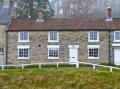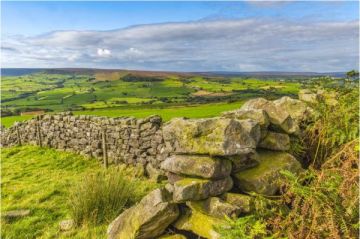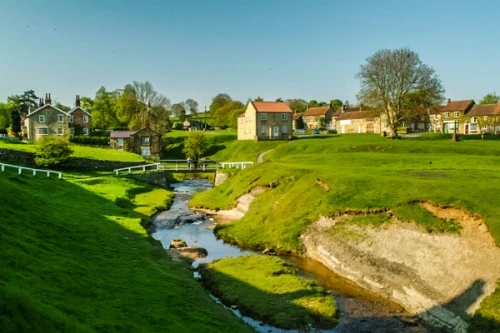
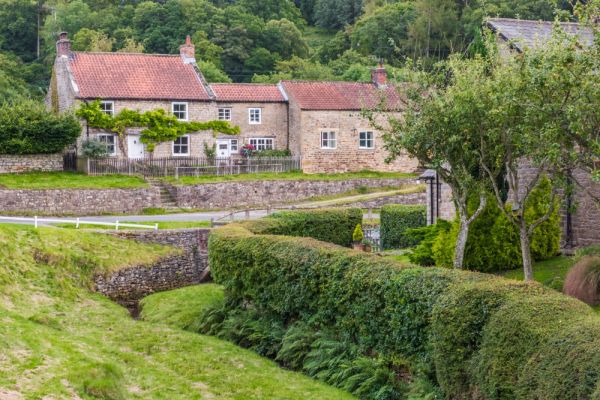
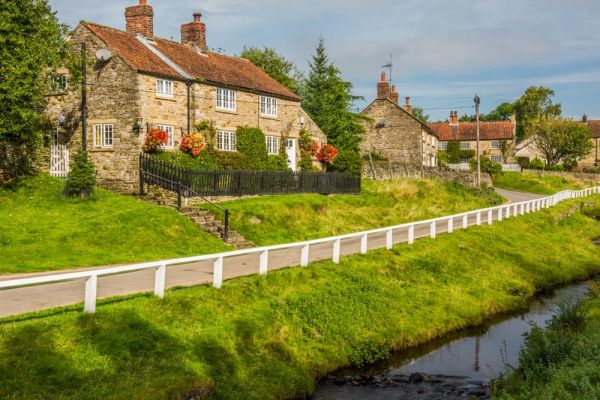
Hutton-le-Hole is one of the most popular beauty spots in the North York Moors. The village is known for its long, winding village green with a stream running down the middle and foot bridges crossing the stream. In the village is the Ryedale Folk Museum, with displays covering the social customs and agricultural heritage of the area.
The first written record of a settlement comes from the Domesday Book, where a village called Hoton is recorded. It was a small village even then, with 8 carucates of land, enough to support 8 families. The village name was transformed over the medieval period, from Hedge-Hoton to Hoton under Heg, to Hewton, and then in the 17th century Hutton in the Hole.
The present name Hutton-le-Hole only appeared in the 19th century. But what does the peculiar name mean? Several theories have been put forward, but the most likely is that 'Hole' refers to burial mounds. Several ancient burial mounds can be found around nearby Barmoor, so it seems plausible that the name simply means 'the place near the burial mounds'.
Ryedale Folk Museum
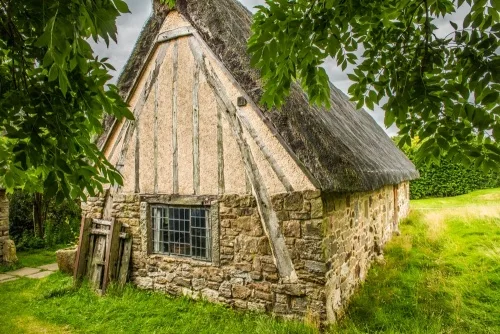
Most people visit Hutton to see the Ryedale Folk Museum, where a wealth of traditional buildings from the area have been rescued from destruction and rebuilt. Among the buildings to explore are an Elizabethan manor, shops, workshops, barns, and thatched cottages. The museum shows what life was like in Ryedale over a span of time from the medieval period to the present day.
One of the most popular gathering places in Hutton le Hole is The Crown Inn. Though the inn dates only to 1940 it stands on the site of an earlier building used as a smallholding, built in the 18th century. Another popular venue is the Red Lion pub, one of the most isolated - and most popular - inns in the region.
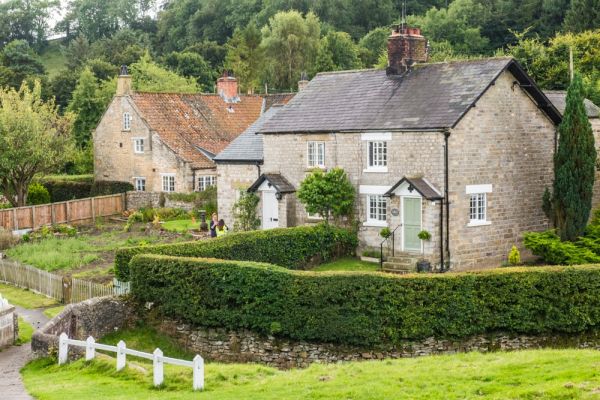
Though the village is small, there are no less than 29 listed buildings - all of them Grade II listed for heritage interest. Most date to the late 18th century, such as Turnpool House on Keld Lane, whose datestone reads 1782.
On the northern end of the parish is Hangman Stone, an early 18th-century boundary stone inscribed with the initials TD for Thomas Duncombe, a former Lord of the Manor of Helmsley. The grim name of the boundary stone refers to the old tale of a man carrying a stolen sheep with its hind legs tied around his neck. When the thief sat down for a rest, the sheep slipped backwards and hanged him.
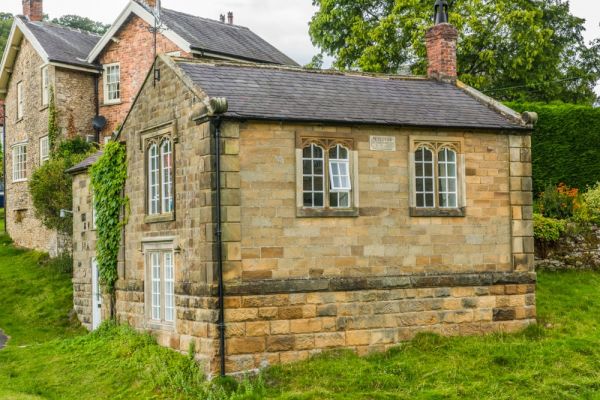
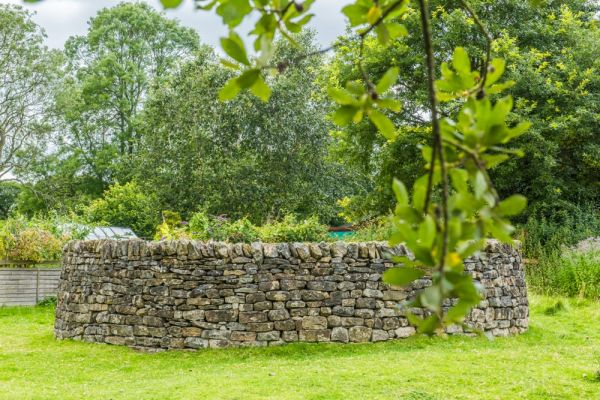
And speaking of sheep ... Hutton le Hole is famous for the moorland sheep which wander freely along the wide green. On one side of the green is The Potter's House, built as a small school by public subscription in 1845 and now a private house. Near the parking area on Moor Lane is a late 17th-century 'pound'; a stone-walled enclosure for holding lost sheep.
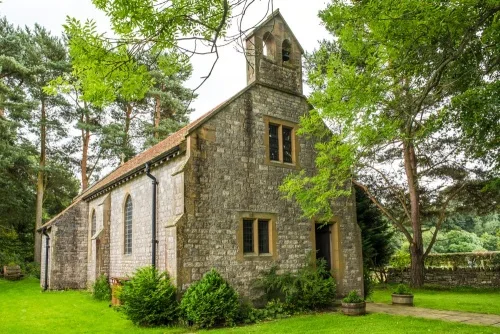
Near the Ryedale Folk Museum is the parish church of St Chad. The church building was erected in 1934, replacing an earlier chapel on the same site. The church was open when we visited, and though the building doesn't have any great architectural interest, its location in a shady stand of trees is very attractive and the interior boasts several very nice stained glass windows. The oldest feature is an organ made in the 1860s and brought here from a Methodist chapel in Scarborough.
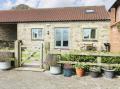
There is a large public pay and display car park on Moor Lane, and several shops to serve the large numbers of visitors who come to explore one of the prettiest villages in the National Park. The village has become extremely popular in recent years and many of the older houses have been converted to serve as holiday cottages.
More Photos


About Hutton le Hole
Address: Hutton le Hole, North York Moors, Yorkshire, England
Attraction Type: Village
Location: There is a large pay and display car park on Moor Lane, just north of the Ryedale Folk Museum and the pub.
Location map
OS: SE704901
Photo Credit: David Ross and Britain Express
HERITAGE
 We've 'tagged' this attraction information to help you find related historic attractions
and learn more about major time periods mentioned.
We've 'tagged' this attraction information to help you find related historic attractions
and learn more about major time periods mentioned.
Historic Time Periods:
Find other attractions tagged with:
17th century (Time Period) - 18th century (Time Period) - 19th century (Time Period) - Domesday Book (Historical Reference) - Elizabethan (Architecture) - Medieval (Time Period)
NEARBY HISTORIC ATTRACTIONS
Heritage Rated from 1- 5 (low to exceptional) on historic interest
Ryedale Folk Museum - 0.1 miles (Museum) 
Hutton-le-Hole, St Chad's Church - 0.2 miles (Historic Church) 
Lastingham, St Mary's Church - 1.5 miles (Historic Church)
Kirkbymoorside, All Saints Church - 2.2 miles (Historic Church) 
Kirkdale, St Gregory's Minster - 3.2 miles (Historic Church)
North York Moors National Park - 3.2 miles (Countryside)
Rosedale Abbey Church - 3.8 miles (Historic Church)
Cawthorn Roman Camps - 4.9 miles (Roman Site)
Nearest Holiday Cottages to Hutton le Hole: