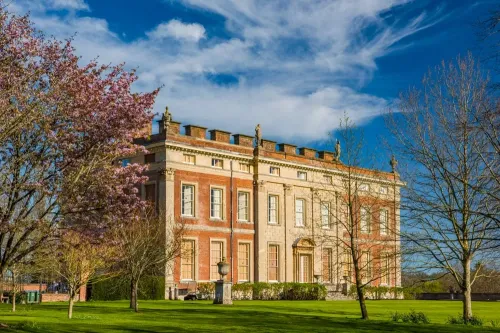
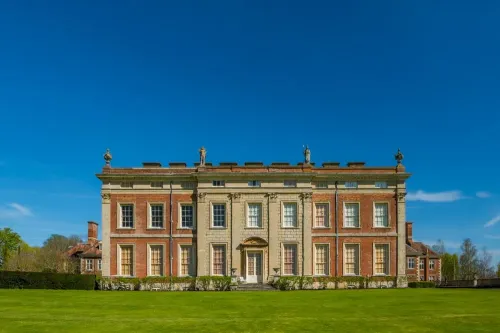
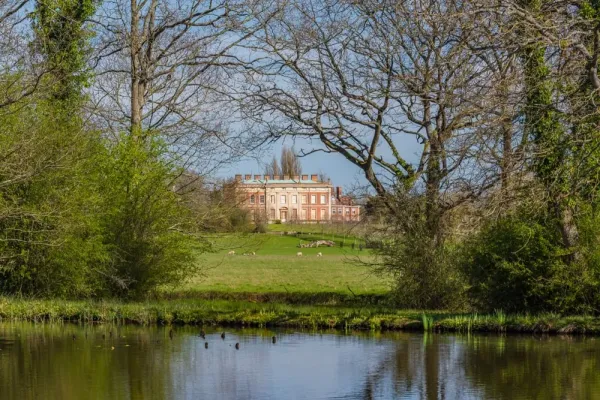
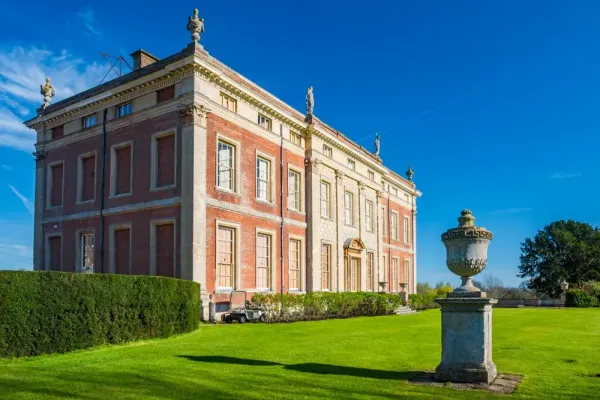
Extensive 18th-century landscape gardens surround the elegant Queen Anne manor of Wotton House, set in beautiful countryside between Aylesbury and Bicester. Wotton was the home of the powerful Grenville family as early as the 11th century, but the English Baroque house we see today was begun in 1704 by Richard Grenville.
At the same time, the extensive grounds were laid out in a formal pattern, with a parterre and a double avenue of elm trees leading to a lake.
Capability Brown Gardens
Later in the 18th century, the fashion for gardens changed into a more informal landscape gardening style, and the grounds were redesigned by Capability Brown, creating a pleasure ground stretching to 200 acres, centred on a pair of lakes linked by a canal.
Brown worked at nearby Stowe House, also owned by the Grenville family. He did not design Stowe's influential gardens, but he certainly developed his ideas while employed there. It was a natural progression for Brown to work on altering the formal gardens at Wotton House in a more naturalistic style.
Brown would have preferred to sweep away the lime avenue that sweeps down a gentle slope from the rear facade of the house to a small lake, but the Grenvilles insisted keeping it. Instead, Brown planted clumps of trees just beyond the formal avenue to soften its rigid lines.
We know from family records that Brown began working at Wotton House, advising on water works, as early as the 1740s. Brown and Benjamin Read then worked here on and off for much of the 1750s and 1760s, developing the landscape design.
The new, informal landscape garden at Wotton House was dotted with classical temples, statues, and bridges in line with fashionable landscape gardening ideas at the time. So successful was the design that Wotton was a destination for garden tours as early as the 18th century, and was mentioned in the same breath as Blenheim Palace, Stowe, and Rousham, a few miles away.
Not every visitor to Wotton was enamoured of the gardens. Thomas Jefferson, visiting in 1786, called it much neglected and commented that there were only two gardeners to look after the entire estate.
Wotton House
The story of Wotton is inextricably tied to the history of the Grenville family. The Grenvilles came to Wotton in the 12th century, but by the early years of the 18th century they were climbing the social ladder.
In 1704 Richard Grenville could afford to rebuild the modest manor house at Wotton Underwood and replace it with a beautiful red-brick mansion. In 1710 Richard's son, also named Richard, married Hester Temple, sister of Viscount Cobham and heir to the vast family estates at Stowe.
When Viscount Cobham died in 1749, Hester Grenville inherited his estates. Hester's son, yet another Richard Grenville, made Stowe the family seat and Wotton House thereafter was used by either the head of the family's eldest son or younger brother.
George Grenville, Richard's son and later to become Prime Minister, took up residence at Wotton Underwood and it was George who helped create the stunning pleasure grounds we see today.
However, none of it would have happened if it wasn't for Richard Grenville's political influence. Richard was elected to Parliament in 1734 and nine years later, in 1743, he succeeded in pushing through an act of Parliament that allowed him to enclose the Wotton Underwood estate, paving the way for his brother to put his landscaping plans into effect.
Cobham's Cubs
George Grenville was part of a political network known as Cobham's Cubs, devoted to bringing Viscount Cobham's political values to life. Other members of Cobham's Cubs included William Pitt the Elder, who visited frequently. In 1754 he proposed to Lady Hester, George Grenville's sister, at Wotton (she said yes).
Pitt was heavily involved in George Grenville's plans for the new gardens at Wotton and maintained a close interest in the decades-long project.
The house was badly damaged by fire in 1820, and the 2nd Marquess of Buckingham called in the famous London architect Sir John Soane to create new interiors in neo-classical style. Soane lowered the house, taking off the top floor to create a pleasing Georgian frontage.
The direct Grenville line died out and the house was sold several times. It was used as a boarding school for boys, and occupied by the Canadian Army during WWII, but by 1957 it was in near-derelict condition and was scheduled for demolition.
A scant fortnight before the house scheduled to be razed to the ground, Mrs Elaine Brunner saw the property - by accident. She fell in love with Wotton and purchased the property, saving it from demolition. She had the Soane interiors restored and began the long, slow process of restoring the landscape gardens to their 18th-century glory.
The nearby Coach House was also restored as a separate property, and it was later the home of actor Sir John Gielgud, who died here in 2000. The house was later purchased by ex-Prime Minister Tony Blair and his wife Cherie.
Garden Highlights
Wotton House looks put over a pastoral landscape, with sheep grazing peacefully beyond a ha-ha, invisible from the house. Descending from the rear lawn is Lake Avenue, designed by Henry Wise and George London.
This broad avenue leads down to a small lake known as the Warrells. The avenue was originally planted with elm trees, but these fell victim to Dutch Elm Disease and have been replaced. Varieties of lime trees form the inner row with chestnuts outside them.
Yew Walk
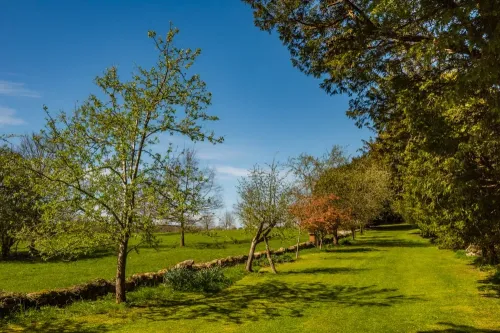
Stretching away to the south-west is Yew Walk. This was likely planted with yew shrubbery but is now lined with mature trees, with crab apple trees on the west.
New River Walk
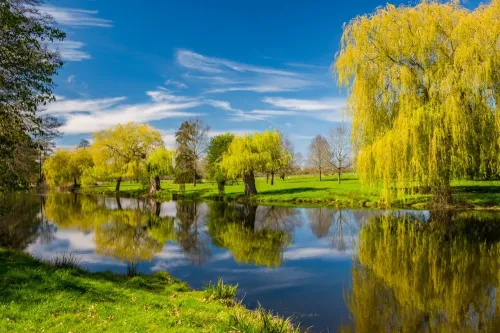
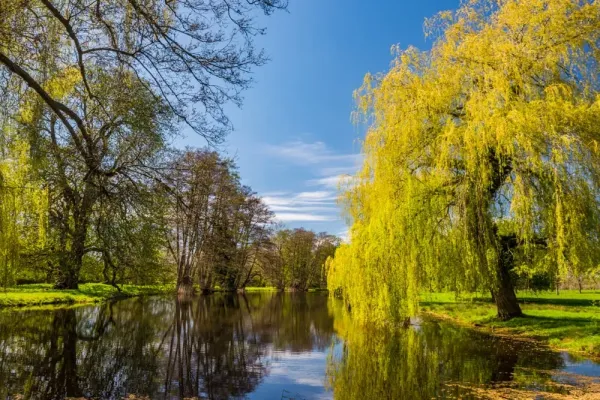
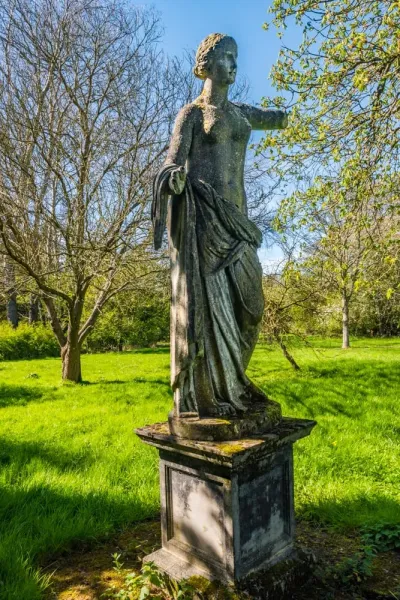
At the end of Yew Walk you come to the New River Walk, where the path leads beside a waterway created by Capability Brown in 1767. This section of the pleasure ground is also known as Chestnut Walk after the tall chestnut trees that line the water. Part way along the waterway you come to an open glade dominated by a statue of Venus on a pedestal.
Tuscan Temples
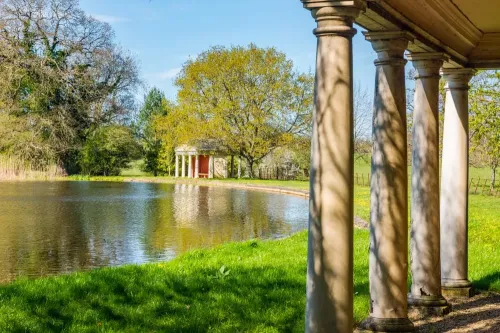
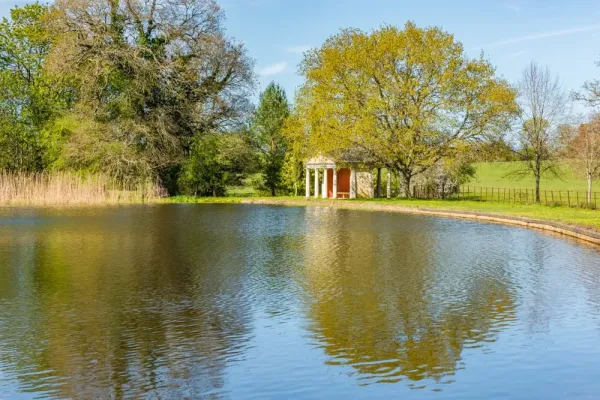
At the end of the New River walk you reach the small lake called the Warrells. If you are lucky you might find swans here (we did!). At the eastern end of the lake stand two Tuscan Temples, designed by Brown. From the northern temple you can see Five arch Bridge at the opposite end of the lake.
Five Arch Bridge
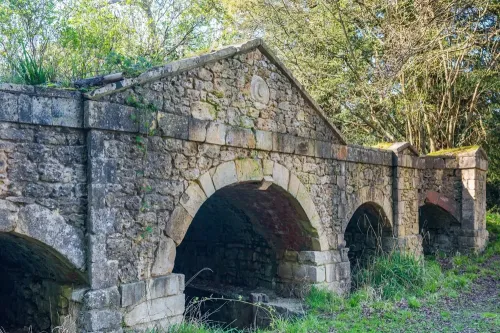
Capability Brown designed this picturesque stone bridge to disguise a change in elevation between the southern and northern reaches of the Warrells. Here, water cascades over a sloping spillway under the central arch.
China Island
Created by Brown, the island is home to a folly known as Mab. Unfortunately, when we visited the island was closed to visitors out of concern for the safety of access.
Octagon
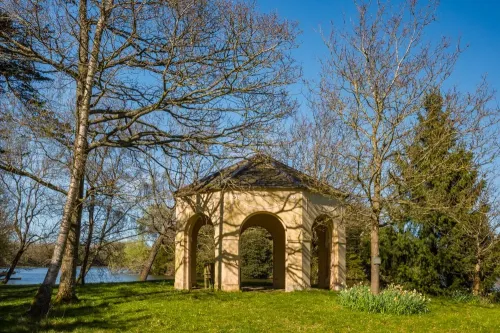
The next major feature is a picturesque structure known as The Octagon. This stands on a small rise of ground looking over The Lake, the larger of the two lakes at Wotton. The arches of the Octagon frame views of Wotton House and the Turkish Tent. It seems likely that the Octagon was formed with an access for horses and riders to pass through the centre of the structure.
Malay Hut
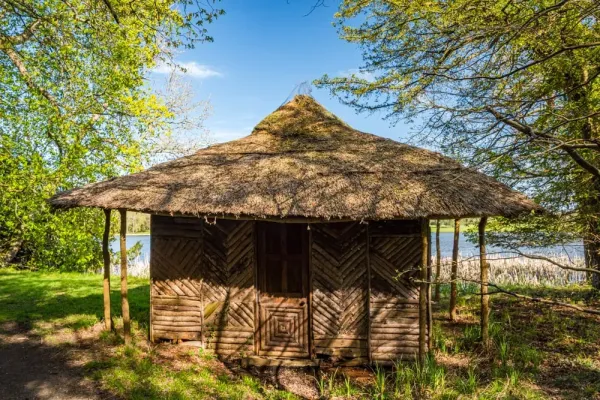
Hovering on the edge of the water is the Malay Hut, a thatched building in the style of a South Sea hut. This was originally installed in the centre of the lake, supported on wooden stilts. The stilts eventually rotted and the hut was moved to the bank for safety.
We don't know when the Malay Hut was built, but it is not shown on an estate map from 1789. Historians think it may have been built by the 1st Duke of Buckingham shortly after the end of the Napoleonic Wars.
Crescent Bridge
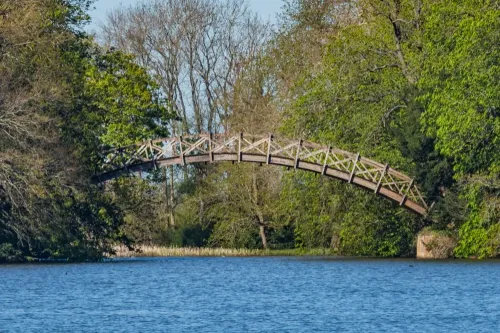
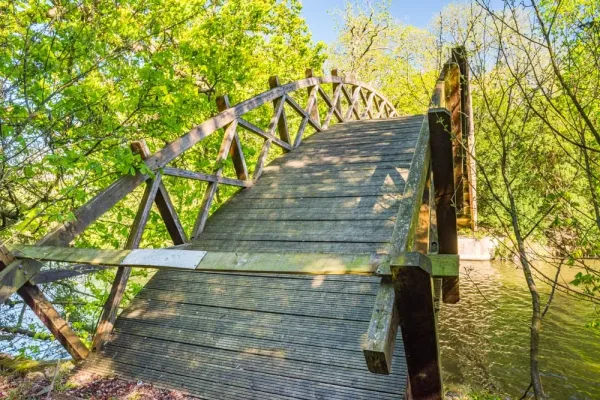
The northern end of The Lake is emphasised by the high-arced Chinese Bridge, also known as the Crescent Bridge for its shape. This is not the original bridge, for that was blown down in the 1800s.
Rotunda
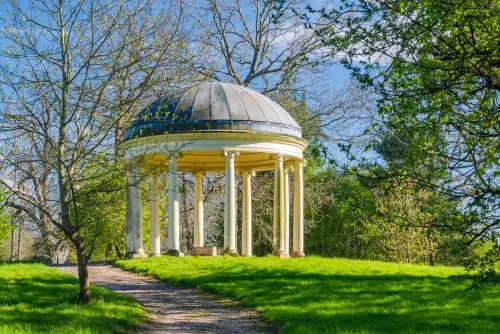
From the bridge, the ground rises and you come to the Rotunda, offering superb views over the lake. This appears to be inspired by the Rotunda designed by Sir john Vanbrugh at Stowe. The arches are carefully arranged to align with views of gardens features such as the Octagon and Turkish Tent. From the Rotunda it is a short stroll to Windmill Hill, once the site of a windmill, but now a tree-covered grassy mound.
Turkish Tent
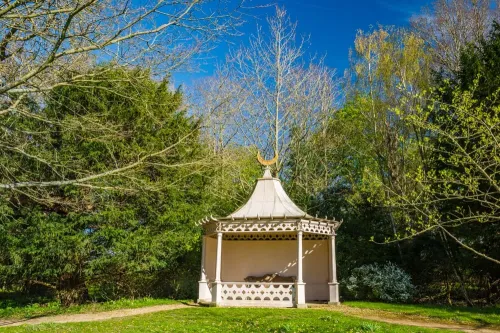
Also known as the Turkish Kiosk, this tent-like hexagonal structure has a copper roof topped by a golden crescent, the symbol of Turkey.
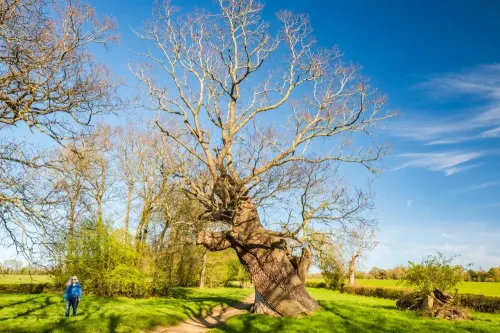
Wotton Oak
A short detour down a grassy path leads you to the Wotton Oak. This ancient tree may be the oldest oak in Britain. It certainly looks it! There are three other oaks clustered around the same spot, suggesting that all four were intentionally planted here during the medieval period.
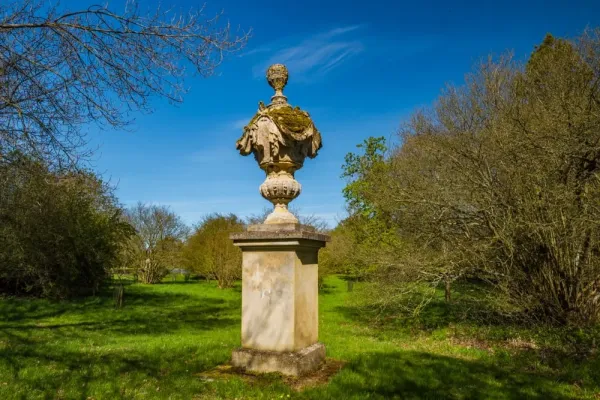
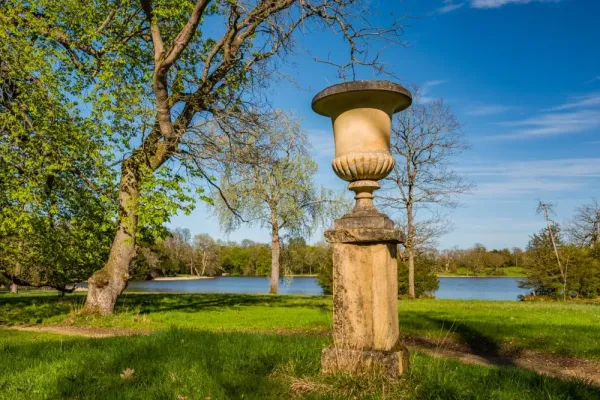
Aside from the highlights listed here, the garden is dotted with sculptures, including classical urns and statues of mythological characters.
Visiting
Wotton House landscape gardens are superb, and a delight in every way. They are open on specific days throughout the spring and summer months. The garden owners do not advertise; in fact, when we visited, they didn't even have a website, so you really have to do your research to even know what the open days are.
By sheer chance, we ran into the head gardener as we were arriving, and he gave us a potted history of the house and garden. He also told us that he came to Wotton when he was 17, charged with repairing the ha-ha. Forty-one years later, he was still there.
You approach Wotton House up a narrow lane just east of Brill. Look for the sign to Wotton Underwoood and follow the lane for several hundred yards. Do not take the right-hand bend that leads to the parish church, but look for an unobtrusive sign with an arrow pointing you up the house drive.
You pass the front facade of Wotton House, behind its ornate gates, then turn left where another unobtrusive sign points you through a gate and into a gravelled parking area directly beside Wotton House.
When we visited, there was a small admission kiosk where you can pay and get a useful map of the state and a very handy guidebook.
If you take the circular walk that encompasses the entire pleasure ground it will be about three miles. Shorter walks of one and two miles are available and all three walks are signposted. I made it around the three-mile loop on my crutches, but I wouldn't advise it for wheelchair users.
Note that Wotton House itself is normally closed to the public.
More Photos
About Wotton House
Address: Wotton Underwood, Buckinghamshire, England, HP18 0SB
Attraction Type: Garden
Location: On a minor lane east of Brill. Look for small signs pointing to the garden parking area.
Website: Wotton House
Location map
OS: SP685161
Photo Credit: David Ross and Britain Express
POPULAR POSTS
HERITAGE
 We've 'tagged' this attraction information to help you find related historic attractions
and learn more about major time periods mentioned.
We've 'tagged' this attraction information to help you find related historic attractions
and learn more about major time periods mentioned.
Historic Time Periods:
Find other attractions tagged with:
11th century (Time Period) - 12th century (Time Period) - 18th century (Time Period) - Baroque (Architecture) - Capability Brown (Person) - Georgian (Time Period) - John Vanbrugh (Person) - Medieval (Time Period) - neo-classical (Architecture) - Queen Anne (Person)
NEARBY HISTORIC ATTRACTIONS
Heritage Rated from 1- 5 (low to exceptional) on historic interest
Brill Windmill - 2.4 miles (Historic Building) 
Waddesdon Manor - 2.9 miles (Historic House) 
Nether Winchendon, St Nicholas Church - 3.8 miles (Historic Church)
Nether Winchendon House - 3.8 miles (Historic House)
Boarstall Duck Decoy - 3.9 miles (Historic Building)
Boarstall Tower - 3.9 miles (Historic Building)
Long Crendon Courthouse - 4.4 miles (Historic Building)
Long Crendon, St Mary's Church - 4.5 miles (Historic Church)
Nearest Holiday Cottages to Wotton House:
Ludgershall, Buckinghamshire
Sleeps: 16
Stay from:£3,632 - £15,110

Ludgershall, Buckinghamshire
Sleeps: 2
Stay from:£350 - £781